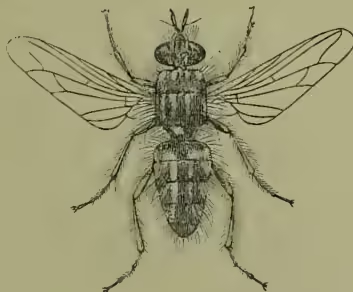
Blow-fly, or FLESH-FLY (Sarcophaga carnaria), an insect of the order Diptera ('two-winged'), (q.v.), and of the large family Muscidae, of which the common House-fly, Blue-bottle (q.v.), &c. are familiar examples. It is very similar to these in general appearance; the body is hairy, the expanse of its wings about one inch, the face silky and yellow, the palps black, the thorax gray with three black stripes, the abdomen of a shining blackish brown, which, in certain points of view, assumes a bluish tint, chequered with glittering yellowish spots. One of the distinguishing characters of the genus is, that the eyes are widely separate in both sexes, but in colour, hairiness, and shape of abdomen the males and females differ slightly. The multiplication is as usual rapid (one female may produce 20,000 larvæ); some species produce their young alive (viviparously); the larvæ feed (as the generic name suggests—Gr. sarx, 'flesh,' phago, 'I eat') on the flesh of living or dead animals; the insect passes the winter in the pupa stage. The adults are common in Britain on heaths, in gardens, copses, &c.; and the larvæ are to be found feeding upon meat, the carcasses of animals, sometimes upon living earthworms, and too frequently upon sheep, of which it is one of the most grievous pests, requiring the constant attention of the shepherd during most of the summer and autumn. Some districts are more infested with it than others; it is particularly troublesome in the fenlands of England. Unless the maggots are removed, they eat into the skin, the sheep suffer great torment, and soon die. At first they may be removed by shaking them out of the wool, into which dry sand is then abundantly sprinkled; but if they are very numerous, a mercurial ointment or wash of corrosive sublimate is applied; and when the skin is much broken, the wool is clipped away, an ointment of tar and grease is used, and a cloth sewed over the part.
Another of the numerous species of this genus, common in Britain, is S. mortuorum, so named from its frequenting burial vaults and laying its ova on corpses. It is very similar to the blow-fly, but the abdomen is of a shining steel blue, and the palps, feelers, and head are reddish brown. There are altogether about 50 European species of Sarcophaga.