Blowpipe. a small instrument used in the arts for glass-blowing and soldering metals, and in analytical chemistry and mineralogy, for determining the nature of substances by the action of an intense and continuous heat. Its utility depends on the fact, that when a jet of air or oxygen is thrown into a flame, the rapidity of combustion is increased, while the effects are concentrated by diminishing the extent or space originally occupied by the flame.
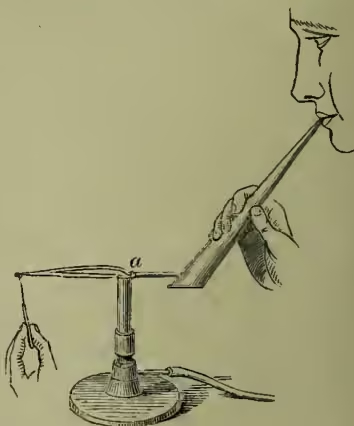
The blowpipe generally consists of a conical tube of metal, about 8 inches long (see fig.), closed at the wider or lower end, but open at the narrow or upper end, which latter constitutes the mouthpiece, and is turned over to admit of the lips closing perfectly round it. Near the lower end, a small tube, fitted with a finely perforated nozzle, a, is inserted in the large tube below being intended as a chamber for condensing the moisture of the breath, and through this nozzle, a fine current of air can be projected against the flame experimented with.
The use of the mouth blowpipe, so as to sustain a prolonged steady blast, requires some skill, and is at first very fatiguing to the learner. In breathing, the manipulator involuntarily closes the back of the mouth, retaining in the expanded cheeks sufficient air to last till the lungs have been replenished through the nose. Where high temperatures are required mechanical blowpipes are resorted to.
When a current of air from the blowpipe is directed against a candle or gas-jet, the flame almost entirely loses its luminosity, owing to the perfect combustion of the gases evolved from the source of heat, and is projected in a lateral direction, as a long pointed cone, consisting of three distinct parts. The first or central cone is of a dark-blue colour, and there the combustion is complete from the excess of air thrown in from the small nozzle. The second cone, or that immediately surrounding the first, is somewhat luminous; and here the oxygen being insufficient for the combustion of the carbon, any metallic oxide subjected to the action of this portion of the flame is deprived of its oxygen, and reduced to the condition of metal; for this reason the luminous cone is generally termed the reducing flame of the blowpipe. Beyond the second cone, or where the flame comes freely in contact with the atmosphere, and abundance of oxygen is present to effect complete combustion of the gases, is a third, or pale yellow envelope, containing excess of atmospheric air at a very high temperature, so that a portion of metal, such as lead or copper, placed at this point, becomes rapidly converted into its oxide; this outer part of the flame is on this account called the oxidising flame of the blowpipe.
Substances under examination before the blowpipe are generally supported either on wood-charcoal or platinum—the latter in the condition of wire or foil. In applying the blowpipe test, the body to be examined is either heated alone, or along with some flux or fusible substance; this being added, in some cases, for the purpose of assisting in the reduction of metals from their ores and other compounds: in others, for the production of a transparent glassy bead, in which different colours can be readily observed. When heated alone, a loop of platinum wire, or a piece of charcoal, is generally employed as a support; the former when the colour of the flame is to be regarded as the characteristic reaction, the latter when such effects as the oxidation or reduction of metallic substances are to be observed.
The following are examples of the difference in colour communicated to the flame by different substances: Salts of potash colour the flame violet; soda, yellow; lithia, purplish red; baryta, yellowish green; strontia, carmine; lime, brick red; compounds of phosphoric acid, boracic acid, and copper, green. The commonly occurring metallic oxides reducible by heating on charcoal alone in the inner flame of the blowpipe are the oxides of zinc, silver, lead, copper, bismuth, and antimony; the principal ores not so reducible are the alkalies and alkaline earths, as also the oxides of iron, manganese, and chromium. The fluxes generally used in blowpipe experiments are either carbonate of soda, borax (biborate of soda), or the ammonia-phosphate of soda, otherwise called Microcosmic Salt (q.v.). The carbonate of soda, when heated on platinum-wire in the oxidising flame, forms with silica a colourless glass; with oxide of antimony, a white bead, &c. The following metals are reduced from their compounds when heated with carbonate of soda on charcoal in the inner flame of the blowpipe: viz. nickel, cobalt, iron, molybdenum, tungsten, copper, tin, silver, gold, and platinum. When compounds of zinc, lead, bismuth, arsenic, antimony, tellurium, and cadmium are similarly treated, these metals are also formed, but being volatile, pass off in vapour at the high temperature to which they are exposed.
Borax, as a flux, is generally mixed with the substance under examination, and placed on platinum-wire. When thus heated in either of the flames, baryta, strontia, lime, magnesia, alumina, and silica, yield colourless beads; cobalt gives a fine blue colour; copper, a green, &c. With microcosmic salt, the results obtained are generally similar to those with borax, and need not be specially mentioned, as the test is applied in the same way. The blowpipe has been long used by goldsmiths and jewellers for soldering metals, and by glass-blowers in fusing and sealing glass-tubes, &c.; it has also been applied in qualitative analysis for many years, but more recently chemists (especially Plattner) have devoted their attention to its use, and have even employed it with great success in quantitative chemical analysis; the advantages being that only a very small quantity of material is required to be operated upon, whilst the results may be obtained with great rapidity and considerable accuracy.
The oxyhydrogen blowpipe is an arrangement by which a jet of oxygen and hydrogen, in the proportions to form water, is ignited and directed against any object. The most intense heat is produced, most of the metals being volatilised when placed in it, and even the diamond changes into ordinary carbon, and is burned when exposed to its flame. When a cylinder of quicklime is heated by it, a most dazzling light is produced, rivalling the electric light in brilliancy, and known as the Drummond Light (q.v.).