Bombay, the Western Province of India, with a Governor appointed by the crown, a Legislative Council, and a European and native garrison under a local Commander-in-chief. Bombay, including Sind and Aden (q.v.), comprises 24 British districts, and 19 native or feudatory states, and contains 197,887 sq. m., of which 73,753 are in native states. The Nerbudda River divides the presidency, as in accordance with the old name it is still often called (see INDIA), into two portions: in the north is Guzerat, chiefly consisting of alluvial plains, with the Cutch and Kathiawar peninsulas; to the south is the Mahratta country, which includes parts of the Deccan, Carnatic, and Konkan or coast-districts. The political control of Baroda (q.v.) was transferred in 1875 from Bombay to the supreme government of India. The small territories of the Portuguese—Goa, Daman, and Diu—have an area of 1062 sq. m. The coast-line is irregular, broken by the gulfs of Cambay and Cutch, with several fine natural harbours, Bombay and Karachi (Kurrachee) being the most important. The chief mountain-ranges run north and south; in the north are the Khirthar Mountains; in the south-east are the Western Aravalli range; south of the Tapti are the Sahyadri Mountains or Western Ghats, which run almost parallel with the coast; the Satpura range runs east, and forms the watershed between the Tapti and Nerbudda. Sind is watered and fertilised throughout its whole length by the Indus; the Subarnati and Mahi flow through the plains of North Guzerat; the Nerbudda pursues a western course into the Gulf of Cambay. The Tapti flows through Khandesh district, entering the sea above Surat. Besides these, there are numerous hill streams, which are torrents during the rains and dry up in the hot season. The Runn of Cutch (q.v.), in the west of Guzerat, covers an area of about 8000 sq. m., and is the great source of salt-supply for the presidency. There are few minerals, and no coal; iron is mined at Teagar in Dharvar, and there is gold amongst the quartz. Good building-stone is abundant, with limestone and slate. As to climate: in the dry sandy districts of Sind, the thermometer has reached 130° in the shade; the mean temperature in Lower Sind, during the hottest months in the year, is 98° in the shade. In Cutch and Guzerat the heat is slightly less. The average rainfall is 70 inches. The coast-districts are hot and moist, with a heavy rainfall. The tableland of the Deccan has an agreeable climate, except during the hot months.
The principal agricultural products are millet, legumes, rice, wheat, cotton, oil-seeds, tobacco, indigo, cane-sugar, &c. The languages spoken are Marathi and Canarese in the south, Gujarati in the north-west, Sindhi in Sind, and west of the Indus Baluchi. Of 80 newspapers 30 appear in Marathi, and almost as many in Gujarati. The University of Bombay was founded in 1887; there are five colleges in the presidency, and some 12,000 schools, with 620,500 pupils (70,000 females). For the government of the presidency, see INDIA. Besides an Anglican bishop and his clergy, there are chaplains of the Church of Scotland. During the Mutiny of 1857 the local army remained, on the whole, faithful. Poona is the military centre. Bombay has benefited vastly from the establishment and extension of the Indian railway-system. The first railway in India was opened in Bombay in 1853; the presidency has now more than 3500 miles of railway, giving communication with all the important towns of India. A cable telegraph from Bombay to Aden was laid in 1869; there are now private company cables, while the Government Indo-European Telegraph Department has its headquarters at Karachi.
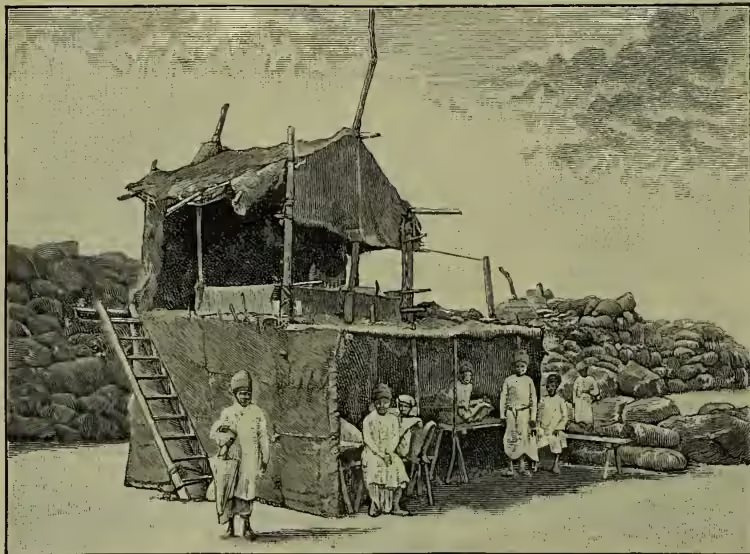
Of late years, manufacturing industries have been extremely active in Bombay. Commanding the richest cotton-fields in India, it has improved to the utmost its natural advantages. The stoppage of the American cotton-supply during the civil war gave a grand impulse to the Bombay trade, the exports of cotton during the five years 1861 to 1866 averaging in value £21,582,847 a year. The wealth poured into Bombay at this period led to a vast extension of the trade, which partly continued after the period of inflation had passed. The first mill was started in 1854, and ten years later there were 13. In 1887 there were 75 factories; and in 1891 there were 89, with 18,192 looms and 2,330,468 spindles. There is still a large but decreasing import of cotton goods from England, but though, on account of currency and other difficulties, the cotton trade was greatly depressed in 1892-93, Bombay not merely competes with Manchester in the Indian markets, but largely exports its own manufactures. The town of Bombay is naturally the chief centre of the cotton manufacture, as it is the place whence cotton and cotton goods are exported. For Indian cotton-growing and cotton-manufacturing, see also Vol. III. pp. 509 and 515. The rapid growth and present condition of the cotton industry is the more striking in view of the abolition, in 1881, of the duty on cotton imports, which placed the local industry at a disadvantage. After cotton, the other great staples are opium, wheat, and seeds. The trade in opium is worth nearly five millions sterling, two millions being the clear revenue derived by government from a pass duty of 550 rupees a chest. Although of recent origin, the wheat trade has assumed large proportions; the exports in some years have had a value of over £6,000,000. Other principal exports are sugar, tea, raw wool, woollen shawls, fibres, and drugs; while among the imports are machinery, metals, oils, coal, and liquors. Silk-weaving is carried on at Ahmedabad, Surat, Nasik, Yeola, and Poona; carpets are made at Ahmednagar; leather-work and pottery in Sind; brass-ware in Bombay city, Nasik, and Poona; cutlery, armour, and gold and silver work in Cutch.—In the year 1891-92 the total imports had a value of £36,776,556, including over £11,000,000 of treasure, about two-thirds being from Great Britain; while the exports had a value of £43,307,113, including £2,600,000 of treasure, of which total some £10,000,000 were sent to Britain.
The population of the presidency (including Aden, Sind, and Perim) in 1891 was in the native states 8,059,298; and in British territory 18,901,123, of whom 14,659,926 were Hindus, 3,537,503 Mohammedans, 1,240,436 Jains, 213,618 of aboriginal faiths, and 161,770 Christians.