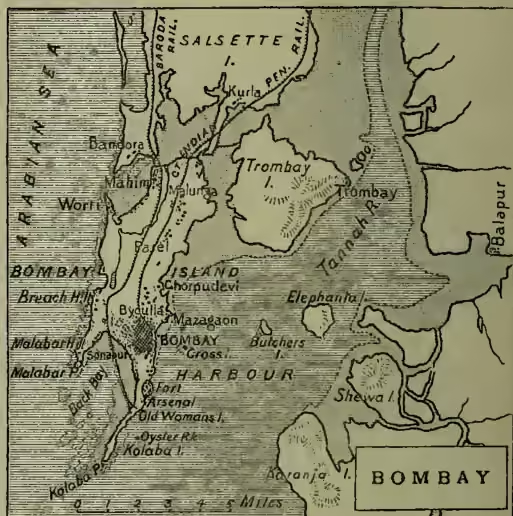
Bombay (City) occupies the entire breadth of the SE. end of Bombay Island or Peninsula, bordering at once on the harbour inside, and on Back Bay outside. The island, now permanently connected by causeways and breakwaters with Salsette Island and the mainland, is over 11 miles long by from 3 to 4 broad. For administrative purposes the city constitutes a district by itself, with an area of 22 sq. m. Its harbour, studded with islands and crowded with shipping, is one of the finest in the world; the space available for shipping being about 14 miles in length by 5 broad. Bombay is the most European in appearance of all the cities in India. In the business part there are several streets continuously lined with splendid buildings; while the bazaars, which extend from the fort towards Mazagaon, are traversed by fairly wide streets, extensive lines of tramways passing through even the most crowded parts. Many of the private houses of European residents are built on the suburb of Malabar Hill, the ridge running into the sea forming the west of Back Bay; and at Breach Candy looking seaward. The Hindus and the Mohammedans form the largest section of the population, and the rest are Parsees, native Christians, Europeans, Indo-Portuguese, Jews, &c. Amid these various classes, the Parsees rank next to the English in position and influence. Among their leaders may be named the late Sir Jamsetjee Jeejeebhoy, and Sir Dinshaw Manookjee Petit, merchant-princes who have endowed Bombay with magnificent charities. The Banias, or Hindu traders, rank next to the Parsees. On the esplanade, facing towards Back Bay, are the secretariat, the university, senate-hall, high court, offices of public works, sailors' home, and statue of the Queen. In the neighbourhood of the fort are the town-hall, the mint, cathedral, and custom-house. The terminus of the Great Indian Peninsular Railway, opened in 1876, is the finest building in Bombay—probably the finest structure of the kind in the world, costing upwards of £300,000. On the promontory to the east of Back Bay stood the old fort, now a mere garrison, its walls having been demolished; the harbour is defended by batteries and two ironclads. It has an extensive system of quays, wharves, and docks, including Princes Dock (1879), which cost over a million sterling, and Victoria Dock (1889). Mazagaon Bay, the centre of shipping activity, is at the head of the harbour. The city water-supply is, since 1892, drawn from Tansa Lake (q.v.), 65 miles N. Always favourably situated for foreign trade, Bombay has profited largely by being the first important port reached by vessels from Europe, and by being the chief mail line to India by Suez and Aden, whence letters are sent on by rail to all parts of India. Bombay now surpasses Calcutta in the amount of her trade; whereas some 35 per cent. of the trade of India is done through Calcutta, over 40 per cent. is done through Bombay. This proportion is partly accounted for by the fact that the bulk of the treasure imports to India are received in Bombay. The chief articles of export are cotton, wheat, shawls, opium, coffee, pepper, ivory, and gums; the chief imports, piece-goods, thread, yarn, metals, wine, beer, tea, and silk. The chief industries are dyeing, tanning, and working in metal. With 70 large steam-mills, Bombay presents the appearance of a city in Lancashire. The population, which is exceedingly heterogeneous and dense, amounted, in 1881, to 773,196, and in 1891, to 821,764. Some 13,000 are British born.
In 1509, about a year before the capture of Goa, the Portuguese visited the island; and by 1532 they had made it their own. In 1661 they ceded it to Charles II. of England, as part of the dowry of his bride, the Infanta Catharine. In 1668 his majesty granted it for an annual payment of £10 to the East India Company, which, in 1685, transferred what was then its principal presidency to Bombay from Surat. The name of the island, styled Maimbi by the Portuguese of the 16th century, is said to be derived from the goddess Mumba-devi; Colonel Yule has traced it back to Mayamba, the name of the Konkan kingdom in the 16th century. The bay towards the mainland is one of the finest havens in India. Among the numerous islands are Elephanta (q.v.) and Salsette. An appalling and continued visitation of the bubonic plague killed 28,418 persons in 139 days of 1896-97, 28,869 in 115 days of 1898, 31,260 in 131 days of 1899, and 50,383 between November 1899 and April 1900. Vast numbers of the inhabitants fled from the city, and trade and commerce were wholly disorganised. Bombay is the birth-place of Jejeebhoy, Monier Williams, Dean Farrar, and Rudyard Kipling.
See Maclean's Bombay (1876); Eastwick's Handbook (2d ed. 1881); and Hunter's Bombay, 1885-90 (1892).