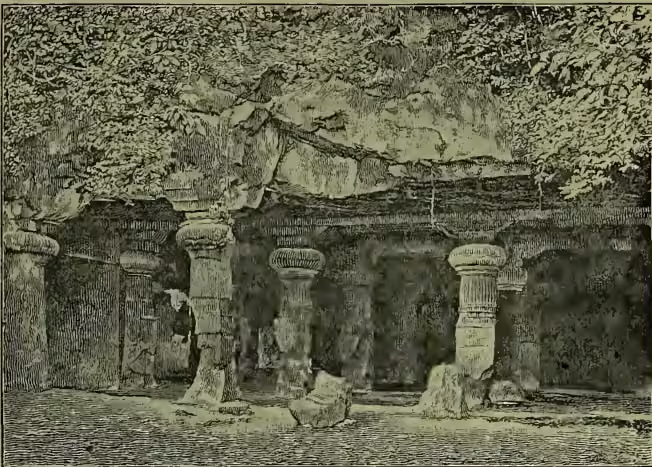
Elephanta (native Ghárāpuri), an island over 4 miles in circuit, in the harbour of Bombay, 6 miles E. of the city, and 4 miles from the mainland. It owed its European name to a large figure of an elephant which stood near its former landing-place, but which, after 1814, gradually sank into a shapeless mass. Of the island's far-famed Brahmanic rock-caves, four are complete, or nearly so; the most important is the Great Temple, still used by the Hindus on Sivaite festivals. It is entirely hewn out of a hard trap-rock, and measures 130 feet from north to south, and the same distance from east to west; the body of the cave forms a square of about 91 feet, originally supported by twenty-six columns, and sixteen half-columns, of from 15 to 17 feet, many of which have been injured or destroyed. The most striking of its many sculptures is a three-headed bust of Siva, nearly 18 feet high and 23 feet round the eyes. This unique bust, like most of the other figures here, has been much defaced, and policemen are now employed to protect the cave. The caves most probably date from the 9th century. See Burgess, The Rock Temples of Elephanta (Bombay, 1871), and Fergusson and Burgess, The Cave Temples of India (1880).