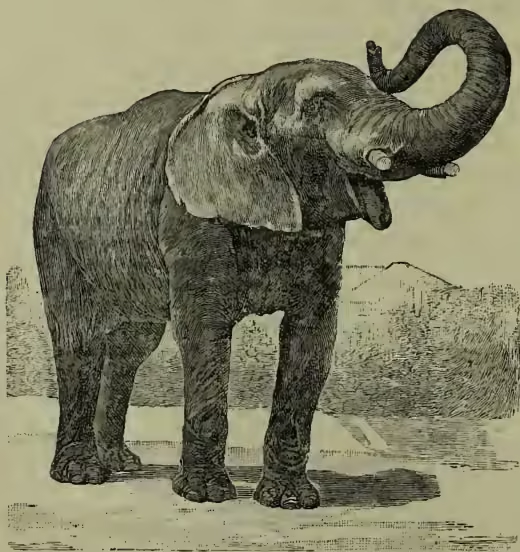
Elephant, a genus of mammals in the order Proboscidea, now represented only by two species. These two survivors of a once numerous and widely distributed order occupy a zoological position of peculiar isolation, but they are connected by the extinct Mastodon and Dinotherium to Coryphodon and the Dinocerata, and further back still to a probable origin among primitive hoofed or ungulate animals. The modern elephants—African and
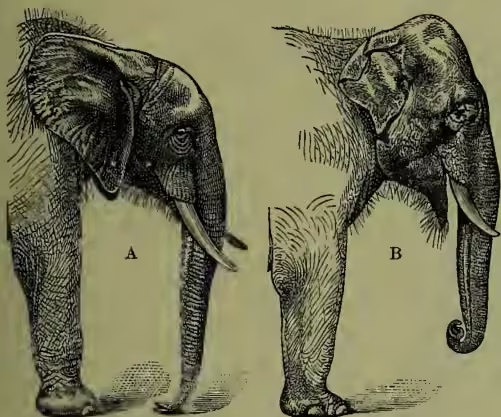
Indian—are quite distinct from one another, and are sometimes referred to separate genera (fig. 2). Like other giant animals, they are becoming gradually restricted in distribution and numbers, a fact of course hastened by the demand for the ivory of their tusks.
Principal Characters.—In some of their structural features, especially in nose, skull, and teeth, the elephants are as highly differentiated as they are in general intelligence; while on the other hand the anatomy of their limbs and anterior venous system is simple and primitive. The huge size, thick skin, and scanty hairs; the enormous head with high rounded skull containing large air-spaces and with wide expanse for the insertion of muscles; the long, muscular nose or proboscis with the nostrils at the tip; the short stiff neck which makes the trunk such an advantage; the huge simple limbs and massive feet, are conspicuous features. The brain is not much larger than man's, but as one would expect from the elephant's cleverness, is richly convoluted; the hind portion or cerebellum is, however, uncovered like a rabbit's. The teeth consist (1) of a pair of enormous, ever-growing upper incisors or tusks, composed mainly of the precious dentine or ivory; and (2) of the large plaited molars, the final result of a long series of historical differentiations, six on each side above and below, but never represented by more than one in full use at a time. The upper parts of the stout limbs are very long, so that the knees especially are situated far down; the five toes are inclosed in a common hoof which is very massive, the circumference of the fore-foot measuring about half the height at the shoulder. More technical characters are the presence of two superior venæ cave, the simple stomach and large cæcum, the abdominal situation of the male organs, the two-horned uterus, deciduate zonary placenta, and the position of the two teats upon the breast. The diet is vegetarian, and the animals are gregarious. An elephant may weigh 3 to 4 tons, and live 120 years, though the average seems to be about eighty.
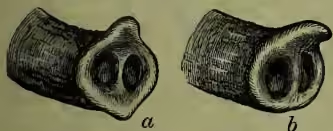
The Two Species.—The Indian Elephant (Elephas indicus) is now restricted to the forest-lands of India and south-east Asia, including Ceylon and Sumatra. The African Elephant (E. or Loxodon africanus) inhabits the greater part of the African continent south of the Sahara. The contrast between the two species may be indicated as follows:
| INDIAN. | AFRICAN. |
|---|---|
| Ears of moderate size. | Ears 3½ feet long by 2½ feet broad. |
| Molar teeth with folds parallel. | Lozenge-shaped folds. |
| Trunk ends in finger-shaped upper lobe. | Lobes of trunk apex nearly equal. |
| Concave forehead. | Arched forehead. |
| Four or five nails on the hind-foot. | Three nails on the hind-foot. |
| Males about 10 feet at shoulder. | Males about a foot higher. |
For extinct forms such as the Mammoth (Elephas primigenius), nearly allied to the Indian species, for the ancient British forms, for the Pigmy Elephant (E. melitensis), and for even more gigantic forms than the two species now alive, the reader is referred to the articles MAMMOTH and MASTODON.
Habits: Food.—The elephants use their trunks in gathering leaves, branches, and herbage, which they pass dexterously to the mouth. The Indian elephant eats the leaves of the palm, fig, and jak trees, &c.; the African form is fond of the succulent mimosa. Most kinds of palatable vegetable food, from sugar-canes to cocoa-nuts, are acceptable. Those brought to Britain are largely fed on hay and carrots. They prefer forest and mountainous regions; are ready to plunder rice and other crops, but seem to have a wholesome dread of fences.
Drinking.—Without bending head or limbs, the elephant dips the end of the trunk into the water, and fills it by a strong inspiration. The trunk is then inserted into the mouth and forcibly emptied. In the same way water or even sand may be blown over the body for cleaning and cooling the skin.
Locomotion.—The general leisurely and heavy tread of the elephant can be changed into a very fast trot or peculiar shuffle, especially when the males furiously charge their rivals or enemies. Their slow but sure progress is found most serviceable in difficult mountain travelling. Though one would hardly expect it, they undoubtedly have considerable powers of swimming. 'A whole herd has been known to swim without touching bottom for six consecutive hours, rest a while, and then swim three more, with one rest.' When a herd with young ones is forced to take to the water, the mothers hold some up with their trunks, while others find a more comfortable position on their mothers' backs.
Herdng.—Elephants are conspicuously social, a habit which has doubtless directly influenced their intellectual development. The herds are usually family parties; the mothers and young go in front, the males bring up the rear. The positions are reversed in alarm and danger. Both family likeness and family sympathies are often strongly marked. The leader is obeyed and also protected with much esprit de corps.
Breeding.—The males of both species are rather larger than the females, and excel in strength, endurance, and in the greater development of the tusks. A male is on this last account valued at one-fifth more than a female. In some localities—e.g. Ceylon, the female incisors remain very small, and the disproportion is always more marked in the Indian species. The male elephant is polygamous, and usually rules alone in the herd, expelling or killing his rivals. By means of such habitual contests the tusks have doubtless been perfected in strength. Except at the breeding season, the adult males live much by themselves, probably for selfish reasons rather than from love of solitude. At pairing-time a gland opening on the side of the head, between eye and ear, becomes especially active in the adult males, which are then said to be in 'must,' and are then well known to be probably the most dangerous of animals. The gland secretes a substance of strong musk-like odour, and is one of the numerous secondary sexual characters exhibited by animals. The fragrance is probably attractive to the female sex, though this must be a subsequent advantage, and not in any way a cause of the development of such an organ. 'The elephant,' Darwin observed, 'is reckoned the slowest breeder of all known animals, and I have taken some pains to estimate its probable minimum rate of natural increase: it will be under the mark to assume that it begins breeding when thirty years old, and goes on breeding till ninety years old, bringing forth three pair of young in this interval; if this be so, at the end of the fifth century there would be alive fifteen million elephants, descended from the first pair.' It is obvious enough that mortality and enemies, especially man nowadays, obviate any approximation to even such slow, natural increase of numbers. The elephant is one of the best examples of Spencer's law of the inverse ratio of individuation and rate of reproduction. Endless stories are told of the savageness of 'rogue' elephants, which seem chiefly to be males who have been expelled from the herd, and have in part the savageness of Ishmaelites, and in part the madness of enforced celibacy. The mothers manifest much maternal affection and care. One young elephant is born at a time, though occasionally twins may occur. There is a long (20½ months) period of gestation. The elephant sometimes breeds in captivity. Even after twenty years of menagerie life, birth is said to have occurred. In Siam and other parts of the East, breeding studs are kept up, but recruiting by fresh captives is always necessary. One of the baby Asiatic elephants born in America weighed 245 lb. at birth, and was about the size of a sheep. It took milk for six months, and afterwards began to eat tender grass. The sucking is done as usual with the mouth, not with the trunk.
While the tusks of the male are much used in the customary contests with rivals, they serve other purposes. Thus Darwin notes: 'The elephant uses his tusks in attacking the tiger; according to Bruce, he scores the trunks of trees until they can be thrown down easily, and he likewise thus extracts the farinaceous cores of palms; in Africa he often uses one tusk, always the same, to probe the ground, and thus ascertain whether it will bear his weight.' The tusks are also used in ploughing the ground in search of bulbs. According to the position and curvature of the tusks, he either 'flings the tiger to a great distance—it is said to even 30 feet, or endeavours suddenly to pin him to the ground'—an action dangerous to the rider, if there be one, who is apt to be jerked off the howdah.
The trunk can be used in endless ways, to pull down a tree or snip a bunch of grass, to lift an immense weight or a pin from the ground, to fight or to fondle. Through it they make a loud shrill sound described by Aristotle as resembling the hoarse noise of a trumpet.
Intelligence.—Though the eyes are very small, they are quick to discern, and the other senses are highly developed. The elephants are also social animals. These two conditions, always favourable to intellectual development, are certainly here associated with a high degree of intelligence. Their memory both for friends and foes is strong, and has been more than once remarkably illustrated by tamed elephants, which, having escaped and been recaptured, returned with all their old obedience to their keeper. In higher mental qualities elephants are only excelled, according to Romanes, by dog and monkey. By dexterous blowing, an elephant made a potato, which had fallen out of reach, rebound against the opposite wall so as to return to an accessible place. Darwin observed similar experiments in the Zoo. Their dexterity in assisting human labour, their quiet submission to operations, the gusto with which decoys practise deceit, the manner in which they thatch their backs in summer to keep off sun and flies, their selection, shaping, and dexterous use of pieces of wood (implements) for leech-scrapers, fans, &c., their discriminating way of lifting and handling different materials according to their hardness, sharpness, (abstract ideas), &c., are all remarkable. To pile up materials round the base of a tree, so as to make a platform from which to reach an otherwise inaccessible enemy, shows decided power of rational device. An elephant has been known to feign death, and the working tamed forms are said to have an accurate sense of time. Of their capacity for learning tricks little need be said; to take tea at a table and ring for the waiter, to uncork bottles and drink the contents, or even to salute princes, puts more strain upon the elephant's patience than upon his intellect.
Emotions.—The elephant may be extremely gentle and affectionate, or when injured, both passionate and vindictive. They readily form friendships with their keepers, with children, or with fellow-animals, and sometimes manifest quite human tenderness. The partnership between the wild elephants and the birds which pick insects from their skin and rise screaming when alarm threatens, is obviously not disinterested. The better emotions, such as sympathy, appear undoubtedly to predominate, but there is no doubt as to their proverbial vindictiveness. The classic story of the tailor and the elephant has been repeatedly verified, in some cases with tragic results. As peculiarities of emotional temperament, Romanes notes the following: 'If a wild elephant be separated from its young for two or three days, though giving suck, it never after recognises or acknowledges it. The members of a herd are exclusive, a strayed stranger is driven off, and may thus become a "rogue" or "goondah." Such an Ishmaelite undergoes a transformation of disposition, becoming savage, cruel, and morose. He is possessed not by sudden bursts of fury, but by a deliberate brooding resolve to wage war on everything, and lies patiently in wait for travellers.' Elephants are also subject to sudden death from what the natives call a 'broken heart,' and which seems in some cases at least referable to psychical or cerebral conditions.
White Elephants.—Albinos occur among elephants as in other animals. In these the colouring matter of the skin is deficient; but the adjective white can hardly be used to describe the result. Their rarity has made them valuable, and they are revered as incarnations of Buddha. Holder notes that in the 16th century Pegu and Siam fought over one for many years, till five successive kings and thousands of men were killed, while Barnum in 1883 bought one in Siam which cost him $200,000 by the time it reached America. Elephants vary slightly in the amount of hair on their characteristically naked hides. Those on high cool regions in India are said to have rather more hair, thus approaching the woolly extinct species of long past Arctic climates.
Apropos of Barnum, an elephant-craze of modern times was illustrated in regard to an elephant named Junbo, which had at least an eventful history of travel. Born in Central Africa, sold to the Jardin des Plantes in Paris, thence to the Zoo in London, and thence in 1882 to Barnum for $10,000 in spite of outcry and petitions, shipped with some difficulty to New York, and killed by a railroad car in Canada—such is in brief the life- history of an animal which secured an unusually large share of popular attention. Its remains—skin and skeleton—were presented to two American museums.
Hunting.—The elephant is hunted either for captivity, work, and pageantry, or for the sake of its ivory. The Indian forms are often captured alive in numbers by organised parties of four hundred or so natives, and the process is both tedious and costly. The herd is surrounded, and the circle narrowed by fires and watchling. A strong fence and moat are made to form the so-called 'kheddah' into which the elephants are driven. There they are separated and hobbled by riders on tame elephants, whom the captives, curiously enough, do not touch. Single elephants are also noosed or decoyed by tame females; the pitfall method is too frequently fatal to be profitably employed if the elephants are wished alive. They are of course also hunted and killed both for sport and ivory. Sometimes, too, their ravages on cultivated ground have necessitated check. The shots are said to kill only on the forehead, temple, and behind the ear. The African elephant is not now trained, as it used to be, for war or show, but is rapidly being hunted to death to supply European markets with ivory. It is followed either on horseback or foot, and some of the Arabs are said to be daring enough to face it with only sword and shield.
Uses.—The Indian elephant has been, and still is, much used as a beast of burden. In its half-domesticated state it becomes a patient and effective worker. They are of great service in lifting and carrying heavy burdens, which they edge on to their tasks with the trunk. An ordinary elephant can carry half a ton continuously on a level road. In their natural state they often march for 20 miles to their feeding-ground or water-supply. In captivity they require a great deal of care and as much food. 'A large tusker needs 800 lb. of green fodder in 18 hours.' Their expensiveness, delicacy, and infertility are obstacles to domestication. The African elephant, once trained for war and pageantry, is no longer tamed, apparently from lack of enterprise. The natives of Africa eat the flesh, and are said to be especially fond of the trunk, feet, and fat of the elephant. The skin is used for water-bags.
From very ancient times elephants have been used in war. Alexander encountered them in his campaigns; Semiramis took clever advantage of their prestige by making sham ones. In the Carthaginian wars, the Romans were at first disastrously affrighted by them, but with familiarity learned to terrify them with torches. They captured several from Pyrrhus in 276 B.C., and took them to Rome, calling them 'Lucanian oxen.' The Carthaginians are said to have used 140 elephants at the siege of Palermo; Hannibal took 37 over the Alps, where, according to Philemon Holland's quaint translation of Livy, they had 'much ado not to topple on their noses in the slabby snow-broth;' and the Romans themselves learned to use them. Even in modern times, in the East, they have continued to be so used, and in the Burmese war, though not actively engaged, elephants were found of great use both for transport and for clearing passages in the jungles.
Elephants have been almost equally used in pageantry and games. Cæsar held elephant tournaments and employed them to draw chariots, while Nero characteristically matched an elephant against a single fencer. So too they have for many centuries held their place in the Juggernaut processions, and were remarkably displayed in honour of the visit of the Prince of Wales to India.
Ivory.—The tusks of an elephant may weigh 150-300 lb., and 'a famous tusk exhibited by Grote & Co., New York, measures 8 feet 11 inches on outside curve, has a diameter at the base of 6½ inches, and weighs 184 lb.' They have small 'milk' predecessors, but these fall out when the animal is very young. The true tusks are what are called rootless teeth, growing from persistent pulp, and owe their value to the large mass, elastic nature, and somewhat peculiar texture of the dentine portion (see TOOTH). The enamel is very slightly developed, and only at the apex. It is estimated that about 75,000 animals, especially in Africa, have recently been killed annually for the sake of their tusks, while 500 tons per annum were imported into Great Britain alone between 1880-84. In more recent years the importation has decreased, there is no doubt that the ivory king is becoming rarer, and an abstinence from the purchase of ivory is the bounden duty of every admirer of the elephant. The fit use of this beautiful animal product is for works of high art, like those of the ancients, and not for handles of pocket-knives. For technical details, see IVORY.
Proboscidean Fictions.—Under this title, Holder, in his interesting account of the 'Ivory King,' collects a number of the oddities erroneously recorded in regard to elephants. Thus it was long believed that they shed their tusks every ten years, but buyers of ivory can no longer have such comfortable assurance. Writers of the 14th century allude to the belief that they have two hearts, such extremes of temperament do they exhibit! From the low position of the knee-joint, the idea arose that the elephant's legs bend in opposite directions to those of other animals; while a different view is expressed by Ulysses in Troilus and Cressida: 'The elephant hath joints, but none for courtesy, his legs are for necessity, not for flexure.' Choicest by far, however, is the expression to a common belief given by Sir Thomas Browne in Pseudo-doxia Epidemica—the elephant 'hath no joynts, and being unable to lye down, it lieth against a tree, which the hunters observing do saw almost asunder, whereon the beast relying by the fall of the tree falls also downe itselfe, and is able to rise no more.'
See DINOTHERIUM, IVORY, MAMMOTH, MASTODON; C. F. Holder, The Ivory King (London, 1886), an admirable account of the general natural history of the elephant, from which many of the above facts are derived; G. J. Romanes, Animal Intelligence (Inter. Sc. Series), and other works. For anatomical characters, see Huxley's Anatomy of Vertebrates, and Flower's Osteology of the Mammalia.