Bone is the hard material of the skeleton of mammalian animals, reptiles, birds, and certain fishes. When the different bones of the skeleton are connected together, they form a framework which affords support to soft parts, and protects delicate organs from injury, while at the same time preserving the shape of the body. Further, the bones, being movably joined to each other, and being acted upon by the attached muscles, become a series of levers capable of executing various movements, and thus, in the case of the bones of the lower extremity, they are the passive instruments of locomotion. In colour, bone is white, but in the living body it has in addition a pink and slightly bluish tint. Besides being hard, it possesses a certain amount of toughness and elasticity, properties which are well marked in the ribs and clavicle. Arab children are said to make good bows of the ribs of camels, and the elasticity of the merrythought—i.e. united clavicles—of birds is familiar to all. Its strength is remarkable as contrasted with other substances:
| Fine Freestone..... | 1.0 |
| Lead..... | 6.5 |
| Elm and Ash..... | 8.5 |
| Box, Yew, Oak..... | 11.0 |
| Bone..... | 22.0 |
We thus see that bone is twice as strong as oak, and a cubic inch of bone will support a weight of 5000 lb.
Chemical Composition of Bone.—It consists of an animal and an earthy part intimately combined together. The following table shows a percentage analysis of adult human bones by Berzelius:
| Animal Matter..... | 33.30 |
| Phosphate of Lime..... | 51.04 |
| Carbonate of Lime..... | 11.30 |
| Fluoride of Calcium..... | 2.00 |
| Phosphate of Magnesium..... | 1.16 |
| Soda and Chloride of Sodium (Common Salt)..... | 1.20 |
| 100.00 |
If we expose a bone to intense heat, the animal matter is got rid of, and though the bone retains its original form, yet the slightest touch will cause its now unsupported earthy matter to crumble away. On the other hand, by soaking a bone in diluted hydrochloric acid, the earthy matters are gradually dissolved out, leaving a tough, somewhat transparent, flexible, and even elastic substance, which also retains the original figure of the bone in its most minute details. This residue is softer and more flexible than cartilage, and when boiled in water it is almost wholly resolved into gelatin, which sets or gelatinises on cooling. We see in the ill-nourished children of large towns too many examples of how necessary is the proper relation of these two elements of bone to each other. In the disease called rickets, the earthy matter is deficient, and the too flexible leg-bones bend under the weight of the trunk; in the aged person, again, the osseous substance being more densely packed with earthy matter becomes brittle, rendering them peculiarly liable to fractures.
Bones are classified according to their shapes—viz.: (1) long—e.g. thigh-bone and arm-bone; (2) flat or plate-like—e.g. shoulder-blade and bones of skull-cap; (3) short and irregular or cubical—e.g. those of the wrist or the vertebrae.
On making a section of a bone, it will be seen that the osseous substance is arranged differently in different parts, being either dense and close, and called compact, or open and reticulated, and called spongy or cancellated. There is, however, no abrupt limit between the two kinds, for they pass insensibly into each other. Again, in all bones the part next the surface is compact, and forms a shell or crust which contains the spongy texture within. Long bones have a shaft of compact substance with very little spongy tissue within, but at each end the spongy tissue predominates, having only a thin coating of compact substance, and thus the expanded rounded extremities enter into the formation of joints. Flat bones consist of two layers of hard tissue with intermediate spongy texture usually called diplœ. Irregular bones are spongy throughout, with only a thin crust of compact substance. Close examination of cancellous tissue reveals the fact that it consists of numerous slender bars or lamellæ, which unite together to form an open lattice-work (cancelli), from which it takes its name. Considerable strength is thus obtained without undue weight; and it will be seen that the strongest lamellæ run in those directions which are naturally exposed to the greatest pressure. The following experiment will show that spongy tissue is able to sustain great weight in spite of its apparently fragile nature: A cubic inch of cancellous texture was taken from the lower end of the thigh-bone and placed with its principal layers upright. Four hundred-weight was then placed upon it, but it did not give way in the least; six hundredweight made it sink half an inch; yet the cubic inch of bone itself did not weigh more than fifty-four grains.
Compact bone is also full of holes which are very small and require a magnifying glass to examine them. If a transverse section be examined under the microscope, these round openings are seen to be the mouths of longitudinal canals named after Clopton Havers, an English physician and writer of the 17th century, who first specially directed attention to them—Haversian Canals. Blood-vessels run in them, and the widest also contain marrow. They vary in diameter from th to th of an inch. They are short, and unite freely with each other. Those nearer the circumference open on the surface by minute pores; those placed deeply communicate freely with the spaces in the spongy tissue, so that they form an extensive network of tubes in which blood-vessels are lodged.
Each canal is surrounded by a series of concentric rings, each of which is a layer of condensed structure. Between these rings minute cavities are found, called lacunæ, generally oval in man. These communicate with each other and with the
Haversian canal in the centre by means of fine pores or tubes called canaliculi, and thus it is evident that nutrient material can pass from the
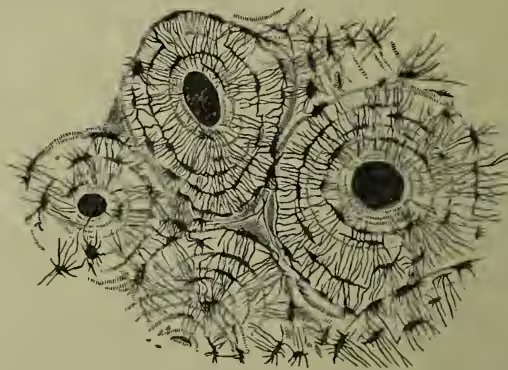
Haversian canal through the rings of dense bone which surround it, and which with the lacunæ and canaliculi are grouped together under the name of a Haversian system.
Bone is covered externally by a fibrous membrane which adheres very closely, investing every part of the surface except where there is cartilage, and called the periosteum. In this membrane fine vessels and nerves ramify, ultimately sending their minute branches into the Haversian canals. If the periosteum should be stripped off, there is great risk that the denuded portion of bone will be deprived of its nourishment and die.
The interior of the shaft of long bones is hollow, and thus we get a further combination of strength and lightness. In some animals this hollow space is filled with air, but in mammals there are no air-spaces in any bones except those of the head. The hollow shaft is therefore filled with marrow (medulla), which occupies the spaces of the spongy bone, and even extends into the widest Haversian canals. Lining the medullary canal there is a fine membrane named the internal periosteum. Its vessels partly supply the bone and partly the marrow. In long bones the marrow is like ordinary Adipose Tissue (q.v.), but in short bones and in cancellated tissues generally the marrow is more fluid, contains fewer fat-cells, and is red in colour.
In addition to the blood supplied to the bone through the vessels in the periosteum, one of considerable size, called the medullary artery, enters the canal containing the marrow by a hole running obliquely through the dense bone. Complete anastomosis takes place between the arteries on the surface and those in the interior of the bone. As has been stated, nerves enter the bone, but how they terminate is uncertain; and experiments seem to show that healthy bone is almost devoid of sensibility, while, on the other hand, the pain of an inflamed bone is extreme. In its earliest stages, bone may be said to exist as a mass of cells having the outward form but none of the characters of bone. Soon, however, these cells become cartilaginous, and in due time points or centres of ossification appear; the cells alter their form and arrangement, and by a deposit of earthy materials the bony tissue gradually becomes formed, rendering the previously flexible substance rigid. However, bone does not form in cartilage in every instance, for the bones of the face and skull-cap arise in connective tissue. Hence we have two great modes of ossification—viz. intra-cartilaginous and intra-membranous.
The uses to which a bone may be put are various. In the cooking of soups, bones form a constant ingredient, and become useful in supplying gelatin, which gives a body to the soup it would not otherwise possess. Even when buried, the organic matter is long retained—e.g. Gimbernat made soup from the gelatin of a mastodon's tooth, and Dr Buckland did the same from the fossil bones of the hyena. Where the soup is required of great lightness, for an invalid with weak digestive powers, the shavings of stags' horns may be employed, and these yield a hartshorn jelly free from oil, and which therefore sits lightly upon the stomach. How far gelatin is of itself nutritious is a disputed question (see GELATIN, FOOD, and NUTRITION). Animals, however, like the dog, which masticate, devour, and digest the entire bone, do derive benefit therefrom, in part from the gelatin, and in part from the earthy substances; and the same remark applies to the use sometimes made of small fish, where, after being thoroughly browned, they are entirely eaten. In times of scarcity in Norway and Sweden, the poorer people even eat the bones of mackerel and other fish.
Bone is largely used in making the handles of small brushes, table-knives and forks, and pen-knives, and in the manufacture of Combs (q.v.). Our forefathers, before the metals were known, fashioned fish-hooks out of bone, and used the spines in the tail and back-fin of certain fishes for pointing arrows. These uses of bone, coupled with the employment of the serrated teeth of sharks as a war-weapon, are still practised by many uncivilised tribes. The fatty and other organic matters in bone allow of its being employed as a fuel where coal or wood cannot be obtained, as in the pampas of South America and the steppes of Tartary. In these regions it is considered that the heat evolved during the combustion of the bones of an ox suffices to cook the flesh.
Bone is likewise serviceable in the arts in yielding bone-ash, bone-black, bone-dust, dissolved bones, phosphorus, and superphosphates, also certain oils and fats, which are employed in forming Lampblack (q.v.), and in the manufacture of soap. Bone may suffer from atrophy, hypertrophy, or degeneration (see RICKETS), often from constitutional affections due to Scrofula or Syphilis (q.v.); Caries and Necrosis (q.v.) are specific bone diseases; inflammation of the bone causes Ostitis; of the periosteum, Periostitis (q.v.); of the medulla, Osteo-myelitis. For ossification of arteries, see ARTERIES, TUMOUR; and for broken bones, FRACTURE. Various matters connected with the bones will be found at ANATOMY, ARM, BIRDS, COLLAR-BONE, FOOD, HAND, JOINTS, OSSIFICATION, RIBS, SKELETON, SPINAL COLUMN, &c.