Bonito, a name common to several fishes of the mackerel family (Scombridae).—(1) One of these, Thynnus pelamys, sometimes called the
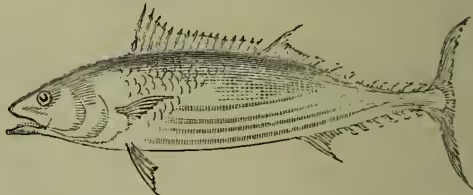
Stripe-bellied Tunny, and of the same genus with the Tunny (q.v.), is well known to sailors as an inhabitant of the tropical parts of the Atlantic and Indian Oceans, and as one of the fishes most frequently seen pursuing the flying-fish. It is often taken by an imitation flying-fish made to skim along and touch the waves. Its flesh is not regarded as very wholesome, though not unnaturally relished by those who have been previously confined to salt provisions. It is occasionally but rarely caught on the British coasts. It is a very beautiful fish, seldom exceeding 30 inches in length, of a beautiful steel-blue colour, darker on the back, and whitish below. Four dark lines extend along each side of the belly. The general form resembles that of the mackerel, but is less compressed.—(2) The Mediterranean Bonito (Pelamys sarda) is closely allied. It has the same blue back and dark transverse bars reaching from the dorsal ridge to the lateral line. It is plentiful in the Black Sea, and has been found in the North Sea. Its flesh is esteemed.—(3) The Plain Bonito (Auxis vulgaris or A. rochei), found in the Mediterranean, may be distinguished at once from both of these by its more uniform blue colour, without stripes or bands, and by the widely separated dorsal fins. Its flesh is little esteemed when fresh; it is generally used either salted or pickled. This fish has been occasionally caught on the coast of England, and even of Scotland.—The Sucking-fish (Echeneis remora), credited with retarding ships, the gorgeous John Dory (Zeus faber), the beautiful 'Dolphins' (Coryphæna), are allied genera of the same family. See MACKEREL.