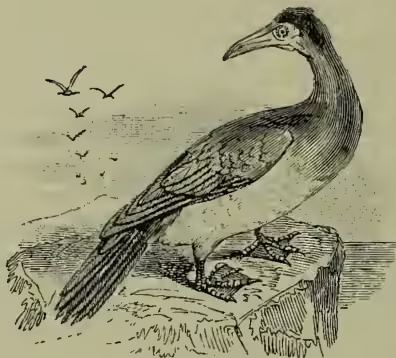
Booby (Sula piscator), a species of Gannet (q.v.), which has received this name from its apparent stupidity in allowing itself to be knocked down with a stick or taken by the hand. Accounts differ very much, however, as to this character of the booby, some representing it as singular in not taking alarm nor becoming more wary even when it has had reason to apprehend danger from man; others, as Audubon, asserting in such a manner as apparently to place it beyond dispute, that it does learn to be upon its guard, and even becomes difficult to approach within reach of shot. The booby is not quite so large as its congener, the common gannet or solan-goose, but, like it, is a bird of powerful wing. It feeds on fish, which it takes by diving in the sea, observing its prey as it sweeps along in graceful and varying flight, sometimes at a height of only a foot or two from the surface of the water, sometimes twenty yards above it. The bird is sometimes taken, like the gannet, by means of a fish fastened to a board, through which it drives its bill, as it dashes at the bait. The booby is of a blackish-brown colour, whitish beneath; its colours are subject to some variation, and in young birds a general brown colour prevails; the sexes differ very little, except that the female is not quite so large as the male. The expansibility of the gullet enables the booby to swallow fishes of considerable size. The bill, which is straight, conical, and longer than the head, opens beyond the eyes, as in the rest of this genus. It is found on almost all tropical and subtropical shores, and sometimes even 200 miles from land. On the east coast of North America, it reaches about as far north as Cape Hatteras, but is much more abundant farther south, great numbers breeding on the low islands off the coast of Florida. The nest is often placed upon a low bush, and 'is large and flat, formed of a few dry sticks, covered and matted with seaweeds in great quantity.' It contains only one egg or young one at a time. The booby is much persecuted by the Frigate Bird and Man-of-war Bird (q.v.), which are more powerful and of swifter flight, and often compel it to disgorge for their use the prey which has just been swallowed. The flesh of the booby, although sometimes eaten by sailors, is dark coloured, and not very agreeable.