Book. The volume which the reader has at present in his hands is a normal specimen of what is now understood by a printed book. Printed matter occupies both sides of a certain number of leaves of paper, which are so arranged that, beginning at the upper end of the left side of the first page, he may proceed without dislocation of thought always from left to right till he reach the lower end of the last page. The first page or recto of the first leaf or folio (often omitted, as in the present work), containing usually an abbreviated form of the title, is technically known as a bastard or half title-page; the next page or verso of the first folio is left blank. Then follows the title-page proper, usually with a blank page at the back. In many books there intervenes a preface or introduction, a dedication, and a table of contents before the main body of the book begins. If any portion of the book has got out of its place, there are two ways by which the true order can be discovered. At the outer corner of each page is a number—1, 2, 3, &c.; this is the pagination or numerical order of pages. At the left-hand foot corner of page 1 is the number 53; and 54 will be found similarly on page 17. The sixteen pages thus indicated have been produced by the folding of a single sheet of paper. Fifty-three is the signature (as it is called) on the first page, because 52 sheets have been used in the previous volume. A, B, &c. are often used for numerals; and if the book goes beyond the number of letters in the alphabet, the series is continued—A A, B B, &c., or 2 A, 2 B, &c.
To understand the historic origin of this normal modern book, we must go back to a remote antiquity. The word 'book' itself (Saxon boc, Ger. buch, Dutch boek) appears originally in Gothic as a plural noun meaning primarily, as is generally believed, the runes inscribed on the bark of separate branches of the 'beech' tree (Saxon boc, Ger. buche, Dutch beuke) for the purposes of divination, &c. Liber, the Latin equivalent (which has been adopted by all the Romance and Celtic tongues—Fr. livre, Ital. libro, Gaelic leabhar, Welsh lcor—and is the source of our English word library), properly meant bark, and was applied to prepared papyrus tissue from its bark-like appearance. The Greek biblia, in like manner, is associated with byblos—i.e. papyrus.
As is now well known, the ancient Babylonians and Assyrians had a wide and varied literature. This was preserved in two ways: either painted on the leaves of the papyrus which grew in abundance on the banks of the Euphrates, or impressed on clay shaped into tablets or cylinders. Such skill was displayed in the treatment of this latter material that the inscribed characters by their minuteness 'suggest that they must have been written with the help of a magnifying glass.' A representation of a typical polygonal Assyrian cylinder will be found in Sayce's Assyria (1885). The defects, as well as certain advantages, of this form of 'book' are obvious. It has no direct connection with the modern European book. The case is different, however, with the ancient Egyptian book. The sequence may be maintained from the volume at present in the reader's hands back for thousands of years to the oldest Egyptian 'volume' still extant (in a sense the oldest book in the world)—the Papyrus Prisse, which must be assigned to a very early period of Egyptian history, according to Chabas and to Virey, Etudes sur le Papyrus Prisse (Paris, 1887), to a date probably prior to the XII. dynasty—i.e. at least 2000 B.C. Owing to its wonderful adaptability to literary purposes, the prepared papyrus tissue (see PAPPYRUS) spread to Greece (at least before the time of Herodotus) and to Rome; and though it was so far supplanted, especially in certain regions, by the finer kinds of prepared skins—the material used by the Jews, Persians, and other oriental nations—it maintained its position as a book-material down to the 10th century A.D. Ali Ibn el Azhad in 920 describes the different kinds of pen required for writing on paper, parchment, and papyrus (see Dr Joseph Karabacek's Das Arabische Papier, Vienna, 1887). The ancient papyrus-book, whether Egyptian, Greek, or Roman, was got up very much like a modern mounted map. A length of the material, written on one side only, was fastened to a wooden roller, round which it was wound; this formed a tama (Egyptian), kulindros (Gr.), or volumen (Latin); hence our 'volume.' Specimens of Egyptian rolls still exist, extending to upwards of 20 and even 40 yards (see Birt, Das antike Buchwesen, page 439); but the great inconvenience attaching to the consulting of such enormous scrolls (though we still find similar pedigree rolls in England—e.g. at Helmingham, Suffolk) made it much more usual to break up any lengthy literary production into sections, each on a separate roll. Certain suitable sizes became normal, and this conventional length of the roll exercised a considerable influence on the length of what are still called the 'books'—i.e. divisions of the classical authors. In Egypt the rolls were kept in jars (holding say nine or ten each); in Rome in wooden boxes or canisters (often of costly workmanship), or in parchment cases. The change from the rolled to the folded form of book appears to have taken place in the ancient world after the adoption of parchment or vellum, though practically the same arrangement of successive surfaces had been in vogue in the books or tablets of waxed wood used for notes and letters. Codex, the Latin name for such a parchment volume, is still retained as the designation of the more important ancient MSS., as Codex Alexandrinus. The form remained practically unaltered throughout the middle ages, and being even more suitable for paper than for vellum, was ready on the invention of printing to facilitate its full development. For details in regard to the ancient MS., see PALEOGRAPHY. For Block-books, see WOOD ENGRAVING.
Sizes of Books.—The vellum, and afterwards the paper book of medieval times, was made up in the following way. 'Quires' or 'gatherings' were formed sometimes of four sheets folded in the middle and placed one within the other, so as to furnish eight leaves, sometimes of five sheets yielding ten leaves, sometimes of six yielding twelve. These groupings were known as quaternions (tetradia), quinterns or quinternions (pentadía), and sexterns (hexadía). This same method was adopted by the early printers, who at first indeed only printed as the copyists had written, one page at a time. In the colophons (see below) of many of the older books, a register or collation, as it is called, of all the quires—whether ternions, quaternions, or so on—is supplied for the guidance of the bookbinder. The signatures on the several quires were at first inserted by hand, and were first printed at Cologne in 1472. When it became usual to print a certain number of pages at once, the paper was not folded and cut up till it had passed through the press. The number of times it required to be folded afforded a ready means of distinguishing in a general way the different sizes of books as long as the paper continued to be made by hand, in frames the size of which did not greatly vary. The nomenclature is still in vogue, though it has ceased in these days of machine-made paper to be a correct guide to the real sizes of books. In America, the proposal to distinguish sizes by an actual measurement of height and breadth of paper has met with some acceptance; but the old fashion still prevails in Europe. A sheet being folded in the middle forms two leaves or four pages; and a book composed of such sheets is styled a folio whether it measure 1½ feet or 4 feet in height. When the sheet is again folded it makes a quarto. In hand-made paper (i.e. the paper used in nearly all books of purely bibliographical interest) the water-line runs either across or down the page according to the number of foldings. The following scheme is serviceable:
| Folio, folded..... | 1 time = 2 leaves, | water-line perpendicular. | |
| Quarto.....(4to) | 2 times | 4 " | " horizontal. |
| Octavo.....(8vo) | 3 " | 8 " | " perpendicular. |
| Duodecimo (12mo) | 4 " | 12 " | " horizontal. |
| Octodecimo (18mo) | 5 " | 16 " | " perpendicular. |
Less ordinary, and of course diminutive, sizes of books are produced and known as 32mo (water-line perpendicular), 36mo (horizontal), 48mo (horizontal), 64mo (horizontal), 72mo (perpendicular), 96mo (perpendicular), 128mo (perpendicular). In this country for a long period printing-paper was chiefly of three sizes—royal, demy, and crown; and according as any one of these was employed, the size of the book was large or small. Demy, however, was the most commonly used; and the demy 8vo may be said to have become the established form of standard editions. The size of the present work is imperial 8vo. Among books, as among men, there are giants and dwarfs. Certain church-books in the Escorial are described as 6 feet in height by 4 in breadth; and the 'Antiquity' volumes, for example, of the Napoleonic Description de l'Egypte measure 37½ inches in height. The 'Thumb Bible' is, on the other hand, not much bigger than a postage-stamp; Pickering's Diamond edition of Tasso measures 3½ inches high by 1½ wide; and Hoepli's 1878 Divina Commedia is less than 2½ inches by 1½.
Colophons.—The scribes employed by Assur-banipal (680 B.C.) used to place the account of their documents at the close of the last column on their cylinders. In like manner, the early European printers often gave details about their books in the closing paragraph, now technically known in English as the colophon (from a Greek word for apex or terminus), in French as souscription, in German as Schluss-schrift. Caxton varies his colophon from the simplest Explicit, Hic finis, or 'Here endeth,' to elaborate epilogues or post-faces. Quaintest of all, perhaps, is his rhyming conclusion to the Moral Proverbs:
Go thou litil quayer | and recōmaund me
Unto the good grace of my special lorde
Therle Ryueris, for I have emprinted the
At his comāndement, folowying eury worde
His copye as his secretaire can recorde.
At Westmestre of feuerer (February) the xx daye
And of Kyng Edward the xvij yere vraye (truly).
Abundant examples of the colophon will be found in Mr Blades's Caxton, and Legrand's Bibliographie Hellénique (1885).
Title-pages.—Though Caxton's work affords no instance of a title-page—unless The Chastising of God's Children (1491?) be his, and it contains simply three lines of ordinary print—this does not represent the general stage of typographic development. As early as 1474 Pictor, Loslein, and Ratdolt in Venice issued a Calendario by John de Monteregio, with a quaint rhyming title-page, with place, date, and names at the foot (see fac-simile in Bouchot, The Printed Book). With the adoption of the title-page, the colophon naturally disappeared, though instances are found well into the 16th century. The treatment of the title-page has varied enormously at different periods: in the 16th and 17th centuries becoming at times so crowded with details as to lose half its value as a ready means of determining the purport of the book. Laudatory descriptions of the author and his work were freely introduced: 'Very necessary to be known'; 'Very pleasant and beneficial'; 'A book right rare and strange,' are among the phrases familiar to all book-lovers. Except in the case of works of fiction and popular theology, the tendency of the present time is to make the title brief and business-like. Dickens's Adventures of Oliver Twist even contrasts curiously with the title-page of the first edition of, say, Robinson Crusoe. Metaphorical titles (so abundant in the Elizabethan and Jacobian periods) are serviceable as distinctly individualising a book, but are very apt (as in Mr Ruskin's Notes on the Construction of Sheepfolds) to mislead the unwary. Double titles (as in Mr Ruskin's Proserpina: Studies of Wayside Flowers) are equally dangerous; and open to strong objection is the habit of re-issuing an old work with a new title. The title of a book is by English law as much the property of an author as any other part of his book. Consequently, a lawsuit may be the result of even unsuspectingly using a title already appropriated (see COPYRIGHT). Compare the fac-simile title-pages in Könnecke, Bilderatlas (1887); Le Petit, Principales Editions originales d'Écrivains Français (1888); and A. Lang, 'Old French Title-pages' in Books and Bookmen.
Dates.—In the dating of their books the early printers, like the scribes, were extremely negligent. 'Of twenty-one works,' says Mr Blades (Caxton, i. p. 31), 'known to have issued from the press of Colard Mansion, not more than five have any date to them; and of nearly one hundred publications attributed to Caxton's press, considerably more than two-thirds appear without any year of imprint.' At other times we find the date given with great precision: thus, The Book of the Knight of the Tower has 'and enprinted at Westminster the last day of Januer, the fyrst year of the regne of Kyng Richard the thryd.' In the present day nearly all respectable publishers put the correct year in which their books are issued at the foot of the title-page, either in ordinary figures or in the Roman notation. When a book is not dated, one suspects a desire on the part of the publisher to sell his old stock as if it had newly seen the light. Unfortunately, the device of attaching a new title-page with a fresh date to matter that has lain in the warehouse for many years is adopted by firms whose reputation ought to be above reproach. The following are among the more important deviations from the normal methods of Roman notation to be found in the colophons or title-pages of early printed books (see Brunet, Connaissances nécessaires à un Bibliophile):
M CCCCiiiij XX VIII = 1488 (i.e. 1000 + 400 + 4 × 20 + 8).
M iiiij Ciiii XX Viii = 1488 (i.e. 1000 + (4 × 100) + (4 × 20) + 8).
M CD XCV = 1495 (i.e. 1000 + (500 - 100) + 95).
M iiiij D = 1496 (i.e. 1000 + 500 - 4).
M IIID = 1497 (i.e. 1000 + 500 - 3).
CIO IO CXX VI = 1626 (i.e. 1000 + + 100 + 26).
In many cases the older printers indulged in curious chronograms; sometimes using them to repeat in the preface a date already distinctly stated on the title-page. An extreme instance is the De spIrItaLi IMItatIone ChrIstI saCræ et VtILes pILIs In LVCeM Datæ, a R. P. Antonio Vanden Stock Societatis Jesu, Ruræmundæ, Apud Gasparem du Pres—a book which contains upwards of 1500 chronograms on the date 1658 (see CHRONOGRAM); and James Hilson, Chronograms, 5000 and more in number (4to, Lond. 1882); and Chronograms Continued (1885).
When dates are wanting, the age of a book may often be approximately determined by certain external characteristics, which must, however, be used with caution. Watermarks (Ger. wasserzeichen; Fr. filigranes), for example, are of importance, but their evidence has been frequently strained. Compare article PAPER; and see the works of Fischer (1804), Boyer (1860), Midoux and Matton (1868), and Sotheby's Principia Typographica.
Place of Publication.—Even when the name of the place of publication is given in full, it may require some knowledge to recognise it under the several forms current in different languages and at different periods. Thus Cologne may appear as Colonia, Colonia Agrippina, Cueln, Ceulen, Keulen, Köln, &c.; or the periphrasis in civitate Colōiensi may be employed, the n's being represented by strokes above the vowels (see PALÆOGRAPHY); Venice may be more or less disguised as Venetia, Venetiæ, Venezia, Venedig (German), Wenez (in the local dialect), Enetiai (in Greek), and Mleci, Bnezieh, Mnezik, and Mijetka (in Slavonic). Well-known places may be concealed under some pseudo-classical translation of, or pun upon, the true name; thus, Herbigopolis stands for Würzburg; Leucopetra for Weissenfels; Probatopolis for Schaffhausen; Eleutheropolis for Freystadt, Francheville, Francavilla, &c. This latter is a good instance of a difficulty that may arise. Not only may Eleutheropolis represent one of many towns, but from the meaning of the word it has frequently been employed by printers who did not wish to declare the true place of publication. Another instance is Irenopolis ('City of Peace'), which is historically an equivalent of Berea. The following list will be convenient: Argentoratum, Strasburg; Augusta Vindelicorum (often only Augusta), Augsburg; Basilea, Basel; Bipontum, Deux-Ponts; Bononia, Bologna, or Boulogne; Cadomum, Caen; Cæsaraugusta, Saragossa; Cantabriga, Cambridge; Corona, Cronstadt; Dortracum or Dordrechum, Dort; Eboracum, York; Gippesvicum, Ipswich; Gratinopolis, Grenoble; Hafnia, Copenhagen; Hala, Halle; Holmia, Stockholm; Insula or Insulæ, Lille; Ispalis, Seville; Leodicum, Liège; Lipsia, Leipzig; Lugdunum, Lyons; Lugdunum Batavorum, Leyden; Lutetia, Paris; Massilia, Marseilles; Matisco, Macon; Mediolanum, Milan; Moguntiacum, Mainz; Mons Regalis, Mondovi; Mussipons or Pontimussum, Pont-à-Musson; Neapolis, Naples; Neapolis Casimiriæ, &c., Neustadt an der Hardt; Enipons, Innsbruck; Olisipo, Ulyssipo, Ulyssipolis, Lisbon; Oxonia, Oxford; Petropolis, St Petersburg; Regiomontium, Königsberg; Rotomagus, Rouen; Sarum, Salisbury; Tarvisium, Treviso; Tornacum, Tournai; Trajectum, Ultrajectum, Utrecht; Treca or Civitas Tricassina, Troyes; Tridentum, Trent; Turoni, Tours. See Dictionnaire de Géographie Ancienne et Moderne à l'usage du Libraire (Paris, 1870).
To divert suspicion, printers have often put totally erroneous names on their title-pages: hundreds of European books bear to have been issued at Pekin; thousands of the products of the Parisian presses claim The Hague (La Haye) or some other
Dutch town as their birthplace. Quite recently Burton's literal translation of the Arabian Nights bears to have been printed at Benares. In the earlier centuries printing and publication were so much the same thing that to know the place where a book was printed was practically to know where it was published, and vice versa. At present it is not uncommon for a work to be printed in one country and published in another. When publishing firms have houses or agencies in different cities, all may be mentioned on the title-page, and precedence accorded rather in keeping with the importance of the cities. Thus, 'London and Edinburgh' frequently appears in books which were entirely produced in the lesser city. With the introduction of stereotype or electotype plates it has become possible for a book to be printed in more places than one with only one setting-up of type. See Weller, Die Falschen und Fingirten Druckorte (1864).
Pagination.—At first the printed book was issued like the manuscript without any numbering of the pages. Before long it was found convenient to number the leaves; the numbering of the pages followed. In many modern books, when the page contains two or more columns, each column is numbered consecutively. When a book consists of several volumes, each has usually its own pagination; but in some great treatises running through several volumes, it expedites reference from the index to number right through from the beginning to the end of the whole series. In the old folios and quartos letters were not infrequently inserted on the margin, so as to break each page into distinct portions without interfering with the continuity of the text. The marginal letters from the first editions of the classics are often reproduced in modern editions just as they originally stood, and form a convenient method of reference.
Preface, &c.—The Preface is the introductory address of the author, in which he explains the purpose and scope of his book, and, as it were, introduces himself to his readers. Our ultra-Saxonists prefer to call it a 'foreword,' in keeping with the German Vorwort. Formerly it was usually headed To the Reader, To the Gentle Reader, To the Courteous Reader, &c.
In the times when the professional author depended largely on the patronage of some person of rank, the Dedication was an integral and indispensable part of a book. If he made sure of his Mæcenas he could let the many go. At present being for the most part a mere expression of personal esteem or affection, the 'I dedicate' has become as simple in form as in the 17th and 18th centuries it was elaborate with all the rhetorical artifice to which flattery could attain.
Pictorial Imprints or Printers' Devices.—One of the happiest passages in the Book Hunter deals with the trade emblems of the old printers. The subject on which it merely touches has been treated at length in such works as Silvestre's Marques Typographiques (2 vols. Paris, 1867); Roth-Scholtz's Thesaurus Symbolorum ac Emblematum, id est, Insignia Bibliopolorum et Typographorum (Norimbergæ, 1730); Berjeau's Early Printers' Marks (Lond. 1866). It is enough here to mention the boldly drawn three-mast ship of Mathis van der Goes, Antwerp (1472-94); the windmill of Andrew Myller, Edinburgh (1508, &c.); the curious wild men and fruit-laden tree of Thomas Davidson, Edinburgh (1541); the olive-tree of the Stephenses; and the sphere of the Elzevirs. In many instances there is a punning allusion to the printer's name: Froschover has his frogs (Frosch in German), and Le Chandelier his seven-branched candlestick; Nicholas Eve gives us a picture of the presentation of the forbidden fruit. Others make use of the arms of the cities in which they worked. Leeu shows the castle of Antwerp, R. Hall the half-eagle and key on a shield of Geneva, Stadelberger the lion rampant of Heidelberg and the shield diapered of Zurich, &c. Ascensius (1462-1532) has 'bequeathed to posterity the lively and accurate representation, down to every nail and screw, of the press in which the great works of the 16th century were printed, with the brawny pressman pulling his proof.' His device with the inscription Prelū Ascēsiānū was adopted by Josse Bade, Paris (1501-35), who added his initials at the foot; by De Gourmont (1507-15); Le Preux (1561-87); and in a modified form by De Marnef (1567) and De Roigny (1565). The anchor and dolphin of the Aldi was employed by Turrisan, De Chenney, Brillard, Tardif, Cou lombel, sometimes, as in the last instance, with the divided Aldus.
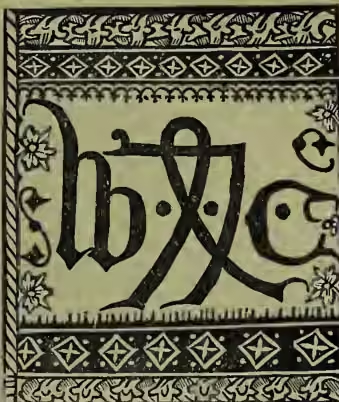
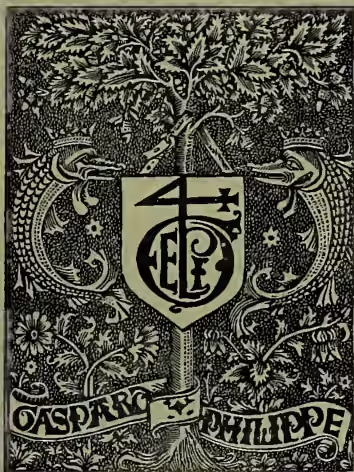
Decoration of the Book.—Leaving out of view the pictorial illustration devoted to the elucidation of the subject treated of in a book (see ILLUSTRATION), there are certain forms of illustration which are merely decorative appendages to the book itself. Besides the ornamental treatment of the title-page with peculiar letters, the use of red or blue ink, and the insertion of a printer's emblem or some appropriate vignette, we must mention the engraved title-page (in the 16th and 17th centuries often a most elaborate and costly piece of work), the frontispiece or engraving placed opposite the title-page; ornamental initial letters for chapters; headpieces or vignettes for the blank space generally left before the beginning of a new chapter; and tailpieces at the end of the chapters. The amount of artistic effort lavished on these apparent trifles will best be understood by consulting Niedling, Bücher-ornamentik (1888); Bouchot, The Printed Book; and Austin Dobson's chapter in A. Lang's The Library (see also the works supra at 'Title-pages'). By the earliest printers the insertion of decorative details was left to a special artist—the rubricker (so called from the red ink which he mainly employed).
Space was often left for his initial letters, and at most only a small letter inserted to guide him.
In describing second-hand books various technical expressions are employed. Black Letter is explained in a separate article. Uneut means that the original size of the paper has not been reduced by cropping the edges, not, as is often supposed, that the paper is still in the sheet, a condition for which there is no generally accepted term. The French use non coupé in this latter sense, and for 'uncut' non rogné. Foxed means that a book is damaged by brown or yellow spots. Curious is used euphemistically for 'improper.' 'Unique,' 'rare,' and 'very rare,' require no explanation, but should be accepted with caution. Many books originally printed in thousands (e.g. school-books) have become rare and even unique in course of time; others have been so from the first through the intentional limitation of the numbers issued. A common device to enhance the market value of a book is to issue only a few copies and promise to destroy the plates. Thus the word edition conveys no idea of number. See Egger, Histoire du Livre (Paris, n.d.); Bouchot, The Printed Book (1887).