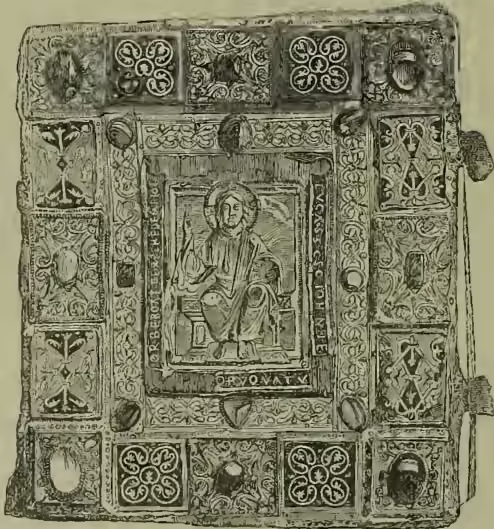
Bookbinding is the art of connecting together in a durable and convenient manner the several parts of a book. Before the invention of printing, the binding of manuscript books, which in those days consisted chiefly of Bibles, Psalters, Books of Hours, and other works of an ecclesiastical character, was performed by various orders of monks, who prepared the books up to a certain point ready for ornamentation by the goldsmith and jeweller; and the earliest works from the press were at first printed and bound in direct imitation of these manuscript volumes. Fig. 1 is copied from the side of a Book of Hours bound in the early monastic, or, as it is commonly called, Byzantine style, with a figure of Christ carved on an ivory plaque in the middle, surrounded by gold filigree work and sixteen jewels. It was not till the end of the 15th century, when the printing-press had become common in Italy, that binding took rank as an art by itself, and it was probably in the workshops of Aldo Manuzio (Aldus), the famous printer of Venice, that decorative art of the highest character was first applied to the ornamentation of book-covers. There are in the National Library at Paris, books bound for an Italian connoisseur named Tommaso Maioli, and for another celebrated bibliophile, Jean Grolier of Lyons (1479-1565), at one time treasurer to the Duke of Milan, which are unsurpassed in beauty of design and workmanship at the present day. This taste for artistic bookbinding soon spread to France, where the king and the richer among the nobility vied with each other in the possession of handsome bindings. Louis XII. and his queen, Anne of Brittany, both possessed fine examples, probably of Italian workmanship. Henry II. and Catherine de Médicis were perhaps the most enthusiastic royal patrons of the art, and the king's favourite, Diana of Poitiers, had probably the finest collection of splendidly bound books that was ever got together. Henry III., who was also a great lover of books, was afflicted with a peculiar mania for all kinds of emblems of death, and carried it so far as to cause the well-known death's head and cross-bones to be introduced on the bindings of his books; it thus became very easy to recognise volumes which had once formed part of his library. Jacques Auguste de Thou (Thuanus), president of the parliament, and a great friend of Grolier, was another celebrated collector of sumptuously bound books of this period.
It is in the reign of Henry III. (1574-89) that we learn for the first time the names of the binders who were employed in the royal service. Among these, Nicolas and Clovis Eve were the most celebrated. They were the first to introduce the style known as fanfare, with geometrical patterns filled in with sprays of leaves, palm branches, and other foliated forms.
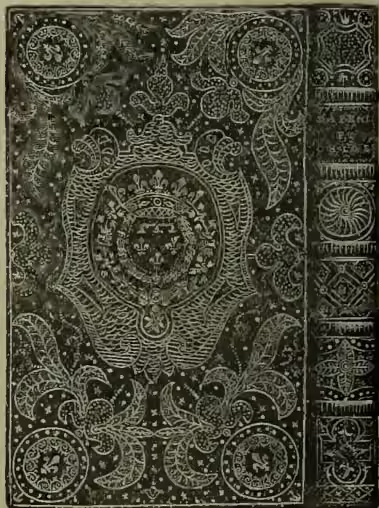
In the middle of the 17th century we meet with the name of Le Gascon, probably the by-name of Florimond Badier, whose work merits great praise. The peculiarity of his ornament, known as pointillé, consists in filling in a geometrical outline with innumerable minute gold dots, often thus forming very pleasing patterns. At the end of this century the most famous workmen of the craft were Duseuil, Padeloup, and Derôme, who faithfully carried on the tradition of their predecessors. A famous binding attributed to Nicolas Padeloup is that figured in our engraving (fig. 2), a Daphne et Chloe of 1718, with the arms of the then regent of France, the Duke of Orleans.
During the 19th century, bookbinding continued to preserve its rank as a fine art, especially in France, where the most elaborate work, executed with the greatest care and skill, and often very beautiful in result, is more sought for than in other countries.
In Germany and the Netherlands most of the books were originally bound in vellum, calf, and pigskin, many of them stamped with ornament in blind-tool (i.e. without gold), and for a few years after printing was invented, the decorative art generally employed was of the most primitive description. In the 17th century, many very elaborate blind-tooled bindings were executed; and during the last half-century, German binders have wakened from their long sleep, and we now see work issuing from Berlin and Leipzig that deserves unqualified admiration.
In England the history of the art is obscure, and, though it must have been extensively practised, the names of few of its followers are known. Julian Notary, in the reign of Henry VII.; John Reynes, in the time of Henry VIII.; John Gibson of Edinburgh, in the reign of James I.; and Roger Payne, at the end of the 18th century, are those which have chiefly survived. Of the work of many English binders of the end of the 18th and beginning of the 19th century, Baumgarten, Kalthoeber, Bohn, Staggemeir, and others, it is impossible to speak too highly. They were succeeded by Hering, Lewis, Mackenzie, Hayday, Rivière, Bedford, Zaehnsdorf, and other excellent binders; and there are at the present day members of the craft whose names will go down to posterity among those of the most celebrated of their brethren.
Bookbinding may be divided into two classes—viz. case binding or 'cloth-work,' and leather or 'bound work.' The former was introduced by Pickering, the publisher, and Leighton, the binder, in 1822. Before that time books were issued by the publishers bound in millboards covered with coloured paper. In both France and Germany most books, even the finest, are originally issued in paper covers; whereas in England the whole edition often appears in cloth binding. As the latter is that most generally used for ordinary books, it may be first described.
Books are usually supplied to the binder in sheets of sixteen pages, that being the number most easily folded. If for convenience they are printed in larger sheets of thirty-two or sixty-four pages, then these are cut into the proper size before going to the binder. Each sheet has its pages arranged (see PRINTING) so that, when folded, they will follow one another in their proper order; and on the first page of each sheet is a letter called its signature. The first sheet of a book is A, the second B, and so on. The sheets are folded either by hand or by any one of a variety of ingenious machines which do the work with great expedition and accuracy. When folded, bundles of the different sheets of the book are laid in order on a table, and a sheet is 'gathered' off each bundle till a book is completed, and so on till the number of books is finished. The separate books are then collated or revised to see that the signatures follow each other in proper order. They are then pressed in a machine to give them a little solidity, and being put straight, are passed over a table having three or four (according to the size of the book) circular saws projecting slightly, which make shallow cuts across the back. The cuts make holes in the sheets, through which they are stitched on a cord which is placed in the saw-cut. The stitching is either done by hand in a frame on which the cords are stretched, or by one of the clever machines which have been invented for the purpose. Some of the machines sew the sheets on tapes, in which case the sawing is dispensed with. The cords or tapes on which the books are sewed are cut with a little piece, half an inch or so, left projecting, and this, after the end or 'waste' papers are tacked on with paste to each side, is pasted down on the outside sheet. The work up to this point is executed by girls. The sewed books are taken to the forwarders, who commence operations by cutting the edges by means of a 'guillotine,' after which any ornamentation of the edges, such as sprinkling with colours, marbling, or gilding, is applied. They are then rounded on the back by hammering on a plate, and put into a press which forces a piece of the back over the sides, forming shoulders, called the joints, which grip the case. A piece of thin canvas being glued over the back, with a portion overlapping, the book is ready for the case, which has meanwhile been also in preparation. The case consists of two pieces of millboard, cut to the proper size by a most ingenious machine, which, like the greater part of the machinery used in bookbinding, is of American invention; the boards are separated by a piece of paper of the proper width to form the back of the book, and the whole covered with specially prepared cloth of any desired colour. The cases are made with great expedition by three or four girls working in concert. The ornamentation of the case is next executed. This varies from the simplest lettering or title on the back or side to the most elaborate decoration specially designed by artists who study that branch of art. This may be stamped in gold, ink of various colours, or blind (i.e. plain), or a combination of all three. The designs are engraved on brass, the gilt portion on one piece, the ink or blind on another, and stamped on the case by means of a press worked either by hand or steam. Where gilt work is intended, gold-leaf is first put on the case, and after being impressed by the stamp, which is kept hot when in use, the superfluous gold is rubbed off, the parts stamped only adhering to the case. The ornamentation of cases is capable of an infinite variety of modifications. When the case is ready, the outside end-papers of the book are pasted, including the pieces of cord and canvas already mentioned; the case is carefully placed in the joints, and the whole placed in a hydraulic press till dry, when the binding is finished.
Leather or bound work differs from case work in the essential particular that the boards are put together on the book. The sewing is much similar to that already described, except that it is more carefully done, and the cords are stronger, and longer pieces are left. The forwarder hammers the back round and forms the joint by hand, laces the ends of the cords through the boards, and pastes them down securely. The edges are then marbled or otherwise ornamented, and headbands, ingenious arrangements to strengthen the top and bottom of the back, are worked on. After lining the back with strong brown paper, little strips of pasteboard to form the back into panels are stuck on, and a piece of leather, very carefully prepared, with the edges pared thin, and cut to a proper size, is pasted over the whole cover, with about an inch turned over the boards. The work is then handed over to the finisher. In his hands the leather is sized with diluted paste, varnished with glair made of white of egg, and the gilt ornamentation, lettering, &c., is executed by hand tools at his discretion. This part of the process demands great skill on the part of the workman, who should have the instincts of an artist. In 'calf' binding, a differently coloured piece of leather is generally pasted on the title panel, but in 'morocco' work this is dispensed with. During the finishing process a book may pass through the workman's hands as many as thirty or forty times, a separate operation being performed every time.
In half-binding, a strip of leather is glued or pasted over the back of the book and reaching about an inch and a half on the board on each side; a triangular piece of leather is usually pasted over the corners to strengthen them. The cloth or paper to cover the sides is then put on and turned over the boards, the marbled or otherwise ornamented end-papers are pasted on the inside, and after being pressed, the book is finished. What is called Roxburghe binding is simply half-binding in morocco, without leather corners; generally with the top only gilt.
In magazine parts, or other books covered in paper, the sheets are stitched together and the paper cover pasted on the back. Sometimes they are fastened with two or three wire-stitches clamped through by means of a machine. In what are called 'limp' books—i.e. books with thin boards which do not project beyond the leaves, the cloth is generally pasted over a paper cover stitched along with the book, and the edges cut afterwards.
There are several divisions of the bookbinding profession. Where publishing is on a large scale, as in London, Edinburgh, New York, and Philadelphia, binding for publishers, which is principally cloth-work, is carried on in extensive factories, fitted up with costly and elaborate machinery driven by steam. The binding of account-books is a separate branch called 'stationery binding.' Other binders devote themselves to fine art binding; others to paper-work; others again to Bibles and Prayer-books exclusively. In all, however, the same three requisites, solidity, elasticity, and elegance, are necessary to a well-bound book. The marbling of edges and the preparation of end-papers is a separate industry.
See L. Gruel, Manuel Historique (1887); G. Brunet, La Reliure Ancienne (1880); L. Derôme, La Reliure de Luxe (1880); O. Uzanne, La Reliure Moderne (1887); H. Bouchot, Les Reliures d'Art (1888); the fac-similes of Mr Gibson-Craig's Collection (1892); Thoinan, Les Reliures Français (1893); Halfer, Die Fortschritte der Marmorier Kunst (1891); Bookbinding Ancient and Modern, by the present writer (1881); and works on the subject by J. B. Nicholson (1882), J. W. Zaehnsdorf (1880; 2d ed. 1890), W. Salt Brassington (1893), and Herbert P. Horne (1894). See also the articles BOOK, ILLUMINATION, ILLUSTRATION, &c.