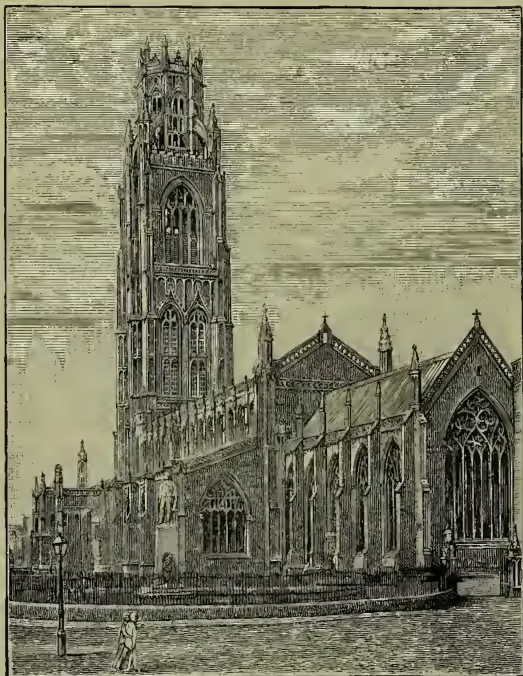
Boston, a parliamentary and municipal borough and seaport in Lincolnshire, on both sides of the Witham, 30 miles SE. of Lincoln, and 107 miles NE. of London, by rail. Its name is a contraction of 'Botolph's town,' and it is commonly supposed to occupy the site of the Benedictine abbey founded on the Witham by St Botolph in 654, and destroyed in 870 by the Danes. Under the Normans, Boston became a place of importance, and in 1204 it paid the largest dues (£780) of any English port but London (£836). In the reign of Edward III. many foreign traders settled, and the merchants of the Hanseatic League established a guild in Boston. After their departure, the town declined, and the suppression of the monasteries by Henry VIII. further injured it; but his grant of a charter of incorporation, and Mary's subsequent grant of extensive lands, partly compensated for this. The modern town consists chiefly of four good streets, two on either side of the river, here crossed by a handsome bridge. The parish church of St Botolph measures 283 by 99 feet, and is one of the largest without transepts in England. The tower is 263 feet high; it is in the Perpendicular style of architecture, and terminates in an octagonal lantern, doubtless intended for a lighthouse by land and by sea, as well as a campanile, and by all the district, as seen rising above everything for miles around, is known as 'The Stump.' The founder's chapel is in the Early Decorated style of Edward II. (1307), and the nave, aisles, and the western part of the chancel are of the Late Decorated, Edward III. In 1843 the restoration of the church was commenced, the works continuing ten years, and over £10,000 being expended. A chapel to the memory of the Rev. Thomas Cotton, at one time vicar of Boston, was erected at the expense of the inhabitants of the daughter-city of Boston in America. A promenade by the river is tastefully laid out, with a people's park, public gardens, and recreation ground adjoining. Boston has also a free grammar, charity, national, and other schools, a guildhall, covered markets for fish, fowls, butter and eggs, a workingmen's college, and school of art. The clearing of the river of silt, the formation of a new channel in 1881, and the opening of a new dock in 1884, have greatly promoted the trade of Boston. Ships of 2000 tons can reach the heart of the town; and the number of foreign vessels entering the port rose from 17 in 1884 to 170 in 1887. The chief exports are coal, machinery, corn, and wool; and the imports consist of timber, maize, cotton-seed, and general merchandise. The river and canals furnish communication with Lincoln and several other towns. Boston is a great market for cattle and sheep, and has manufactures of canvas, sail-cloth, ropes, sacking, beer, iron, brass, leather, bricks, whiting, and hats, with some shipbuilding. Fox the martyrologist, and Herbert Ingram, founder of the Illustrated London News, to whom a statue was erected in 1862, were natives of Boston. Since the Distribution of Seats Act (1885) Boston returns only one member to parliament. Pop. of municipal borough (1851) 14,733; of parliamentary, 17,518; (1891) 14,593 and 18,711.