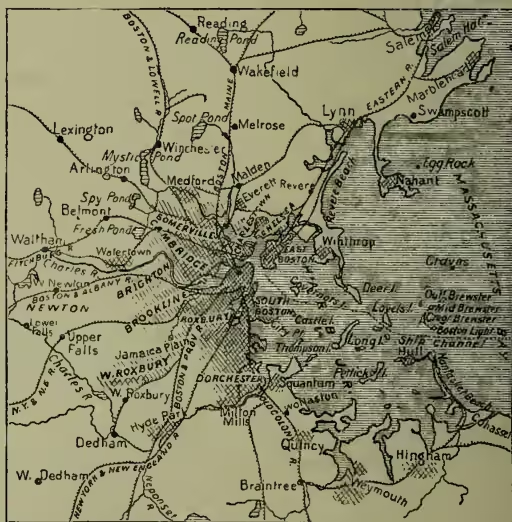
Boston, the capital of Massachusetts, and one of the chief cities of the United States, is situated on an inlet of Massachusetts Bay, Copyright 1888 in U.S. called Boston Harbour, at the by J. B. Lippincott mouths of the Charles and Mystic rivers, in 42° 21' 27" N. lat., 71° 3' 30" W. long., and 234 miles NE. of New York by rail. Company.
Boston possesses an excellent harbour, protected by several forts, and covering 75 sq. m., with a minimum depth of 23 feet at low tide, and is in all respects favourably situated both for foreign commerce and coasting-trade; the harbour has four fine lighthouses, and is dotted with more than fifty islands, on some of which hospitals have been built. Eight lines of railway, controlling over 2000 miles of road, converge at this city, in the outskirts of which the Junction Railroad connects most of the lines with one another; and ten lines of ocean-steamers ply regularly between this and British and other foreign ports. The chief imports are sugar, wool, hides (for its large boot and shoe manufactures), chemicals, flax, and cotton goods; the principal exports, meat and dairy products, cattle, bread-stuffs, cotton, and tobacco. The value of imports for the fiscal year, ending June 30, 1887, was 61,018,330, and of exports 59,001,505; 2647 vessels in the foreign trade, of 1,258,524 tons, entered the port in 1886, 1949 of them, with a tonnage of 892,897, being British. The Charlestown government navy yard is within the present limits of Boston, and the city, besides being the seat of many varied local manufactures, is the headquarters of heavy railroad, mining, and insurance interests, the active operations of which are carried on in all sections of the United States. It has 60 National Banks, with an aggregate capital of about $60,000,000, 13 savings-banks, and a board of trade.
Boston is exposed to east winds, and pulmonary complaints are very prevalent; but otherwise its climate is healthy. It is one of the best built cities in the United States, prominent among its specimens of elaborate architecture being Trinity Church and the Roman Catholic cathedral, the former erected at a cost of 750,000, and said to be the finest church in New England. The streets in the older portion of the city, once singularly irregular in their course, have been very generally straightened, at great expense, and most of the principal ones are traversed by tramways, which extend for many miles, connecting with suburban towns. Nevertheless, still preserves something of the appearance that characterised the town in colonial times. The older buildings include the State-house (1795), with a conspicuous gilded dome, and fronting on the well-kept Common, the Old State-house (1712), Christ Church (1723), Faneuil Hall (1743), afterwards termed 'The Cradle of Liberty,' and King's Chapel (1754). Among later public buildings and institutions may be noted Tremont Temple, the headquarters of New England Baptists, containing an audience-hall, with seats for 2600, and a fine organ; the Free Public Library, with a half-million bound volumes, accessible to all comers; the government Post-office and Sub-treasury building, of granite, erected at a cost of about 6,000,000; the Lowell Institute, for the support of free public lectures; the Massachusetts, City, and several minor hospitals; a large number of homes, asylums, and orphanages, under the charge of the various religious denominations; and city dispensaries and institutions for the insane, the blind, &c.
Boston has about 225 churches, of which 34 are Congregationalist, 31 Roman Catholic, 27 Baptist, 30 Methodist, 26 Unitarian, and 26 Episcopalian. Its elaborate system of public schools embraces high, normal, and Latin schools, over 50 grammar-schools, and more than 400 schools of minor grade, with a staff of some 1400 teachers. The average attendance of pupils is over 60,000, and about $2,000,000 is expended annually for school purposes. Among the higher institutions of learning are the Boston College (Catholic); the Boston University (Methodist), for the education of both sexes; schools of technology and industrial science; two conservatories of music, both of high repute; schools of law and divinity; and the Massachusetts Medical College, connected with Harvard University, which, though located in the adjacent city of Cambridge, is virtually a Boston institution.
The 'Hub of the Universe' has long been noted for the interest taken by its citizens in literature, science, and art. The city possesses some 250 literary, musical, and kindred associations, many of them incorporated and endowed, besides a number of social and political clubs. The number of newspapers and periodicals here published is about 250, of which 9 are issued daily, and the remainder weekly, monthly, or quarterly.
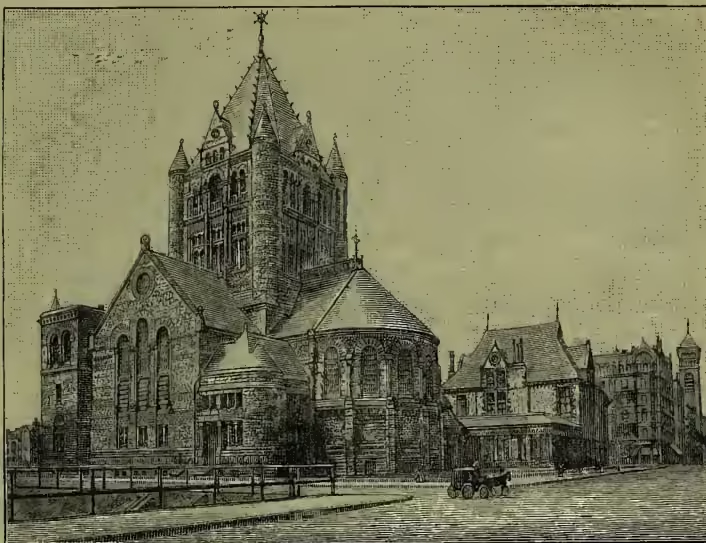
(From a Photograph by H. G. Peabody, Boston.)
Originally founded in 1630 upon a peninsula known as Shawmut, it was first called Trimountain, from the three hills which were then a marked feature of the territory, and was afterwards officially named Boston, after Boston in Lincolnshire, the native place of some of the principal colonists. This tract, purchased from the original settler, William Blaxton (or Blackstone), for £30, comprised 783 acres; but by successive additions the territory of the city has been increased, until, in 1888, it covered 23,661 acres, or nearly 37 sq. m. Among these additions are comprised the city of Roxbury, annexed in 1867; Dorchester, annexed in 1869; and Charlestown, West Roxbury, and Brighton, annexed in 1873. Charlestown had in 1870 a population of 28,000. Large tracts of ground also have been reclaimed from the harbour and its branches, and sixteen bridges, besides the railway- bridges and steam-ferries, connect the city with its suburbs.
Boston has been identified with many events of general interest to Americans, such as the meeting of the first grand jury (1635), and the publication of the first regular newspaper (1704). The stern, impatient Puritan spirit of its founders led to the banishment of heretics and the execution of Quakers and witches, and later, to the expulsion of James II.'s officials. The conspicuous part borne by the town in the early troubles with England brought about the 'Boston Massacre' of 1770, in which several people were killed by the fire of the soldiery; and after the destruction of the British-taxed tea in the harbour (1773), the port was practically closed, and the town occupied by a British force, which, in March 1776, was finally compelled to evacuate the place (see BUNKER HILL). From 1830 to 1860 Boston was the headquarters of the movement for the suppression of slavery, against which its citizens had shown a strong feeling as early as 1645. The city has suffered from several destructive conflagrations, that of 1872 having been exceeded in the United States in the extent of the calamity only by the Chicago fire (1871).
Boston was the birthplace of Franklin, Copley the painter, his son Lord Lyndhurst, Poe, Emerson, Ticknor, Sumner, and Parkman, as Cambridge was of Holmes and Lowell; while associated with it and Cambridge have been Hawthorne, Longfellow, Agassiz, Whittier, Motley, Bancroft, Prescott, Channing, Theodore Parker, Dana, Margaret Fuller, Thoreau, Aldrich, the Alcotts, Jameses, and Howells. Pop. (1800) 24,937; (1840) 93,383; (1860) 177,840; (1880) 362,839; (1890) 448,447. Besides the suburbs already named are South Boston and (on Noddle's Island) East Boston; and the cities of Cambridge (q.v.), on the other side of the James, Newton, Somerville, and Chelsea are practically suburbs. See Winsor's History of Boston (4 vols. 1880-82).