Brachiopoda, a class of shelled animals having certain affinities with worms and with Polyzoa, but less with molluscs, though often included within the limits of the last-named group. The presence of two shells gives them a superficial resemblance to true bivalves (Lamellibranchs), but the shells lie dorsally and ventrally instead of right and left, and the anatomy of the inclosed organism is quite different.
History.—Naturalists were for long content with placing Brachiopods beside Anomia or among Lamellibranchs. Forbes and others have shown that this is impossible, and the growing tendency, due to better acquaintance with their structure and to the researches of Morse, Kovalevsky, and others on their embryology, has been to regard them as specialised and passive Annelid types. Other suggestions have not been wanting, but there is now a general consensus of opinion in defining them as one of the many offshoots from the 'worm' branch of the genealogical tree. The Tunicata have been removed from any close alliance with Brachiopods, while the Polyzoa have come to be regarded as very closely allied.
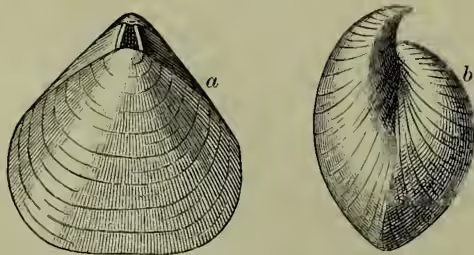
Structure.—The external form of the animal certainly suggests that of an ordinary bivalve, but, as above noted, the position of the two valves is quite different. The size varies from considerably under half an inch to an inch, or rarely two inches in length. The shell consists of two distinct valves, the ventral usually larger than the dorsal, and each divisible into symmetrical halves. Where the valves unite, a perforated beak is often present. Through the hole of the beak a muscular bundle passes, serving in some cases for mooring the animal. The shell may be horny (among Discinidae and Lin- gulidae), glassy, or massively limy. Its structure is very much simpler than that of ordinary bivalves, and often consists of a single layer, which, in the majority, is penetrated by skin processes, which possibly have a respiratory significance. These are absent in Rhynchonellidae and a few others, where the shell is therefore described as non-porous. The outer surface may be sculptured and coloured. The dorsal valve bears internally a limy ribbon of very varied shape, which forms the supporting organ of the respiratory apparatus. The ventral valve is in many cases provided with hinge teeth, which fit into depressions in the upper valve and lock the two halves firmly together.
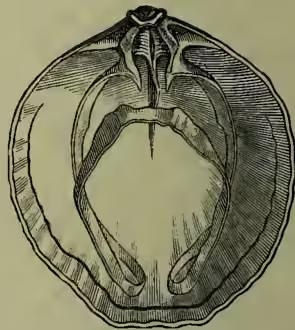
The shell is secreted and lined by a delicate double membrane or mantle. Between the two layers there is a rich distribution of blood-vessels (the arterial system according to Huxley) which are connected with the body proper by two or four contractile heart-like organs. They communicate the hinge, and the large space between the two mantles is occupied by two large and exceedingly characteristic organs, which are probably respiratory, and certainly serve to waft little food-particles to the mouth. They consist of long tubes, bearing on one side movable cirri, and varying greatly in their degree of freedom and manner of twisting. In some cases these can be protruded through the open valves, in other cases they return upon themselves and are supported throughout by the limy ribbon above mentioned. They are tentacular, or labial organs, and arise from the outpulled margins of the mouth; in a few cases they are absent. The three or more pairs of muscles working the valves of Brachiopods are more complex than those of Lamellibranchs, and vary considerably in the two main divisions. The nervous system consists of a ring round the gullet, with superior and larger inferior pairs of ganglia, and of nerves regularly distributed to the various organs. Sense organs seem to degenerate in the very passive adults, but the young may possess eye-spots, and sometimes also ear-sacs. The alimentary system consists of the inconspicuous mouth at the base of the long tentacles, of an ascending gullet widening into the stomach, of an associated digestive gland, and of an intestine which bends downwards, and either ends blindly or in an anus on the right side anteriorly. The respiratory system, as already noticed, probably consists of the processes from the mantle and of the tentacular arms, but further researches are necessary to make this certain. The vascular system between the mantle-layers has been already noted. The heart is usually described as a pear-shaped organ above the stomach, supplied by a main vein, and giving off two arteries. The excretory system consists of a pair of tubes (compare segmental organs of other Invertebrates) to the right and left of the gut, opening internally into the body-cavity, and externally into the space between the two mantle-flaps. In Rhynchonella psittacea a second pair is present. These tubes serve also for genital ducts. The reproductive system is usually represented in one division by two pairs of glands, situated in sacs from the body-cavity into the mantle-cavity, and in the other division by glands near the coils of the gut. In the former the sexes are separate, in the latter the glands are hermaphrodite.
Mode of Life.—The adult Brachiopods are excessively passive organisms. Some are fixed by whole or part of their ventral valves, others seem to have been anchored in the mud by long spines, while a few are stalked either for life or in their earlier stages. The lamp-shell Lingula, with the longest stalk, is at the same time, as one would expect, one of the least limy, and has in fact a horny shell. L. pyramidata has been shown by Morse to have the power of moving along the sand, and Terebratulina caput serpentis has also considerable power of moving on its stalk. The nadir of passivity as expressed in enormously thick limy shells is well illustrated by the very large and massive fossil Productida. The food seems largely to consist of diatoms, but the Lingulidae are also known to sweep in small crustaceans and abundance of mud. They are all marine, and attach themselves to rocks, corals, molluscs, &c.
Development.—The eggs may be laid externally, or develop within the ducts, or in Thecidium in a special brood-chamber. The segmented larvæ, which in some cases show marked affinities with Chaetopod worms, are free-swimming and very unlike the adults. They fix themselves by their posterior portion, lose their anterior sensory region, and form the body out of the rest.
Distribution in Space.—The Brachiopods are widely distributed, but are at the same time much localised. In favourite haunts they occur in great numbers. Lingula abounds at above half-tide mark, while the more abundant limy forms go down to very great depths—as far as 2600 fathoms. The horny forms are fonder of warm and tropical, the limy of cold and temperate waters.
Distribution in Time.—The Brachiopods furnish a striking illustration of a moribund class. In former periods they were vastly more numerous. The hingeless forms appear first, soon accompanied by hinged types, in the Cambrian strata; in Silurian times they were exceedingly numerous; in the Devonian was their golden age. In the Carboniferous strata they are much rarer, and still more so in the Dyas. They increase again in the Jurassic, and reach another climax, sinking again in the Chalk, and gradually dwindling to the presently existing residue. Of the 125 genera and 2600 species, 17 genera and 110 species are still extant—a striking instance of decadence, which may in part be due to their extreme passivity, and also to the number of relatively trivial characters so often connected with this state. Lingula and some others have persisted from the earliest times.
Classification.—The Brachiopods are often divided into two orders of Testicardines and Ecardines, respectively with and without hinges. In the former it may be further noted that the shell is always limy, the mantle-flaps are united posteriorly, the gut ends blindly. In the latter the shell may be horny, there is no arm skeleton, the mantle-flaps are always separate, the gut has an anal aperture. Terebratula, Thecidium, Stringocephalus, Rhynchonella, Spirifer, Strophomena, and Productus are examples of the various families of the former; Crania, Discina, Obolus, and Lingula of the latter. The absence or presence of an anus, in regard to which there is a good deal of reasoning from analogy in default of observation, is expressed in another couple of names—Clistenterata for the former sub-class, Tretenterata for the second. The terms Articulata and Inarticulata refer to the same twofold division, and emphasise the presence or absence of the locking hinge. The two terms Testicardines and Ecardines are, however, generally adopted. It has been proposed to erect a third division—Abrachia—for a few armless forms, in which these characteristic organs are replaced by a tentacular sheath formed from the mantle. In other respects they resemble Testicardines. For further information, see T. Davidson, Fossil Brachiopoda (1859), Challenger Reports, Huxley's Invertebrates, and other text-books.