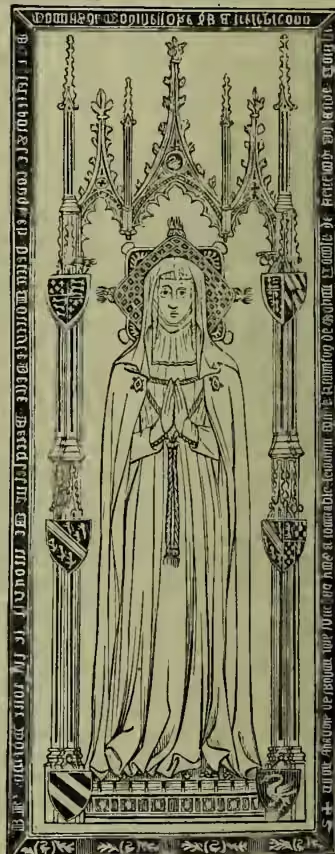
Brasses, MONUMENTAL, large plates of brass, or of the mixed metal called latten or laton, inlaid on slabs of stone, and usually forming part of the pavement of a church. The figure of the person intended to be commemorated was generally represented either by the form of the brass itself, or by lines engraved on it. Such, however, was not always the case, an ornamented or foliated cross, with other sacred emblems, being frequently substituted for the figure. Nor was the practice of imbedding them in the pavement uniform, as we sometimes find them elevated on what were called altar-tombs. The incised lines on these brasses were occasionally filled up with nicello, and in the case of armorial decorations and the like, the field or background was often cut out by the chisel, and filled up with some species of coarse enamel, by which means the appropriate tinctures were produced. In England, the brass was usually of the form of the figure, the polished slab forming the ground, and the ornaments, arms, inscription, &c. were also inserted each as a separate piece. On the Continent, where the metal was more abundant, the brasses were one long unbroken surface, formed of plates soldered together, on which were engraved all the objects represented, the portions of the plate not so occupied being ornamented by elaborate flower-work. Brasses are known to have been used for monumental purposes from an early period, though there are no existing traces of them in England previous to the middle of the 13th century. There is reason to think that, if not imported from France, they were at first executed by French artists, but as no example of a brass exists now in France, it is impossible to establish this. Subsequently the art took root in England, and English brasses, like English architecture, acquired a distinctive national character. The oldest complete specimen in England is that on the monument of Sir John d'Aubermoun, at Stoke d'Abernon, in Surrey. The knight died in 1277, and it is probable that the brass was executed shortly after that date. Next in antiquity are those of Sir Roger de Trumpington, who died in 1289, and of Sir Richard de Buslingthorpe, 1290; the former at Trumpington in Cambridgeshire, the latter at Buslingthorpe in Lincolnshire. In addition to the interest which they possess from their age, these brasses are remarkable as being still unsurpassed in the beauty of the workmanship and the spirit of the design. In the following century (1325), on the brass of Sir John de Creke, at Westley Waterless, in Cambridgeshire, the artist's mark is affixed by a stamp—a fact which has been regarded as a proof that his craft had attained to some importance, and that his services were pretty frequently called into requisition. But in this case, as in every other, with one exception, the name of the artist has perished. The exceptional case is that of the brass which once covered the tomb of Bishop Philip, in the church of the Jacobins at Evreux, in Normandy, where the inscription ended with the words, 'Guillaume de Plalli me fecit.' Some of the brasses executed in England in the 14th century are probably Flemish; and in the churches at Bruges some exist which appear to be by the same hand as others which are found in England. But England is the only country which now possesses a series of brasses fairly representative of the different periods, and exhibiting the characteristics of a national style. Very few brasses are to be found in Wales, and there are only two on record in Ireland, and three unimportant examples in Scotland. For this, as for most other arts that subsequently flourished in Britain, we were indebted to the artists of France and Flanders, who in their turn were debtors to Byzantine craftsmen for the art of working in brass also. Of late years there has been a decided revival, not merely of interest in the art, but in the use of it in Britain for its original purpose—for the most part in rather close imitation of ancient patterns and methods.
See Cotman's Sepulchral Brasses in Norfolk (1819), Boutell's Monumental Brasses of England (1849), Haines' Monumental Brasses (1861), Creeny's Monumental Brasses of the Continent of Europe (1884), and Macklin's Monumental Brasses (1891).