Brazil Nuts are the seeds of the Bertholletia excelsa, a majestic and beautiful tree belonging to the Lecythidaceæ, a sub-order of Myrtaceæ (q.v.).
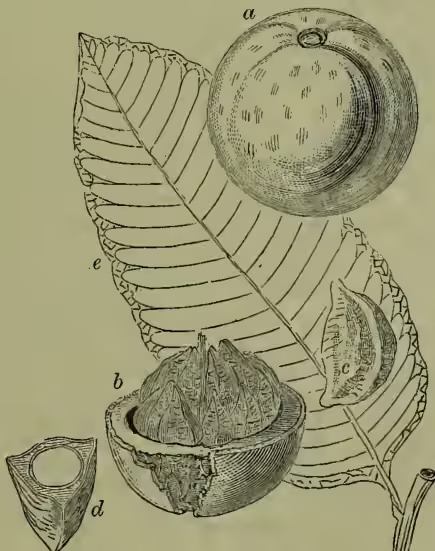
The tree grows to the height of 100 or 120 feet, and abounds on the banks of the Orinoco, and in the northern parts of Brazil. It produces a round woody seed-vessel, almost as large as a man's head, within each of the four divisions of which lie six or eight of the seeds. The pericarp is very heavy and solid; and at the time when this great fruit is ready to fall, it is dangerous to walk under the tree. The seeds, which are popularly called nuts, and much resemble fruits of that description, are wrinkled and triangular, having a hard shell and a pure white kernel, which, when fresh, is very agreeable. They are chiefly exported from Pará and French Guiana, and are well known in our shops. They yield as much as 56 per cent. of oil, which is good for burning. The also much esteemed nuts or seeds of the Lecythis ollaria, the Sapucaya or Monkey-pot tree, are produced in a pericarp which resembles a rusty iron pot with a lid, and which is indeed employed as a vessel for many purposes by the Brazilian Indians. L. bracteata (Couroupita guanensis) is the cannon-ball tree; the fruit contains a sweet, fragrant, and refreshing pulp.