Myrtaceæ, a natural order of exogenous plants, consisting of trees and shrubs, natives chiefly of warm, but partly also of temperate, countries. The order, as defined by the greater number of botanists, includes several sub-orders, which are regarded by some as distinct orders, particularly Chamælauciaceæ (in which are contained about fifty known species, mostly beautiful little bushes, often with fragrant leaves, natives of Australia and Tasmania), Barringtoniaceæ, and Lecythidaceæ. Even as restricted, by the separation of these, the order contains about 1300 known species. The leaves are entire, usually with pellucid dots, and a vein running parallel to and near their margin.—Some of the species are gigantic trees, as the Eucalypti or Gum Trees of Australia, and different species of Metrosideros, of which one is found as far south as the Auckland Islands, in 50½° lat. The timber is generally compact.—Astringency seems to be rather a prevalent property in the order, and the leaves or other parts of some species are used in medicine as astringents and tonics. A fragrant or pungent volatile oil is often present in considerable quantity, of which
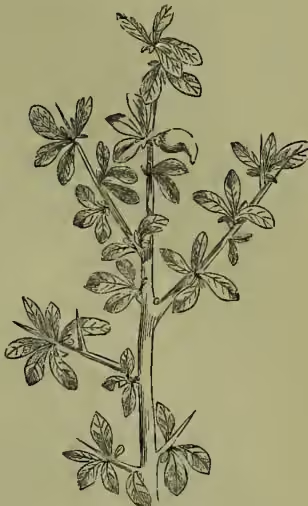
(Balsamodendron myrrha).
Oil of Cajeput and Oil of Cloves are examples. Cloves and Pimento are amongst the best-known products of the order. The berries of several species are occasionally used as spices in the same way as the true Pimento. A considerable number yield pleasant edible fruits, among which are the Pomegranate, the Guava, species of the genus Eugenia, and some species of myrtle.