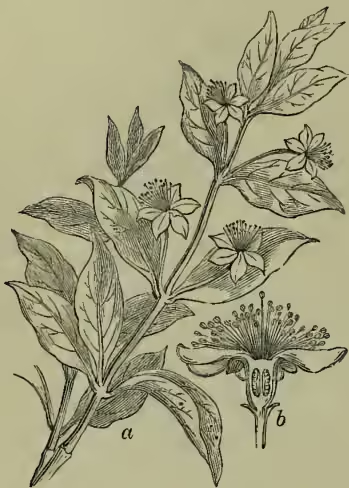
a, branch in flower; b, vertical section of flower.
Myrtle (Myrtus), a genus of Myrtaceæ, the characteristics of which are well illustrated in the accompanying figure. The Common Myrtle (M. communis) is well known as a beautiful evergreen shrub, or a tree of moderate size, with white flowers. It is a native of all the countries around the Mediterranean Sea, and of the temperate parts of Asia, often forming thickets, which sometimes occur even within the reach of the sea-spray. The leaves are ovate or lanceolate, varying much in breadth. They are astringent and aromatic, contain a volatile oil, and were used in medicine by the ancients as a stimulant. The berries are also aromatic, and are used in medicine in Greece and India. A myrtle wine is also made. Myrtle-bark is used for tanning in many parts of the south of Europe. Among the ancient Greeks the myrtle was sacred to Venus, as the symbol of youth and beauty, was much used in festivals, and was, as it still is, often mentioned in poetry. The myrtle en- dures the winters of Britain only in the mildest situations in the south. The Small-leaved Myrtle of Peru (M. microphylla) has red berries of the size of a pea, of a pleasant flavour and sugary sweetness. Those of the Luma (M. luma) are also palatable, and are eaten in Chili, as are those of the Downy Myrtle (M. tomentosa) on the Neilgherry (Nilgiri) Hills, and those of the White-berried Myrtle (M. leucocarpa) in Greece and Syria. The berries of this species or variety are larger than those of the common myrtle. A very humble species of myrtle (M. nummularia) spreads over the ground in the Falkland Islands, as thyme does in Britain. M. Ugni, a native of Chili, was about 1865 highly extolled as a fruit-bearing shrub adapted to the warmest districts of Britain; but it proved unfit for open-air culture, though it fruits freely in an unheated greenhouse. The fruit emits an aromatic fragrance which permeates the atmosphere around the plant continually, and the juicy pulp of the berries possesses a rare mixture of sweetness and spiciness which is very agreeable.