Breakwater is a barrier intended for the protection of shipping in harbours or anchorages. It sometimes happens that, in front of a semi-circular bay, a small island is so situated as to form a natural breakwater. This is to some extent the case with the Isle of Wight, which occupies such a position as to protect Portsmouth and Southampton from the south. In many other places, however, bays and harbours are without such screens. A pier may be so placed and constructed as to serve also the purpose of a breakwater, but the term breakwater is generally confined to a structure used solely for protection, and not for berthing or traffic, and breakwaters are frequently insulated, so as to be cut off from any communication with the shore unless by water.
Plymouth Breakwater is the best known of these engineering works. The sound or harbour, being open to the south, was so much exposed to storms that, early in the present century, it was determined to construct a breakwater across its mouth, with openings between it and the shore, on either side, for the ingress and egress of ship- ping. The works were commenced in 1812, from designs by Rennie, and were estimated to cost £900,000. The operations consisted in transporting along a tram-road large blocks of limestone got from a neighbouring quarry, shipping them in vessels fitted with trap-doors, and by means of these depositing them in the shape of a huge mound in the required situation. The design was to carry the rubble mound to a height of 10 feet above low-water, to give the seaward face a slope of 3 to 1, and the inner face to 1, and the width on top 30 feet. As soon as the stones began to appear above water, a perceptible benefit resulted in the relative calmness of the sound during the prevalence of storms; but the structure was frequently very roughly handled by the waves, which altered and flattened its shape. A severe storm in November 1824 overthrew a length of 796 yards of the finished work; after this the breakwater was raised 10 feet higher, the seaward slope made 5 to 1, and the top width 45 feet, the top and slopes paved with masonry, and the top protected with expensively dressed granite blocks, juggled together and bedded with cement. It was not until 1841 that the works were finally completed, by the deposit of more than 3,000,000 tons of stone, and the expenditure of nearly £1,500,000. The breakwater is nearly a mile long, the central portion is 1000 yards; and two wings, of 350 yards each, extend from the ends of this at a slight angle. The open channels at each end, between the breakwater and the shore, are each about half a mile wide, and their depth is respectively 40 and 22 feet at low-water. The breakwater is 400 feet wide at the base, and 45 at the top—the two sides being made very sloping for the security of the stones. The slopes and top are faced with masonry. The water-space protected by this breakwater comprises 1120 acres, and it is generally admitted that the money has been well spent on the work. The breakwater requires constant repair; the sum voted in some years exceeds £2500.
Holyhead Breakwater was designed by Mr Rendel for the purpose of converting Holyhead Bay into a harbour of refuge. It is formed of stone quarried from Holyhead Mountain, the stone being run out upon a timber staging and dropped into the sea. This mode of construction was first adopted at this work, and it permits the stone being deposited in rough weather, when it would not have been safe to use barges. The rubble reached up to the level of high-water, and has assumed a seaward slope of 1 in 12; the inner slope is to 1. A vertical wall, 20 feet thick, is founded in the rubble at low-water level and carried up to 40 feet above that level; the width of roadway inside is 40 feet. The breakwater shelters an outer roadstead of 400 acres, with a depth of from about 20 to 50 feet, and an inner harbour of 267 acres, with a depth of 3 to 7 fathoms. It was originally contemplated to inclose the area by two breakwaters—a north one 5360 feet long, and an east one 2000 feet in length. The east breakwater was, however, abandoned, and the north breakwater lengthened to 7860 feet. The original estimate was £1,400,000. The stone for the breakwater was obtained by enormous blasts: one of the mines exploded on 21st May 1857 contained 21,000 lb. of gunpowder, which displaced 130,000 tons of stone. On Mr Rendel's death the completion of the work was intrusted to Sir John Hawkshaw, who completed the head, which was founded by divers at a depth of 20 feet under low-water, and carries a lighthouse rising to the height of 70 feet above high-water. The cost of the breakwater has been £163, 10s. per lineal foot. The work was begun in 1847 and finished in 1873.
Portland Breakwater is of very great value, in converting into a harbour of refuge the expanse of water between the Dorsetshire coast and the Isle, or rather peninsula, of Portland.
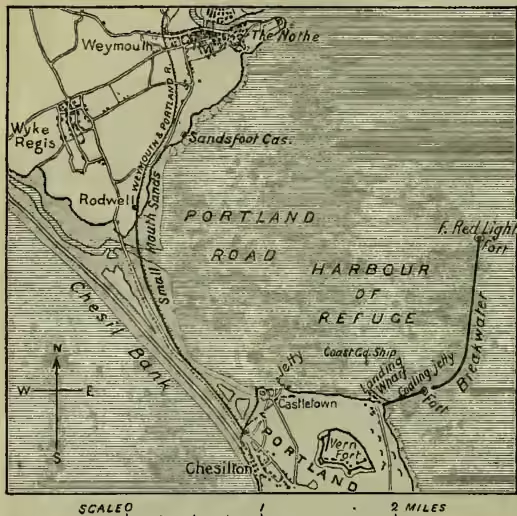
An act of parliament was obtained in 1847, authorising the works, which were begun in 1849. The breakwater, starting from the north-east point to the isle, stretches nearly due north for more than 2 miles, with one or two intervening openings for the ingress and egress of shipping. The works are of the same engineering character as Holyhead, but were conducted more easily than those of any other great breakwater; for the isle contains an abundance of stone easily quarried, and the steep shores afforded facility for transporting the stones by their own gravity to their destination. The work, finished in 1872, is for the most part a rough rubble stone bank, surmounted by vertical walls from the low-water level; the depth is about 50 feet at low-water. From the nature of the operation, any part of the breakwater became useful as soon as constructed, increasing the safety of Portland Bay as a harbour of refuge.
A battery constructed of iron and mounted with heavy ordnance has been erected on the extreme end of the outer breakwater, and another has been placed on the end of the inner breakwater, while formidable batteries have been erected on shore.
Dover Breakwater has been chiefly useful as the French mail-packet station. There is no stone near to form a mound, as in the other breakwaters spoken of, and, in consequence, the work has been brought up in solid ashlar from the bottom by the diving-bell, with the interior formed of blocks of concrete. In 1891 a bill was passed for extending the commercial harbour, and the memorial stone was laid by the Prince of Wales in 1893. The work includes an extension of the Admiralty Pier 580 feet in length, with another new east pier, and enclosing an area of 75 acres. It is expected to be completed in 1901. Meanwhile, works for a further extension in the form of a National Harbour of Refuge were commenced in the beginning of 1898. These consist of a further extension of the Admiralty Pier of 2000 feet, an east arm extending 3320 feet, and a breakwater 4200 feet long, at a distance of three-quarters of a mile from the shore, to form the sheltering arm of the harbour on the south. The area enclosed, including the commercial harbour, will be 685 acres; the cost is estimated at £3,500,000, and the whole is to be completed in 1908.
Alderney Breakwater was designed for the government by the late James Walker in 1847. The situation is fully exposed, and the depth of water at its extremity is 130 feet. This breakwater consists of a rubble mound, with walls above founded 12 feet under low-water. The work was completed in 1864, but has been at various times seriously damaged. Up to now the cost of repairs was nearly £150,000; the total cost of the structure has been £1,327,050. The length of breakwater is 4500 feet; but the outer portion has been abandoned on account of the difficulty of maintaining it.
Small breakwaters have been constructed at Cette near Marseilles, at the mouth of the Delaware in the United States, and at Buffalo in Lake Erie; but they do not call for description.
Cherbourg Breakwater is the greatest and the most costly ever constructed. More than 100 years ago, M. de Cessart proposed to the French government the formation of a breakwater at Cherbourg, to be commenced by the construction of a number of hollow cones formed of timber-framing, sunk in a line as close as they could be placed to each other, and then filled with stones. These cones, of which there were to be 64, each about 70 feet high, 150 feet in diameter at the base, and 60 feet at the top, were intended to form a nucleus to the stone breakwater, to prevent the stones, during its formation, being knocked about and too much spread out by the action of the waves. In 1784-88, 16 cones were constructed, and 13 of them sunk; but so great was the destruction which they underwent during stormy weather, that the government at length abandoned the plan, and carried on the stone breakwater without the aid of the cones. It was completed under Napoleon III. at a cost
BREAKWATERS.—SECTIONS.

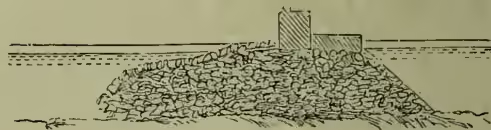
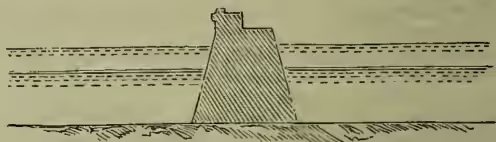

exceeding £2,500,000. The breakwater itself was finished in 1853, but since that year large fortifications have been built upon the upper works. The length is nearly miles; the breakwater is 300 feet wide at the bottom, and 31. at the top. The chief mass consists of rubble or unshaped stones, thrown down from ships; but there is a larger ratio of wrought and finished masonry than in the Plymouth Breakwater, consisting of granite blocks imbedded in cement. The depth of water is about 60 feet at low-water spring-tides; and the breakwater rises to 12 feet above high-water level. The water-space included within and protected by the breakwater is about 2000 acres, but two-thirds of this has scarcely depth enough for the largest sized ships. The relation which this breakwater bears to the vast military and naval arrangements of the place will be noticed under CHERBOURG.
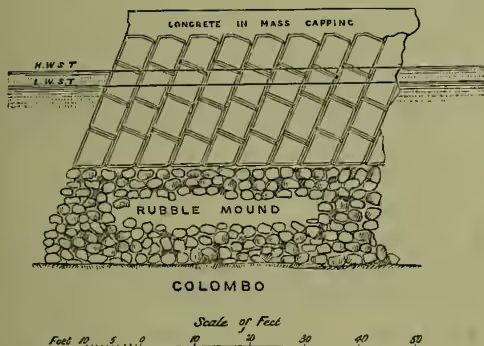
Concrete Breakwaters.—The introduction of concrete made from Portland cement has in recent years greatly modified and simplified the construction of breakwaters. The cement is mixed with sand, gravel, and broken stone in various proportions according to exposure; 1 of cement to 7 of other materials being a common proportion for breakwaters. Sometimes the concrete is made into large blocks on shore and deposited under low-water. On the other hand, it may be lowered down, inclosed in large bags; or it may be lowered down in boxes, with hinged bottoms, and deposited in mass on the bottom, either within timber casing, or even without any protection at all. The south breakwater of Aberdeen is formed of large blocks from the bottom up to 4 feet above low-water, and above that level of concrete in mass formed within temporary casing. The Colombo Breakwater is composed of a mound of rubble brought up to 24 feet under low-water, and above that level of concrete blocks weighing 35 tons each set on edge. Sometimes breakwaters are made by first depositing large concrete blocks of 20 to 50 tons in weight, in pierres perdues style from the bottom up to a little above low-water, and then forming a monolithic mass of concrete above, such as the breakwater at St Jean de Luz. The breakwater in Peterhead Bay (part of the great harbour of refuge, begun in 1886), is in the Colombo style, and is being made by aid of convict labour. The breakwater at Fraserburgh, begun in 1878 and finished in 1882, is constructed of Portland cement concrete; the lower portion is formed of fifty-ton bags dropped from a barge on the system adopted first by Mr Cay at Aberdeen. The result at Aberdeen has not been favourable to the bag-work system for exposed situations, serious damage having been sustained by the works. Mr Abernethy reported to the trustees that a sum of £11,000 would be required to repair the work and make the structure safe. The bag-work has had to be protected at some parts by large concrete blocks deposited in front of them.
Many substitutes have been proposed for solid breakwaters, such as floating breakwaters constructed of timber framework, open iron screens, &c., but none of them have been shown to be suitable for actual practice. Close timber-work, filled in with stones, is found to be quite efficacious; but on most of our coasts the timber is liable to be eaten by the marine worm, which is an almost insuperable objection to its being used under water. See HARBOUR.