Bream, a popular name applied to three very different kinds of fish, but especially to the first mentioned. (1) The Fresh-water Bream (Abramis brama), a common little fish nearly allied to the Bleak (q.v.). It has an elongated, laterally compressed body, a short blunt snout, and long anal fins. The colour varies from silver gray to brown. It may measure over a foot, and usually weighs between two and four pounds, though often more. The bream is frequent in North Europe, including England and Ireland, and lives in great shoals, in quiet waters. They are shy in habit, hardy in constitution, and very prolific. Fresh-water plants, such as Isoetes, form the favourite diet. At the breeding-time the males become adorned with numerous whitish knobs, which become amber-coloured; as many as four are said to follow the spawning female. The flesh is esteemed, especially on the Continent. The White Bream (A. blicca) is another common species, also British, but its flesh is not eaten, or at any rate not liked.
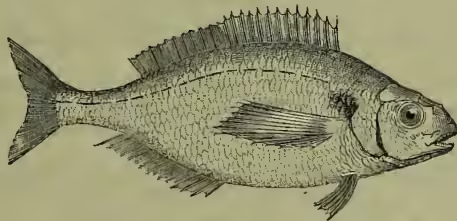
(2) Quite distinct from these is the large family of Sea-breames or Sparidae, in the Acanthopterygii division of bony fishes. They have compressed oblong bodies, one dorsal fin, with approximately equal soft and spinous portions, with the lower rays of the pectorals usually branched, with thoracic ventrals. They are especially characterised, however, by the nature of their dentition. Anterior cutting teeth, or lateral molars, or both, sometimes plus anterior conical canines, are present, and the palate is usually toothless. The family is a large one, with 30 genera and about 160 species, occurring abundantly along the coasts of tropical and temperate seas. They feed on flesh or algæ, and are for the most part fit for eating. The solitary Black Sea-bream or Old Wife (Cantharus lineatus), the Common Sea-bream (Pagellus centrodontus), caught in great numbers with the seine net, the Mediterranean Gilthead (Chrysophrys aurata), and many others, occur in varying abundance on Southern British coasts. Box, Sargus, and Pagrus are allied genera. (3) The term Bream is also applied to Brama raii (q.v.), a widely distributed fish of the mackerel family.