Brushes. Few things are in more universal use than brushes. One kind or another is to be found wherever people dwell or are at work. The materials used for the manufacture of brushes are, taking first those of animal origin, hog's bristles, horse-hair, strips of whalebone, and to a smaller extent goat's hair, badger's hair, fitch (polecat), sable and camel's hair. Those of vegetable origin are principally aloe fibre, called also Mexican fibre (Agave americana); kittool fibre (Caryota urens); bass or piassaba fibre (Attalea funifera); and cocanut fibre (Cocos mucifera). But many other vegetable fibres, as well as esparto grass and the like, are used locally for brushes or brooms in different parts of the world. Brushes of steel and brass wire are used for certain purposes.
For the stocks of the commoner kinds of brushes and brooms, native woods, such as sycamore (often called plane-tree), beech, elm, birch, chestnut, and oak, are employed, and ash for the handles of small brooms. Veneers or plates of rosewood and satinwood, of ivory, tortoise-shell, mother-of-pearl, xylonite, and silver adorn the backs and handles of toilet-brushes.
Bristles, though less so than they were, are still the chief material used in the manufacture of brushes. The chief sources from which they are obtained are noted under BRISTLES. They are so far sorted into qualities when received by the manufacturers, who separate the larger and more valuable sizes by means of steel combs with one row of vertical teeth. The largest size stick in the teeth of the first comb, the next size in the second comb, and so on. Every bundle of the better qualities yields a small proportion of long and strong bristles which have a high value, and are not made into brushes but sold to shoemakers. The bristles are also sorted by hand and a size-stick or gauge into various lengths, and by the eye into various colours, as black, gray, white, and other shades. Either before or after they are sorted, bristles require to be washed, and the 'whites' are bleached with sulphurous acid or other agent (see BLEACHING). French white bristles are generally beautifully bleached.
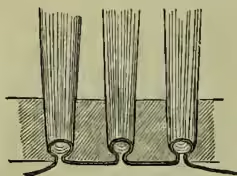
A hair-brush may be taken as an example of how the class known as 'drawn' brushes are made. With the assistance of a perforated lead or wood gauge the stock is drilled with holes for the tufts. These are formed by doubling the bristles, and are then drawn into their place by thin brass wire, which loops in tuft after tuft, and is continuous all through the filling of a single brush (see fig. 1, in which the bold line shows the wire). A back which conceals this wire-looping is then glued on and otherwise fixed. It may be stated that a hair-brush has the points of the bristles of unequal length, in order to penetrate the hair. Hat-brushes and baby's hair-brushes are made of horse-hair. The work of filling drawn brushes with bristles is very generally done by women working in their own homes.
Brooms, bannister, and other 'set' brushes, many of which have long tufts, are made in a different way. The stocks are turned, cut to shape, and drilled with holes of the proper size, but in this style of work they are only sunk to a certain depth. The root ends of the tufts, which are also the root ends of the bristles, if they are not doubled, are first dipped into melted brushmakers' pitch, next tied with a string at the root, and again dipped into the pitch; this fixes the tuft when pushed with a certain twist of the hand into one of the holes of the stock. In some cases the stock is twisted with one hand, and the tuft held steady by the other. In this manner the broom or brush is filled with bristles.
A painter's round brush or sash tool is one of the simplest kinds of brushes, and is made in one way by fixing a bundle or tuft of bristles, previously dipped into a cement formed of rosin and linseed oil, to the end of a two-pronged wooden handle by a piece of twine, which is then coated with glue. There are other methods of binding the bristles of large round brushes, such as by an iron or copper ring, or by wire.
Whitewash and other flat brushes of similar shape consist, in some cases, of two, three, or more cylindrical brushes, placed side by side, and fastened separately on a projecting edge of a flat stock or handle. Each of these single brushes forming the compound brush is bound with twine or copper wire, the latter being now preferred. There are other kinds of the same shape differently made; one variety, for example, is merely a single brush of oblong form with the bristles held together by a strip of leather and nails; another sort is formed by tufts fixed with pitch in the manner of a hearth-broom. In those cases where the root ends of the bristles are exposed, they are singed with a hot bar of iron. It is curious how sometimes one, sometimes another kind of these brushes is preferred for the same purpose in different districts of the country. The brushes used by artists are, for large sizes, made of hog's hair bound with tin, and for small sizes of sable and camel hair. The latter are either bound with quill or tin. A sable-hair pencil is the most costly brush for its size that is made. Softening brushes of badger's hair are used both by artists and grainers of wood.
Machine-made Brushes.—There are several kinds of mechanism in use for making brushes. The Woodbury machine, which has been extensively used in America, is perhaps the best known. Its chief parts are a comb with an arrangement for filling its divisions with bristles; a shaft to work devices by which the bristles are fed in tufts to plungers that double them, bind them with wire, and introduce them into the back of the brush; an arrangement by which the wire is fed to and through the bristles after doubling; and mechanism for centring the brush-back under the two plungers concerned in preparing and inserting the tuft. The machine is too elaborate for illustration here. Fig. 2 shows how the tufts are bound with wire, which takes the form of a spiral, and by a movement of the plunger is made to screw its way into the hole in the brush-back.
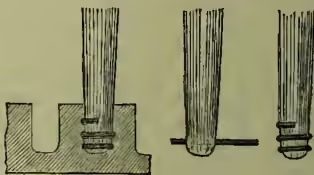
In England, machinery is chiefly applied to the manufacture of the cheaper kinds of brushes from vegetable fibres, although it is not confined to these. The fibres have to undergo a process of preparation. The tufts in these machine-made brushes are secured in different ways, such as by a cross wire, shown in fig. 3, or by a hard steel wire loop bent into a triangular shape, and placed as in fig. 4, with the shoulders pressed firmly on the sides of the drilled hole, and the points fixed to the bottom.
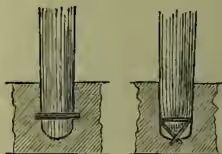
Fig. 4.