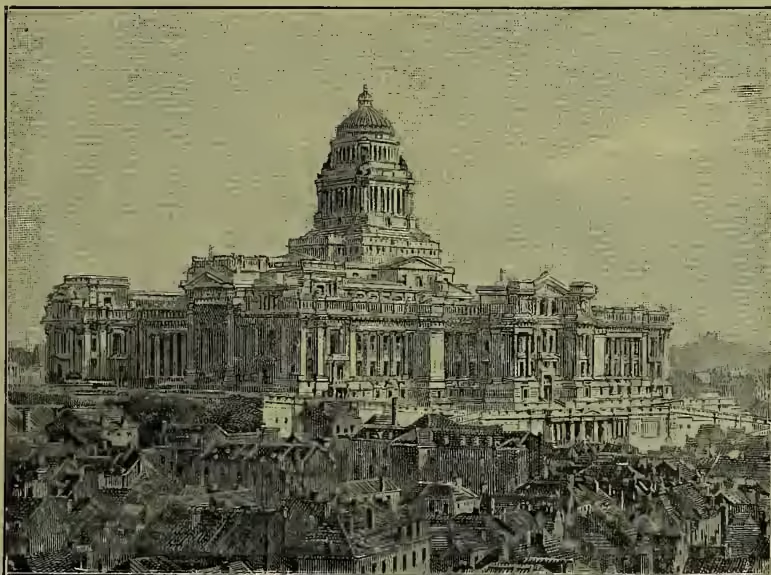
Brussels (Fr. Bruxelles), the capital of Belgium, is situated in a fertile plain on the ditch-like Senne, 27 miles S. of Antwerp, and 193 NE. of Paris. It communicates by canal with the Scheldt, and so with Antwerp, and railways connect it with Germany, France, and Holland, as well as with all the principal towns of Belgium. The city has a circumference of about 5 miles, and is built partly on the side of a hill; though some of the streets are so steep that they can be ascended only by means of stairs, Brussels may on the whole be pronounced one of the finest cities in Europe. The Upper Town is the newest and most fashionable quarter, and is the residence chiefly of the great and wealthy. The king's palace, public offices, chief hotels, and mansions of foreign ministers are here. It is also much more healthy than the Lower Town, which is greatly subject to fogs, owing to its intersection by the canals and the Senne, although the stream now passes under an arched covering, which supports a new boulevard. But the closely built old streets, with their numerous handsome buildings, formerly belonging to the Brabant nobility, but now occupied by merchants and traders, have a fine picturesque appearance, while some of the public edifices are unrivalled as specimens of Gothic architecture. This part has also several noble churches, but it is now wholly given over to trade. French is spoken in the upper division; but in the lower Flemish is prevalent, and in one quarter the Walloon dialect is spoken. The English language, owing to the large number of English who reside here for economy, is also very common. The walls which formerly surrounded Brussels have been removed, and their place is now occupied by pleasant boulevards extending all around the old town, and shaded by alleys of limes. The Allée Verte—a double avenue along the Scheldt Canal—forms a splendid promenade, and leads toward the country palace of Laeken, 3 miles north of the city. Besides the fine park in the Upper Town, covering an area of some 32 acres, ornamented with fountains and statues, and surrounded by the palace and other state buildings, Brussels has several other squares or places, among which the most noteworthy are: the Place Royale, with its colossal monument of Godfrey of Bouillon; the Grand Place, in which is situated the hôtel-de-ville, a splendid Gothic structure, erected in the beginning of the 15th century, with a spire of open stonework 364 feet high, and where, in 1568, the patriot counts, Egmont and Horn, were beheaded by order of the Duke of Alba; and the Place des Martyrs, where a memorial has been erected to those who fell here in the revolution of 1830. Among the churches the largest and finest is the cathedral of St Gudule, which dates from the 13th century, and is built in the pointed Gothic style, with many richly painted windows, and a pulpit considered to be the masterpiece of Verbruggen. In the Palais des Beaux Arts is the picture-gallery, containing the finest specimens of the Flemish school of painting; a valuable museum; and the public library, with 234,000 volumes and 22,000 MSS., many of the latter being beautifully illuminated. The observatory is well equipped. The new Palais de Justice, built in 1866-83 from designs by Poelaert at a cost of more than £2,000,000, is one of the most magnificent buildings in Europe. The royal palace and the national palace (for the chambers) are important buildings. There are several celebrated scientific societies, and educational institutions are both numerous and important. The university, founded in 1834, has over 1200 students. There are schools of painting and sculpture, and a conservatorium. The city contains also numerous charitable and benevolent institutions, and is the seat of the provincial government of South Brabant, as well as of the general government of the kingdom. Brussels is one of the chief centres of the industry of the country. Its lace is particularly famous. Of the esteemed carpets which pass under the name of Brussels carpets, only a few are manufactured here, most of those of Belgian make being produced at Tournai. It has also manufactures of damask, linen, ribbons, embroidery, paper, jewelry, hats, soap, porcelain, mathematical and musical instruments, &c. Carriage-building is an important branch of industry; and printing and lithographic establishments are numerous. A great World Exhibition was held here in 1888. Pop. (1846) 123,874; (1866) 157,905; (1885) 171,751; (1891) with suburbs, 482,268.
As early as the 8th century, we find Bruchsellæ, then probably a villa of the Frank kings, mentioned in old chronicles; and that a church existed here in 966 is proved by a deed of the Emperor Otho I. Under Charles V. Brussels was made the court-residence in the Netherlands, and became afterwards, under Philip II., the chief arena of the revolution, and of the atrocities committed by the Duke of Alba and the Inquisition. The city suffered greatly in the war of Spain against Louis XIV.—in whose reign it was bombarded by Marshal Villeroi, and upwards of 4000 buildings destroyed —and in that of Austria against Louis XV.; but still more from the continual prevalence of party animosities caused by the policy of Austria. Under the mild rule of Maria Theresa, it flourished greatly, and in this time many of its best institutions and public buildings were founded. In 1789 occurred the Brabant revolution under Joseph II.; and scarcely had Austrian rule been re-established, after a brief time of independence, when Brussels fell into the hands of the French (1792). After other changes of fortune, Brussels, with the other parts of Belgium, was incorporated with the kingdom of the Netherlands in 1815, and so remained until the revolution of 1830, by which it became the capital of the independent kingdom of Belgium.