Bull-fight. Combats of men with bulls for the entertainment of the public were common in Greece, particularly in Thessaly, and in Rome under the emperors, though in later times they were forbidden both by emperors and popes. They are still a favourite spectacle in Spain and Mexico, where, indeed, the corrida de toros is the national pastime. In Spain they were abolished by Charles IV.; but Joseph, Napoleon's brother, re-established them out of policy, the mass of the Spanish population being passionately fond of the sport. The most magnificent bull-fights were at one time instituted by the monarchs themselves; at present, both in the capital and in the larger towns of Spain, they are held either as private speculations or for the benefit of public institutions. So also in the city of Mexico, where in the season of 1887 nearly £70,000 was spent in fitting up the six rings in which bull-fights are held. In Madrid the bull-fighting season commences in April and lasts until November. During that time there is at least one Sunday or Saint's-day afternoon in every week devoted to the sport. The proceeds go to the funds of the public hospital. The
MODERN RIFLE-BULLETS.
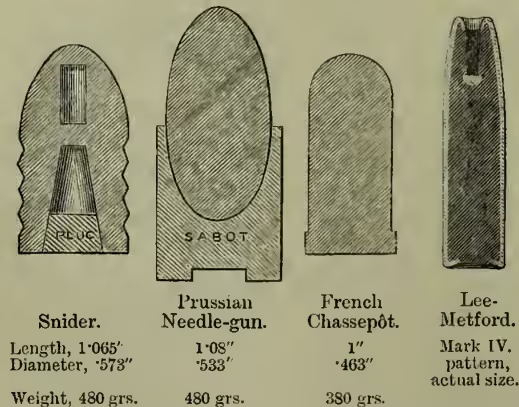
into the lead by the force of the explosion, caused it to expand and take the grooves in the barrel. fights take place in a kind of circus, called the Plaza de Toros, round which the seats rise one above another, like the steps of a stair, with a tier of boxes over them. The Plaza is capable of containing from 10,000 to 15,000 people, who pay a high price of admission, considering the rate of wages in Spain; and all go attired in their best to the spectacle. The Castilian bulls, usually chosen for fight in Madrid, are fiercer and more active, but inferior in strength to British animals. The horses engaged in the conflicts are worthless brutes, fit only for the knacker. The men employed in the fight are generally those who have been bred to it as a profession; but occasionally amateurs may take part in it.
The bull-fight has been described as a tragedy in three acts. The principal performers in the first are the picadores; in the second, the chulos are the only actors; the third and last act devolves solely on the espada. The picadores are all mounted, dressed like Spanish knights of the olden time, and armed with a lance; they take up their position in the middle of the circus, opposite the bull-stalls. The chulos, who are on foot, are gay with ribbons, and wear very bright-coloured cloaks; they distribute themselves in the space between the barriers. The espada or sword-man is also on foot. He is handsomely dressed, and holds in the right hand a naked sword, in the left the muleta, a small stick, with a piece of scarlet-coloured silk attached. On a sign given by the president of the sport, a bull is let out from the stalls; the picadores stand ready in the arena waiting his charge. With a brave bull, they find all their skill requisite in acting on the defensive; with a cowardly one, they act on the offensive; and should their stabs be ineffectual in rousing the animal to the requisite fury, the poor beast is hooted by the crowd, and ultimately stabbed ingloriously in the spine. Whenever a horse is wounded, the rider betakes himself to flight; and when either the above casualty happens, or a picador is thrown, the chulos rush in, and attract the bull by their cloaks, saving themselves, if need be, by leaping over the barrier which incloses the circus. At the same time, another picador calls off the bull's attention to himself by shouting. When the bull begins to flag, the picadores are succeeded by the chulos, who bring with them the banderillas—i.e. barbed darts about two feet long, ornamented with coloured paper-flags, which they stick into the neck of the animal. Sometimes these darts have crackers attached to them, the explosion of which makes the bull furious. The espada now enters alone to complete the tragic business. As soon as the bull's eye catches the muleta, he generally rushes blindly at it; and then the espada, if well skilled, dexterously plunges the sword between the shoulder-blade and spine, up to the very hilt, and the animal drops dead at his feet. A splendid team of mules then enter, glittering with flags and tinkling with bells, who drag off the slain at a gallop. The victorious matador is greeted with acclamations, and not less so the bull, should he wound or even kill his antagonist, in which case another matador steps forth into the arena; but human life is rarely sacrificed. From six to ten bulls are usually despatched in a single day, twenty minutes being about the time usually taken to slay one. It has been computed that about 2500 bulls and 3500 horses are annually killed in Spanish bull-fights.
Every large town in Spain possesses a Plaza de Toros, and so do many towns in Spanish America; those of Madrid, Seville, and Caceres are especially handsome. Bull-fighters personally are esteemed much as prize-fighters are in England; but they are the idols of the lower classes, from whose ranks they are drawn. Formerly, those who were killed on the spot, and died without confession, were denied burial rites; but a clergyman is now in attendance with the consecrated host, in case of accident.