Bullfinch (Pyrrhula rubricilla or vulgaris), a bird of the great finch family Fringillidæ (q.v.), a little larger than the common linnet, and of a genus closely allied to the grosbeaks and crossbills. The genus is particularly characterised by the short, thick, rounded bill, of which the sides are inflated and bulging, and the tip of the upper jaw overhangs that of the lower one. The plumage is very soft and dense. The crown of the head, the long wing-feathers, and the tail are shining black. The back of the male is ashy gray, that of the female brownish gray. The under surface of the male is a bright tile-red, that of the female bluish gray. There is a conspicuous white bar across the wing. The tail of the bullfinch is almost even.
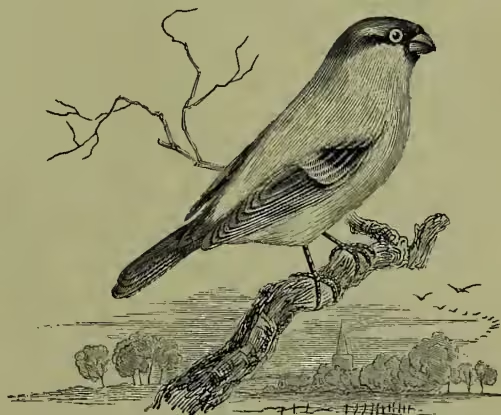
This bird is not unfrequent in England, Ireland, and the south of Scotland; and is found in most parts of Europe, from the south of Norway to the Mediterranean, extending eastward throughout Asia, even to Japan. It frequents woods and gardens, and builds its nest in trees or bushes a few feet from the ground. The nest is loose, made of dry twigs and fibrous roots. The eggs are four in number, bluish or purplish white, spotted and streaked with purplish gray and reddish brown. It feeds chiefly on seeds and berries in winter, and in spring is excessively destructive to the buds of fruit-trees in those localities in which it is abundant, selecting the flower-buds, and apparently finding them the most palatable of all food. Selby says: 'I have known a pair of these birds to strip a considerable sized plum-tree of every bud in the space of two days.' On this account gardeners are sometimes compelled to wage war against the bullfinch. He is also deliberately adjudged to be the farmer's enemy by impartial judges (see Wood's Farmer's Friends and Foes, 1888).
The song of this bird, in a wild state, is very simple, but it is remarkably susceptible of improvement by education. Some trained bullfinches can whistle an air very accurately, and with a power and variety of intonation far exceeding their natural song. The ability to whistle several airs well is rare. The training of these birds is a work both of time and trouble: it is chiefly carried on in Germany. Not less than nine months of training are requisite: it begins when the bird is a mere nestling, and must be carefully continued till after the first moulting; for it is a curious circumstance, that all which has been previously acquired is very apt to be lost at that time, or is afterwards so imperfectly remembered that the bird is of little value. The bullfinch is capable of very strong attachment to those who feed and caress it, and often becomes so thoroughly domesticated as to exhibit no desire for liberty (see CAGE-BIRDS).—Curious variations of plumage are sometimes observed in it.—Other species of the genus Pyrrhula are known, natives of different parts of the world; and in this genus some ornithologists include Corythus of Cuvier, of which one species, the Pine-finch or Pine Grosbeak, is a native of Britain. The canary (Serinus canarinus) is closely allied.