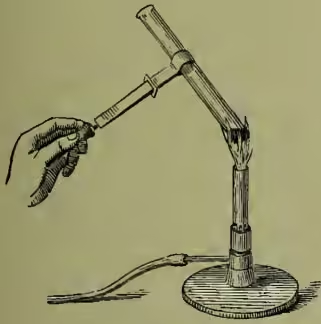
Bunsen Burner. Probably no invention has done so much to facilitate work in the chemical laboratory as that of the Bunsen burner, so named after the distinguished chemist. Prior to its introduction, the heating by gas or oil had been unsatisfactory, owing to the imperfect combustion of the carbon causing the deposit of soot on any body in contact with the flame. Applying the principle of the Blowpipe (q.v.), a plentiful supply of air was caused to mingle with the gas before ignition, so that a smokeless flame of low luminosity but great heating power was the result. The Bunsen burner has undergone many changes, by which it has been adapted to the various requirements of domestic life, but through all, the essential principle remains the same. The simplest form consists of an ordinary gas-jet, over which is placed a piece of metal tube, 4 to 6 inches long, and perforated with holes at the bottom. The gas having been turned on, air rushes in at the holes, so that when a light is applied to the upper end of the tube, a greenish-blue flame is obtained. If the air is in excess, the flame inclines to green; if deficient, a yellow flame results. The great objection to this, the original form, lies in its tendency to burn back, if the gas pressure be but small. When this occurs, and the flame burns at the jet, before it mixes with the extra volume of air, a long smoky flame issues from the tube, while the disagreeable odour of acetylene, , a product of the imperfect combustion of coal-gas, at once becomes apparent. To remedy this drawback, wire-gauze, through which flame cannot pass, is sometimes placed over the aperture, forming a 'solid flame' burner, or the mixture of gas and air is allowed to issue through small holes or narrow slits. The purposes for which the Bunsen burner is used are very varied. For cooking, fire-lighting, heating, ironing, soldering, &c., its utility is well known, while for the production of asbestos gas-fires many ingenious forms have been devised.