Buoy, in nautical affairs, is a floating mark placed in the navigable track of vessels to indicate the existence of a sunken danger. They are made of various shapes and colours so as to indicate on which hand vessels must keep them in passing. A conference of the nautical authorities of Great Britain and Ireland resolved in 1883 to adopt a systematised scheme of buoyage. For full particulars the reader is referred to this report; but the chief conditions are as follows: Buoys showing the pointed top of a cone above water shall be called conical, and shall always be starboard-hand buoys. Buoys showing a flat top above water shall be called can, and shall always be port-hand buoys. Buoys showing a domed top above water shall be called spherical, and shall mark the ends of middle grounds. In Scotland, however, port and starboard hand buoys must be painted of a different colour. Port-hand buoys are black, and starboard-hand buoys are red. Spherical buoys are distinguished by white stripes. The starboard buoys are on the right hand when the vessel is ascending a river. On the coast the starboard-hand buoy is on the right hand when the vessel is going with the main stream of flood-tide. Wreck buoys are painted green, and marked Wreck. Buoy dues are levied on ships coming to ports within the jurisdiction of the several authorities which maintain the buoys.
Lighted Buoys.—River buoys are now in many cases lighted by compressed oil-gas on Pintsch's principle; the buoy is charged to a pressure of about 7 atmospheres, or 105 lb. per square inch. The buoys are surmounted by a small dioptic apparatus in which the light burns constantly. The buoys are charged once a month. The Clyde Lighthouse Trustees were the first (in 1880) to introduce these buoys in Scotland, having erected a work at Port-Glasgow for the manufacture and compression of the gas. This trust also lights the buoys of the Clyde Navigation Trust. Twelve lighted buoys have been moored in the Clyde.
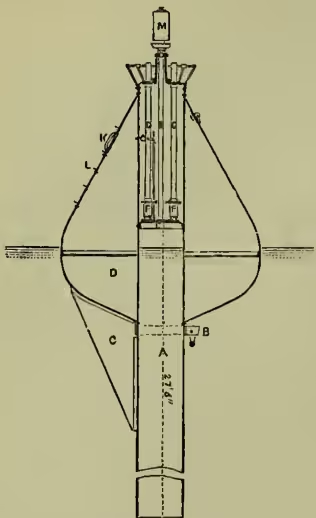
Eight lighted buoys have been moored by the Trinity House in the Thames. In the United States certain buoys are lighted by electricity; others by various systems of compressed-gas burning. ing of air, which by an arrangement of valves is compelled to impinge on the edge of the whistle, and thus produce a deep loud sound, heard in favourable circumstances at a distance of 5 to 7 miles. One of these buoys was in 1879 moored at the east end of Inchkeith in the Firth of Forth. A similar 'whistling buoy' is largely used in American waters.
Bell Buoy.—The bell buoy is formed as a large segment of a sphere, the flat side being uppermost. On this is erected a framework which carries a bell of about 3 to 7 cwt. The bell is a fixture, and is rung by the swinging of movable clappers. It is not nearly so efficacious as the Courtenay buoy.
For LIFE-BUOY, see that head.