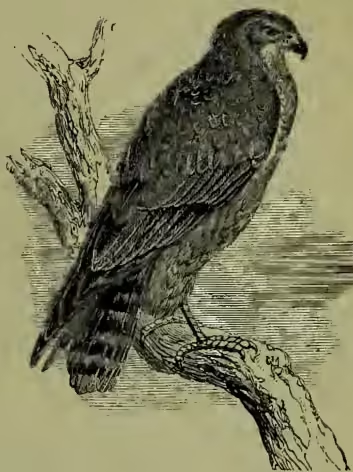
Buzzard (Buteo), a genus of birds of prey, in the family Falconidae, having a rather small and weak bill, which bends from the root, and is not notched, as in falcons. The 'cere' is bristly, except between the nostrils. The portion of the leg just above the foot is not feathered. Buzzards may be regarded as an inferior kind of eagles, which they do not equal in courage or strength. They are large birds, the Common Buzzard
(B. vulgaris or fuscus) measuring almost 4 feet from tip to tip of its outstretched wings. It is a bird still frequent in Britain, though much less so than it formerly was. It is subject to great variations of plumage; the prevailing colour is brown, with a considerable mixture of black on the upper parts, and of white or grayish white on the under. It is sluggish and inactive in comparison with many other birds of the same family, and is usually slow in its flight. It often sits long on a tree, watching for prey. When occasion presents it glides silently into the air, and sweeping rapidly down, seizes its victim in its claws. Sometimes, however, it ascends to a great height in the air. This buzzard is plentiful in all the wooded parts of Europe; it is found also in the north of Africa, and is known to exist in the western parts of Asia; but it is doubtful how far it extends over that continent, a distinct although very similar species occurring in the Himalaya Mountains. It is a most useful bird of prey, feeding to a large extent on mice, also on adders and the like. Thirty field-nice have been taken from the crop of a single bird. It is of use too in killing off sickly birds. The nest is built on a tree or rock, or a crow's nest may be utilised. The nest is rough, and composed of sticks and grass. The eggs are three or four in number, and usually bluish white with reddish blotches. Tame female buzzards have been known in several instances to exhibit so strong a propensity for incubation and the rearing of young at the proper season, that they have hatched hens' eggs and brought up the chickens, although if chickens not of their own hatching were brought within their reach, they devoured them. Meat given to the buzzard nurse was carefully divided among her nurslings, but they found out by their own instincts the use of grain and other vegetable food. In Sweden they are often caught for food.—The Rough-legged Buzzard (Archibuteo lagopus) is very similar to the former, but is at once distinguished by having the lower portion of the leg feathered to the toes. It is a rarer British bird, yet not of unfrequent occurrence; it is very widely diffused, being found in the Old World from Lapland to the Cape of Good Hope, and equally common in the northern parts of North America. It is very sluggish, and is most frequently to be seen in marshy districts, and often skimming over marshes, where it makes prey of frogs.—The Red-tailed Hawk of North America is a buzzard (Buteo—according to some Falco-borealis), in very bad repute among American farmers and housewives for its frequent invasion of poultry-yards, from which it has acquired the name of Hen-hawk.
—Several other species appear to be limited to particular parts of the world, as the handsome Buteo jactal—so called from the resemblance of its voice to that of the jackal—to South Africa.—The Honey Buzzards (q.v.) belong to a different genus, although nearly allied to the true buzzards, as are also the Harriers (q.v.), of which the most common British species, the Marsh Harrier, is sometimes called the Moor Buzzard.—Bald Buzzard is a name of the Osprey (q.v.).