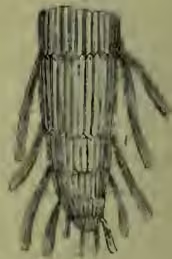
Calamites, a group of fossil plants which make their first appearance in the Devonian, occur abundantly in the Carboniferous, and seem to die out in the Permian strata. There is some doubt as to the true affinities of these plants, but they are most probably related to the Equisetaceæ, and are believed to be a kind of gigantic 'horse-tails,' from which, however, they differ in certain points. The decorticated stem is longitudinally ribbed or furrowed, and transversely jointed at intervals—these intervals sometimes increasing or decreasing regularly, or in other cases being equal or irregularly different in length. (In one series the longitudinal furrows do not alternate at the joints or nodes, and these fossils are now separated from Calamites proper under the genus of Archæocalamites.) In some stems long narrow branchlets proceed from the transverse joints, and in others branches bearing whorls of small branchlets or long narrow pointed leaves. The branch-scars occur periodically, the node-bearing scars being separated from each other by a certain number of joints without branches. The root termination is conical. Some of the species were provided with thick, and others with thin bark. The former did not show on their outer surfaces the fluting which is so marked a characteristic of the decorticated stems—the condition in which these fossils usually occur. The thin-barked species did show a fluted surface. Calamites seem to have grown in dense brakes on low alluvial flats, and perhaps even in water. They seem to have budded out at the base, forming clumps of plants, while to support themselves they threw out cord-like roots from the lower part of the stem. The fruits were long and generally thin spikes, bearing spore-cases under scales, and were attached to the twigs or branches. Some of the forms reached a length of 30 feet.