Calculus, or STONE (in Medicine), a hard concretation formed within the animal body, in consequence of the deposition in the solid form of matters which usually remain in solution (see CONCRETION). The calculi most commonly met with and of most importance are those formed in the kidneys or bladder (Urinary Calculus), and those formed in the gall-bladder or biliary ducts (Biliary Calculus). Both of these give rise to very painful symptoms, and may even threaten life.
Urinary Calculus is a disease of all ages, but most common in early and in advanced life and in the male sex. It is also very frequent in gouty persons, or among those who pursue sedentary occupations, and live freely. It is rare among those who live much in the open air, or who take much violent exercise, and use little animal food and wine. Among sailors it is peculiarly rare. In certain parts of the country the disease is said to be frequent, as in Norfolk, and perhaps along the east coast of Scotland. In some parts of India, too, where some of the predisposing circumstances mentioned above can hardly be said to prevail, stone is by no means uncommon. It would appear, therefore, that the predisposing causes of calculus are still very imperfectly understood. In its early stages the disease usually presents itself in the form of Gravel, shown by the passage of numerous very small portions of gritty concretions, which may be observed in the urine as a deposit like sand, or like small grains of Cayenne pepper. When such deposits occur frequently, especially if they are present at the time of passing the urine, and not merely after it has cooled, there is reason to apprehend the formation of calculus. If, in these circumstances, there are pains of a dull character in the loins, with occasional twinges of sharper suffering, no time should be lost in seeking medical advice. If a fit of very severe pain should occur in a person for some time affected with gravel, if the urine be bloody, if agonising twinges, commencing in the loins, sting downwards into the thigh or the groin, it is probable that a stone has already formed in the kidney, and is being displaced towards the bladder. Calculus in the bladder is at first attended with little suffering, as compared with that caused by the stone in its passage downwards from the kidney; but unless removed or evacuated, the calculus is sure to enlarge, and it then becomes the cause of one of the most painful diseases that afflict humanity. The existence of a stone in the bladder, however, should never be taken for granted without a surgical examination, as all the symptoms are deceptive in certain cases. The most striking, and perhaps the most trustworthy evidence of stone in the bladder, apart from the use of the sound (see LITHOTOMY), is smarting and burning pain experienced after the bladder has been emptied, together with occasional presence of blood in the urine. The correct appreciation of all the symptoms, however, demands considerable familiarity with such cases.
The discovery of the tendency to urinary calculus at an early period of its growth has been greatly aided by the use of the microscope and of chemical tests. Generally speaking, it may be said that whenever the urine, after standing for a few hours, can be observed habitually to contain more sediment than a very slight cloudiness towards the bottom of the vessel, there is room for careful inquiry into the existence of some derangement of the health. But sediments are not all equally apt to determine calculus, nor is the treatment of the different kinds of sediment at all similar; care should therefore be taken to determine, from time to time, whether the character of the sediment may have undergone a change, so that the treatment may be adapted accordingly.
The chief varieties of urinary calculus are—(1) uric acid (red sand) and urate of ammonia; (2) oxalate of lime; and (3) phosphates of ammonia, magnesia, lime, &c. Calculi formed of other substances do occur, but much less frequently. Calculi are sometimes found to be composed of numerous successive layers, having a perfectly distinct chemical composition. Urates and phosphates in particular frequently succeed each other, and form what is called an alternating calculus.
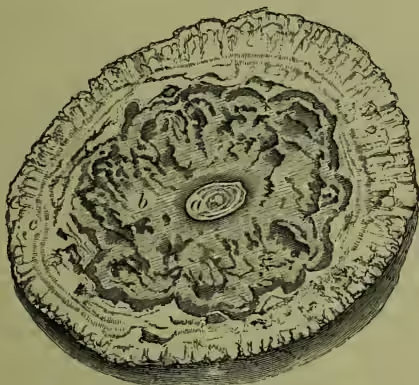
When calculus has once fairly formed in the urinary passages, it seems probable that no absolute cure exists except the removal of it, if possible, from the body (see LITHOTOMY and LITHOTRITY); but in the stage of gravel, and still more in the earlier stages detected by careful examination of the urine, much may be done to check the tendency to this distressing and dangerous malady. The chief remedies consist in careful regulation of the diet and mode of living, together with the use of solvents adapted to the particular form of deposit found to be habitually present. See URINE.
Biliary Calculi or Gall-stones almost invariably consist of Cholesterin (q.v.) with a variable proportion of biliary pigments, lime, mucus, &c. They are generally formed in the gall-bladder, and while they remain there often give rise to no inconvenience. Their presence is usually first revealed by their passing from the gall-bladder into the cystic duct (see BILE, LIVER), and giving rise to the train of symptoms known as biliary colic. Severe pain, either sudden or gradual in its onset, is felt just below the ribs on the right side, and radiating in various directions, but most commonly upwards. It is almost always accompanied by vomiting. When the calculus reaches the common bile-duct it closes it for the time, and if it does not pass onward into the intestine within a few hours, leads to jaundice. The pain in a severe case is probably the most intense of all known forms of suffering. Happily the attack rarely lasts beyond a few days at most; but, as gall-stones seldom occur singly, is very likely to be repeated at some subsequent period. During such an attack copious draughts of hot water containing bicarbonate of soda in solution often give relief; but large doses of morphia or opium are generally required to control the pain. When the calculus has reached the intestine it is passed onwards and voided with the faeces.
Though in the majority of cases gall-stones are thus harmlessly discharged, they may give rise to inflammation, ulceration, or other dangerous complications at any part of their course—in the gall-bladder, the bile-ducts, or the intestines.
The cause of their formation is obscure. They are more common in the female sex, and rare before the age of thirty. Regular habits, plenty of exercise, and simple diet are believed to be the most important means of preventing their formation.
During the last ten years the gall-bladder has frequently been opened with success for the removal of gall-stones which were causing serious symptoms; and this operation (cholecystotomy) has now a recognised place in surgery.