Calcutta, the capital of the province of Bengal, and metropolis of British India, is situated on the left bank of the Húgli (Hooghly), an arm of the Ganges, in lat., and long., about 80 miles from the sea by the river. Calcutta was founded by Governor Charnock in 1686, by the removal hither from Húgli of the factories of the East India Company. In 1700 three villages surrounding the factories having been conferred upon the company by the Emperor Aurungzebe, in recognition of a present made to his son, Prince Azim, they were forthwith fortified, and received the name of Fort William, in honour of William III. Calcutta is the Anglicised form of Kalikata, as this again is the Moslemised form (1596) of Kali-ghat, a famous shrine of the goddess Kali, which still exists to the south of the city. In 1707 Calcutta had acquired some importance as a town, and was made the seat of a presidency. In 1756, however, a great misfortune befell the rising town; it was unexpectedly attacked by Suráj-nd-Daulá (Surajah Dowlah), the Nawáb of Bengal, and yielding after a two days' siege, was the scene of the tragedy of the ‘Black Hole’ (q.v.). The city remained in the hands of the enemy until seven months afterwards, when Clive and Admiral Watson recaptured it, and afterwards concluded a peace with the Nawáb. Soon after this, and subsequent to the important victory of Plassey, the possessions of the East India Company were greatly extended by grants made by the emperor of Delhi. In 1772 it superseded Murshidabad as seat of the central government in India; in 1852 it was erected into a municipality. In 1837 the population of the town proper amounted to 229,700; in 1881 it had increased to 401,671, or, with port and suburbs, but exclusive of Howrah (q.v.) 684,658; and in 1891 (without Howrah) to 840,130. Besides these, thousands of the three and a half millions who sleep at night in the surrounding districts of Húgli and the twenty-four Parganas, flock during the day to Calcutta, on foot, by boat, or by railway, to their daily toil. Of the inhabitants 62 per cent. are Hindus, 32.2 Mohammedans, and 4.4 Christians. About 20,000 are Europeans; 20,000 Eurasians; and there are a good many Armenians, Greeks, Jews, Parsees, Chinese, and negroes.
The city extends for about five miles along the river, and is somewhat less than two miles in breadth at its broadest part, the area being nearly 8 sq. m. (30 with suburbs), and is comprised for the most part between the river and the Circular Road, a spacious roadway which marks the landward boundary of the city proper. Howrah and other villages on the opposite side of the river contain the government warehouses, large ironworks and timber-yards, a number of the principal jute- its armoury contains 80,000 stands of small-arms. Facing the Esplanade, among other fine buildings, is the Government House, a magnificent palace erected (1799-1804) by the Marquis of Wellesley. Beyond this, extending northwards along the river-bank, is the Strand, two miles in length, and 40 feet above low-water, with various ghats or landing-places. It is adorned by many fine buildings, including the custom-house, the new mint, and other government offices, and is lined by a splendid series of jetties for ocean steamers. Among other places of interest are the High Court, the Bengal Government Offices, St Paul's Cathedral, the Scotch kirk (St Andrew's), the Imperial Museum, the town-hall, Bank of Bengal, Jesuits' College, Medical College, university, the domed post-office, and the Treasury. Calcutta has three theatres, several large European hotels, two fine clubs—the Bengal and United Service, four daily English newspapers, and a number of monuments throughout the city, the most noticeable being those to the Marquis of Wellesley, Sir James Outram, and Sir David Ochterlony, the last a column 165 feet high.
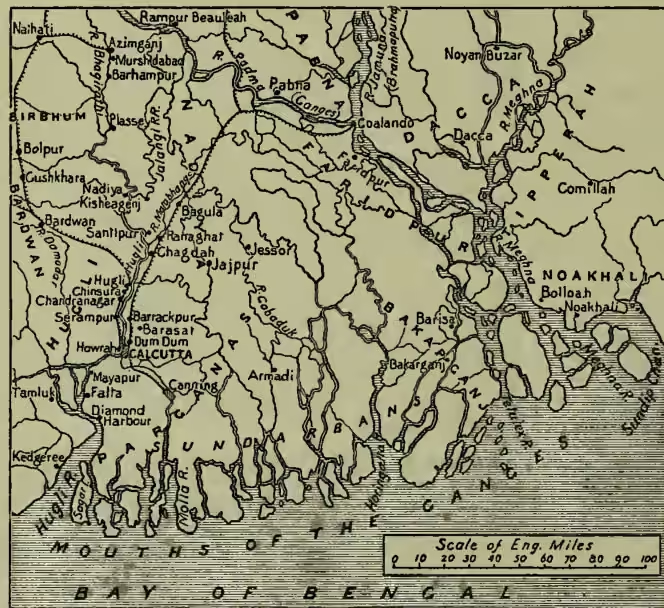
Although the European quarter of the town is distinguished for its fine public buildings and commodious dwelling-houses, the quarters occupied by the natives present a very different appearance, their houses being in most instances built of mud or bamboo and mats, and the streets narrow and unpaved. Great havoc was done here by the cyclone of 1864, which destroyed 40,700 native houses; and those of 1867 and 1870 were likewise very destructive. Considerable improvements have now been effected; new and wider streets have been opened through crowded quarters; brick houses are fast replacing the huts, and an extensive system of drainage has been carried out to the no small advantage of the inhabitants. A new municipal bill, with large sanitary provisions, was passed by the Bengal Council in May 1888. The water-supply of Calcutta has been very much improved. Formerly, the water was kept in large tanks, interspersed throughout the city, whence it was borne by water-carriers or bhisties in large leather bags. But since 1865 a supply of excellent water has been obtained from the Húgli, about 15 miles above Calcutta, where it is filtered and sent down by pipes in the mills, and the great terminus of the East Indian Railway. The appearance of the city as it is approached by the river is very striking; on the left are the Botanical Gardens, destroyed by the cyclones of 1867 and 1870, but since replanted; and the Bishop's College, a handsome Gothic edifice, erected by the Society for the Propagation of the Gospel, and now used as an engineering college; on the right is the suburb of Garden Reach, with the palace in which the ex-king of Oudh resided from the time of the annexation of his territory till his death in 1887; farther on are the government dockyards and the arsenal; beyond these is the Maidan Esplanade, which has been termed the Hyde Park of India, being the favourite place of resort of the élite of Calcutta for their evening drive. Here, near the river, lies Fort William, the largest fortress in India, constructed (1757-73) at a cost of £2,000,000, and occupying, with the outworks, an area of 2 sq. m. It is garrisoned by European and native soldiers, mounts 619 guns, and usual way. In 1888 large new works were under construction, by means of which the daily supply of filtered water is to be raised to 16 million gallons. The result of this has been a marked improvement in the health of the city. Gas has now taken the place of the oil-lamps which were formerly in general use for lighting the streets at night. Tramways have been extensively introduced, and steam tramways run to some of the suburbs. A canal girds a part of the city beyond the Circular Road. A pontoon bridge (1874) connects Calcutta with Howrah, and a project is on foot to substitute a fixed bridge.
The communications of Calcutta afford great facilities for its extensive commerce. There are several lines of railway to various parts of India; the East Indian to Benares, Delhi, &c.; the Eastern Bengal to Gulundu; the Calcutta and South-eastern to the mouth of the Ganges; and the Bengal-Nagpur to Bombay. Calcutta is also the headquarters of the Indian Telegraph Depart- ment. Uninterrupted communication is kept up with Great Britain by numerous and well-appointed steamers and sailing-vessels. Navigation on the Húglí has been greatly improved, and an extensive scheme of docks is in course of construction at Kidderpur, at an estimated cost of 2½ millions sterling, to be completed in 1895. The river, adjacent to the city, varies in breadth from a quarter of a mile to nearly a mile. Ships of 5000 tons ascend to Calcutta in the usual course, the main difficulty to shipping being the James and Mary shoal, half-way down the river.
The learned societies are mainly of European origin, but several have a considerable native membership. The principal bodies are the Bengal Asiatic Society, founded in 1784 by Sir W. Jones, possessing a fine library; the Dallhousie Institute, for the literary and social improvement of young tradesmen; the Public Health Society; the Microscopical Society; the Photographic Society. The university of Calcutta was founded in 1857, on the same basis as the London University, and exercises functions over Bengal, the North-west Provinces, Oudh, and the Central Provinces. Educational institutions are numerous in Calcutta. Among the principal are the institutions of the Established and Free Churches of Scotland, the Doveton College, the Martinière College, St Xavier's College, and the four government colleges—namely, the Presidency College, the Sanskrit College, the Madrasa or Mohammedan College, and the Bethune Girls' School. The last-named has passed several pupils at the Calcutta University examination for the B.A. degree. There are also a medical college, a school of art, and an engineering college; while in medical hospitals and charities Calcutta is as well endowed as any European city. The first Protestant missionary settled here in 1758, on the invitation of Clive; now there are in the city and suburbs some forty or fifty centres of Protestant missions alone. Several of the colleges named above are mission colleges. Calcutta was the birth-place of W. M. Thackeray.
Calcutta, reproached with being a city of palaces in front and of pigsties behind, may be regarded as the great commercial centre of Asia. The seaborne trade of the province of Bengal, including treasure, has a value of from £60,000,000 to £80,000,000 a year; and about 95 per cent. of this trade belongs to Calcutta. Of the total value of Indian produce exported in an average year, Calcutta was found to have contributed 18 per cent. in opium, 15 per cent. in jute, 14 per cent. in grains and pulses, 13 per cent. in tea, 11 per cent. in oil-seeds, 7 per cent. in indigo, 7 per cent. in hides and skins, 4 per cent. in raw cotton, and 2 per cent. in raw and manufactured silk; while other exports, of which lac, saltpetre, and castor-oil are the most important, made up the balance. Calcutta exports enormous numbers of gunny-bags (in some years 65 millions, worth over £1,000,000). Tea and wheat are among the most important exports. The port is annually entered by 300 or 400 sailing-vessels and 700 or 800 steamers, with an aggregate tonnage of over 2,000,000 tons. For other particulars as to the trade and manufactures, education, &c. of the capital, see the article BENGAL. See also INDIA, HOOGLY, BLACK HOLE, CLIVE, HASTINGS, EAST INDIA COMPANY, and the articles on Bishops Heber and Cotton and on Dr Duff. As a great central depôt for the richest parts of India, including the Ganges valley and Assam, Calcutta has an extensive inland trade. In an ordinary year the imports by rail, steamer, and country boat may amount to over £60,000,000, and the exports to £25,000,000 or £30,000,000. It is difficult to fix the comparative standing of Bombay with regard to trade; probably, how- ever, Bombay has not more than two-thirds of the trade of Calcutta. As a place of residence Calcutta is perhaps the pleasantest city in India. The mean temperatures of December and May, the coldest and hottest months, are 68° and 86° respectively. The cost of living is expensive for India, and the shops (many branches of London firms) are very fine.