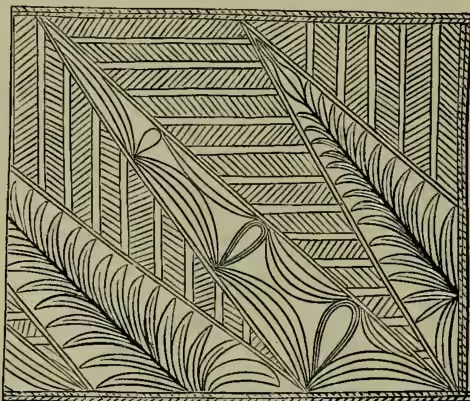
Calico-printing. In its widest sense this is the art of imprinting colours on textile surfaces, but the term is almost restricted to the printing of coloured patterns on cotton cloth or calico. The art, doubtless, arose from the inherent love of man for ornament, for we find savage races rudely decorating, with pigments or with charred patterns, their dresses formed of such materials as the bark of trees or skins of animals. Fig. 1 represents a portion of a primitive frame made of the leaves of a species of Pandanus, and used in the Fiji Islands for printing a pattern on cloth formed of the bark of the paper mulberry. Between a mode of printing fabrics like this, or even by the Indian method with carved hand blocks, and the art as now practised in England and other parts of Europe, there is a great and striking contrast, since the wonderful results now obtained in our calico-printing require the application of the highest chemical and mechanical skill along with the aid of trained designers for the patterns.
Except in the use of steam printing-machines, with engraved rollers and other modern improvements, the ancient Egyptians printed colours upon cloth in much the same way as it is done at the present day. Calico-printing is also a very ancient art in India, Persia, and China. Calico derives its English name from Calicut, a town in the Indian district of Malabar, where cotton-printing was formerly carried on extensively. The art seems to have been practised for centuries in Asia Minor and the Levant before we first hear of it as an industry in Holland, at Hamburg, and at Augsburg. There are some bits of block-printed silk stuff known, which experts consider to be Sicilian work of the 13th century. About the close of the 17th century Augsburg had become celebrated for its printed cotton and linen fabrics, and by that time the art had also been introduced into Switzerland and Alsace. The first calico print-work in England was established near Richmond, about the year 1676, by a Frenchman.
Printing Blocks and Rollers.—In the process of textile printing the first step is the drawing out of a design. The workmen of Eastern nations then cut this out on a block of wood if the pattern is simple, or on a series of blocks if it is complex, a different block being used for each colour. But in Western Europe, where the printing requires to be done with great accuracy and speed, engraved copper rollers are used. Block-printing is, however, sometimes employed in England to fill in additional colours on a print mainly produced by engraved cylinders, and special patterns are to a small extent entirely obtained from blocks. Some ingenious processes are in use for producing the patterns on the copper rollers. Sometimes these are engraved by a peculiar method, sometimes they are punched, but most frequently perhaps they are put upon the copper by the mill-and-die process. The die is a small cylinder of soft steel, about an inch in diameter, upon which a pattern is cut. It is then hardened and used to impress a reverse upon another cylinder called the mill, which in turn is hardened and used to impress the pattern upon the printing roller. The use of these copper cylinders or rollers involves a large outlay, the stock of them in some large calico print-works exceeding in value a hundred thousand pounds. For some patterns, such as spots upon handkerchiefs, produced by discharging the colour, perforated plates are used.
Printing-machines.—The principle of a calico-printing machine will be understood by the annexed diagram (fig. 2), which shows in cross section the arrangement of rollers and colour-boxes for producing a pattern in three colours.
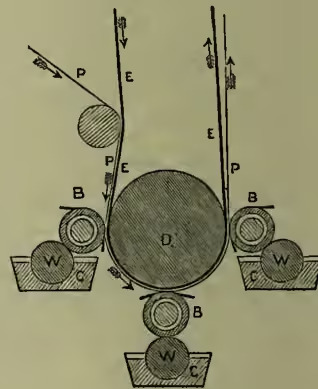
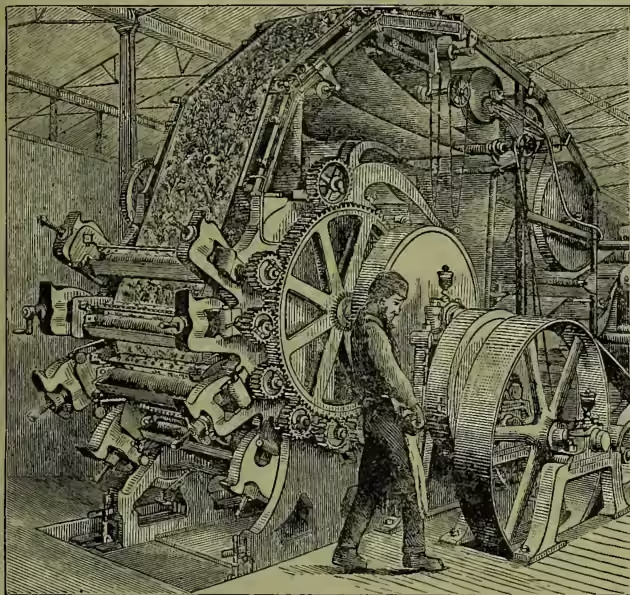
Machines are now made to print as many as sixteen colours at one operation.
Cotton or linen can very seldom be permanently dyed by merely immersing it in a dyeing solution.
But to get an idea of one or two very simple ways of producing a pattern on calico, let us suppose that it can. If we print dots or stars in wax upon calico and immerse it in some dye, the wax acts as a resist which can afterwards be removed, and we get a white pattern on a coloured ground. The same result can be obtained by chemically discharging the colour in the form of dots or stars after the fabric is dyed. Still more simple is the plan of printing a device in one colour on a white ground.
Mordants.—The production of patterns upon calico is, however, of no service unless the dye can be fixed upon the cotton fibre. What is called a 'mordant' is required for this purpose. A mordant has been figuratively described as an agent with two hands, one of which grasps the cloth and the other the dye. It must have the double property of adhering to the fibre and of forming an insoluble compound with the dye. Among the mordants commonly used are solutions of acetate of alumina or 'red liquor,' acetate of iron or 'black liquor,' and salts of tin. The mordant is usually applied to the cloth before the dye, but sometimes they are printed on together. Flour, starch, dextrin, and other substances are used to thicken mordants in order to bring them to a proper consistency for printing. It is important to keep in mind that the machine most frequently prints only mordants, not colours. As these have usually little or no colour, some of a fugitive character is added in order to 'sighten' the pattern. This enables the printer to see that the pattern is being uniformly printed on the cloth. The sightening colour disappears in the dunging process previous to dyeing. The same mordant may be printed of different degrees of strength on the same piece of calico; so also may different kinds of mordants.
Aging.—When alumina and iron mordants are printed by themselves (i.e. not mixed with dye) on the calico they require to be 'aged' in order to dissipate the acetic acid by which they are held in solution and fix the oxides of aluminium and iron within the cotton fibre. The aging was formerly effected by hanging the cloth up for days in a warm moist room. It is now accomplished much more quickly by passing it slowly but continuously through a chamber heated to a temperature of from 80° to 120° F., the air being moistened nearly to saturation by jets of steam.
Dunging.—The calico requires to be next passed through a mixture of hot water and cow-dung in order to remove any undecomposed mordant remaining in the fibre. Instead of cow-dung, solutions of phosphate, silicate, or arseniate of soda, have been largely used in recent years. The cloth is washed once or twice after the dunging, and is then ready for the dyeing process. The aging and dunging processes described here, apply only to the madder style and its modifications.
Various Styles of Printing.—There are several methods of producing coloured patterns upon calico. These are called styles. Thus the process of dyeing a mordanted pattern with madder is called the madder style; that of dyeing cloth over an entire mordanted surface, upon which a pattern is often produced by afterwards locally discharging the colour, is called the padding style; that of topically printing insoluble colours is called the pigment style; and that of producing a pattern by printing a mixture of mordants and dyes to be fixed by steam is called the steam style. Prints in which indigo and aniline black, termed oxidation colours, are used, receive a peculiar treatment.
Madder Style.—One of the dyes which has been used from a remote period is Madder (q.v.). Since the remarkable discovery in 1869 of a method of artificially preparing Alizarin (q.v.), its chief colouring principle, the artificial product has gradually come to be much more largely used than the dye from madder roots. But the process for printing alizarin is practically the same as that for madder.
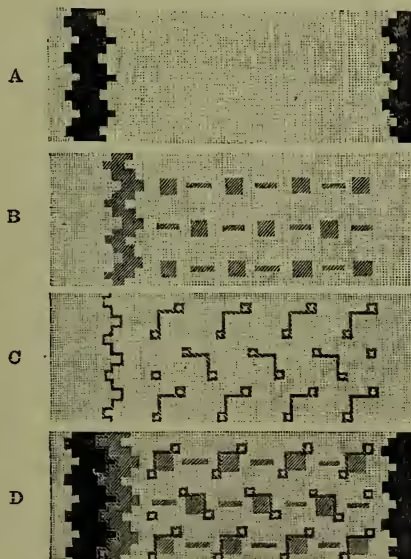
Suppose that a pattern in three colours is required, it can be produced in this way by using only madder or alizarin as the dye. Three mordants are employed in printing on the pattern. One of these is 'red liquor,' another is 'black or iron liquor,' and the third is a mixture of these two. A separate roller and colour-box (really, in this case, a mordant-box) is used for each of these in the printing-machine. When the cloth is printed, aged, dunged, and dyed, the result is that, with the same solution of alizarin, the alumina (red liquor) mordant has produced a red, the iron mordant a purple, and the mixed mordant a chocolate colour. The accompanying woodcuts represent a pattern thus produced. Fig. 4, A, shows the chocolate portion from the first roller, B the purple portion from the second roller, C the red portion from the third roller, and D the complete pattern made up of all three colours. The impression from each roller is shown separately in these, but the full pattern is printed at one operation in the machine. If a design is required with each of these colours in two shades, then each mordant is prepared of two strengths, and six rollers are necessary to print the pattern, one dye-bath being used as before.
The dyeing consists in passing the mordanted calico through a solution of alizarin in a dye-beck or cistern heated by steam, over which is supported a winch, which serves to draw the cloth in a continuous manner through the dye until it is saturated with the colour. The operation of 'clearing' follows the dyeing, and this is effected by boiling the cloth in soap and water. Clearing removes any dye from the unmordanted portions of the calico, leaving the pattern sharp and distinct.
Padding Style.—When a mordant is applied, not to any particular part, but to the whole surface of the calico, by the padding-machine, it is said to be padded. The mordant is generally either red or black liquor, or a mixture of both. The machine consists of a pair of cylinders over a trough containing the solution, through which and between the rollers the cloth is made to pass. It is then dried in a long heated chamber, and the design printed upon it in an acid discharge, such as citric acid and a salt of potash. When the calico is dunged and dyed in alizarin and other solutions, a white pattern is produced on a coloured ground, because the dye does not attach itself to the parts where the acid mixture has been printed. A pattern may also be printed in a stronger mordant than that used for the padded ground, so that we can have, for example, a dark purple, as well as a white device, on a pale purple ground. The white device may be afterwards wholly or partly filled with colour, and in this way designs in numerous shades or colours are produced.
Indigo Dyeing and Printing.—Owing to its chemical peculiarities this substance is unlike other colouring matters in ordinary use. The blue Indigo (q.v.) of commerce is insoluble in water, dilute acids, and alkalies, and therefore not adapted for the work of the calico-printer. But this insoluble indigo can be changed by deoxidation into soluble white indigo, which is capable of penetrating cotton fibre; and when calico is 'dipped' into white indigo and exposed to air, it becomes blue by absorption of oxygen. In practice a stone cistern or vat is used for the dipping. It is nearly filled with water, and then blue indigo, sulphate of iron (copperas), and lime are added. In the vat protoxide of iron is separated by the lime from the copperas and changed into the peroxide by absorbing oxygen from the indigo, thus reducing it to white indigo. For light blues the calico only requires to be immersed a couple of minutes, but for darker shades repeated dippings into indigo solutions of various strengths are necessary. There is an arrangement by which the calico, which is hooked upon frames, is exposed to the air after each dipping for the absorption of oxygen.
When a white pattern is to be produced on an indigo-blue ground, it is printed in resist-paste on the calico before it is dyed. This paste varies in composition, one kind being made up with sulphate of zinc, nitrate of copper, and soap, thickened with gum. On the resist being removed after dyeing, the white device appears. Clearer whites can, however, be obtained by printing a pattern in some discharging medium on the dyed cloth. Chromate of potash and oxalic acid separately applied—that is, either being printed on and passed through the other—will effect the discharge of the blue colour.
Since 1883 a process has been to some extent employed for printing patterns in indigo, which for this purpose is made into a thick paste with caustic soda and Indian-corn starch, and then printed upon calico previously padded in a solution of Glucose (q.v.). In the presence of alkalies and in contact with steam, glucose is an energetic reducing agent. In this process the ordinary blue indigo is also reduced to white indigo, and is immediately fixed on the cotton fibre. It then becomes blue in contact with air.
Artificial indigo (see INDIGO), which was first made in 1878, is, owing to its high price, not much employed in printing, but in some cases it is useful, such as with light shades and small designs.
Chrome Yellow.—This is chromate of lead, which, when prepared as a pigment, is largely used by house-painters. In calico-printing it is obtained by two operations. A mixture of acetate and nitrate of lead is first printed on the cloth as a mordant and fixed by dilute sulphuric acid, or, if the nature of the pattern requires it, by other agents. The calico is then worked in a warm solution of bichromate of potash, which produces a yellow colour, and if caustic soda or milk of lime be added to the solution, this is deepened into an orange. Chrome yellow is a permanent colour upon cotton.
Indigo Blue and Chrome Orange.—The production of an orange pattern on a blue ground has been a very successful style in the hands of some calico-printers. After what has been said it will be easily understood that before dyeing in the indigo vat a resist can be printed with a lead basis, which can be eventually changed to orange. By means of resists and acids this style can be varied so as to have in the same design orange, yellow, white, and two shades of blue, together with green, if Prussian blue be added to the yellow.
Catechu is a substance used in both dyeing and tanning (see CATECHU). It is the source of numerous shades of brown, fawn, gray, and drab, which are fast, and can be combined with the colours obtained from madder. Catechu fixes readily upon cotton fibre, but its colouring principle requires to be oxidised by such agents as lime-water, bichromate of potash, or a salt of copper.
Logwood.—In calico-printing logwood is used with iron, alumina, and chromium mordants. It is employed for black and chocolate colours.
Pigment Style.—Formerly this style was almost confined to printing with artificial ultramarine, but it has been much developed of late years. Other colours, as vermilion, cadmium yellow, chrome yellow, Guignet's (chromium) green, ochres, and umbers, are now printed as pigments on cloth. These colours are not soluble, as is the case with those used in other styles, but must be ground to fine powder and mixed with albumen before being printed. The calico is afterwards exposed in a close chamber to steam, which coagulates the albumen and fixes the pigment. Either white of egg or blood albumen is employed, and some of the colours so printed have great brilliancy.
Steam Style.—What are technically called steam- colours are fixed upon cotton by the agency of steam. For these the calico is first 'prepared' by a padding with stannate of soda, and souring with dilute sulphuric acid, for the purpose of depositing oxide of tin in the fibre. In this style the mordants and colours are mixed together and printed on the cloth. When, for example, alizarin is applied in this way, a mixture is made of the dye with the acetate of alumina, or acetate of lime, along with some thickening body such as starch. The printed stuff is either at once steamed in a suitable chamber or piece of apparatus, or it is first exposed for some hours to the air, and then steamed for from half an hour to more than twice as long. Alizarin colours are not quite so beautiful when produced in this way as when dyed upon mordants by the old madder process above described; but this steam process has the great advantage of enabling them to be used in combination with pigments and other colouring matters, thickened with albumen, since the steam also fixes the latter, as explained in the last paragraph. By the old way, if these pigment-colours are used in the same design with madder, they require to be put in with hand-blocks. Among the 'steam-colours' which have been in use for some length of time are those from Brazil-wood and other dyewoods, the yellow from Persian berries, cochineal red, and Prussian blue.
Spirit Style.—In this, as in the steam style, the made-up colours are applied topically. Such dyes as those from Persian berries and sapanwood are compounded with oxymuriate of tin and other substances, and printed on the calico. They are not steamed after printing, but simply dried at a moderate temperature, aged for a short time, and washed. The colours are bright but not permanent. The name has arisen from the tin compounds used being called 'spirits.'
Aniline Black.—This is not merely the only permanent colour from aniline, but it is one of the fastest colours known. One of the mixtures used to produce it is composed of chloride of aniline, sulphide of copper, chloride of ammonium, and chlorate of potash, thickened with starch. More recently vanadium salts have been substituted for sulphide of copper, but both mixtures are used. The calico is nearly colourless when newly printed, but it gradually darkens by oxidation when hung up in warm and moist air.
Other Aniline Colours.—With the exception of black, the colours from Aniline (q.v.), although fairly durable on silk and wool, are fugitive upon cotton. Since the discovery of aniline mauve by Perkin in 1856, the number of patents taken out for aniline colours is about two hundred. The brilliancy of some of these, especially the purples, is great. Methylene blue, saffranine (red), methyl green, auramine (yellow), Bismark brown, and several other aniline colours, are a good deal used in calico-printing. They are fixed by various mordants, such as red liquor with arsenic, stannic oxide with tannin, and tannin with tartar emetic; or they may be printed on the cloth with albumen as pigments. Most aniline colours are steamed after they are printed. Some of the best known do not harmonise well with other colours, but they are much used for cheap prints.
Seats of the Industry.—Calico-printing in Great Britain is carried on chiefly about Manchester and Glasgow, where some very large factories exist. The amount of work which these can produce may be imagined when it is stated that one of them, possessing forty-five printing-machines, has the power of printing annually 25,000 miles of calico. The distribution of calico-printing machines throughout the world in 1882 was: England 640, Scotland 280, Ireland 22, America 500, Russia 150, Germany, including Mulhouse (Mulhausen), 100, France 50,
Austria 25, Switzerland 24, Portugal 15, and Holland 5.
Patterns.—The great strides which calico-printing has made during the past fifty years have been in the science of the art. The artistic merit of the patterns printed has made comparatively little progress. In 1840 Mr Thomson of Clitheroe said, before a parliamentary committee, 'that while the printing of calico had become one of the most refined of the chemical arts, the art of designing patterns had retrograded.' In 1851 Mr Redgrave, R.A., referring to the want of excellence in the designs of European garment fabrics, said: 'If we look at the details of Indian patterns, we shall be surprised at their extreme simplicity, and be led to wonder at their rich and satisfactory effect.' Up to the present time the patterns on many Indian and Persian calicoes are still unmatched for beauty by the best European designs. It cannot be denied, however, that a considerable number of the patterns printed on the Continent and in England from French designs are very meritorious.
Calicut, a seaport of Malabar, Madras presidency, 6 miles N. of Beypur terminus, and 566 SSE. of Bombay. It was the first spot in India visited by Covilham (1486) and Vasco da Gama (1498), being then the chief emporium on the coast, with stately dwellings and magnificent pagodas. So populous and powerful was it, that it twice repulsed the Portuguese, slaying their commander in 1509, and expelling Albuquerque himself, after a momentary success on his part, in 1510. In 1792, when it fell into the hands of the English, owing to the ravages of war, the city was little better than a ruin. Since then it has made considerable progress in trade and population. It is the headquarters of the Malabar district, and has a custom-house, salt depot, barracks; the anchorage is an open roadstead. The French have a comptoir or factory here, and the right of flying their flag. The cotton cloth at first exported hence was called 'calico' by the English, and 'calicute' by the Portuguese. Pop. (1891) 66,078. See Logan's Malabar (Madras, 1887).
Calif (also spelt Caliph and Khalif) was the title borne by the successor of Mohammed in temporal and religious authority (Arab. sing. Khalifah; fully Khalifat Rasûl Îllâh, successor of the Apostle of God).
The First Four Califs.—The Prophet leaving no son, the wise and good ABU-BEKR, father of his favourite wife Ayesah, was elected by an assembly of the faithful (632 A.D.). On Abu-bekr's accession, Mohammed's prophetic rival, Mosailima, was defeated and killed by Khâlid, 'the Sword of God,' and the Arabs were united in faith and in the holy war which the calif immediately declared against Syria. Khâlid routed the Persians in several battles; a Roman imperial army was severely defeated; Damascus capitulated; Baalbek and Emesa fell. Abu-bekr at his death (634) nominated the intrepid, severe, and virtuous OMAR, another father-in-law. Under him the war was continued. Jerusalem after a sharp conflict surrendered (636), and Omar rode thither from Medina with all his provisions and baggage on a camel to ratify the terms. This only time did one of the first three califs step beyond the domestic care of religion and justice. Aleppo was surprised; Antioch yielded after a battle; Tripoli and Tyre were betrayed. By the end of 638 Abu Obeidah and Khâlid had given all Syria to the califate. Meanwhile the little Arab Christian kingdom of Hira had been destroyed (632). Persia also fell. With the national banner, she lost all hope at the four days' battle of Kadesia west from the Euphrates not far from old Hira (635). A few months after the battle Seleucia and Ctesiphon the Persian capital were taken. Kufa was planted near Hira, which soon disappeared. Now Kufa's great rival Basra was founded. 'The victory of victories' at Nehavend permitted one army to reduce Ecbatana and Media, then to help the army of Syria to subdue Mesopotamia and part of Armenia; and permitted another army with Saad to conquer as far as the east end of the Persian Gulf. Egypt was next subdued. From Syria Amru broke into Egypt by Pelusium and took Memphis. The native monothelite Christians helped him to expel the orthodox Greeks. Alexandria capitulated in 641; was recovered, retaken and dismantled in 646. Thereafter Cairo became the capital of Egypt. Omar it was who began the use of the Hegira (Hijra or Hedjra), the Prophet's retreat from Mecca (622), as the Mohammedan era, and took the title Emir-ul-Muminin, 'Commander of the Faithful.' Othman's lieutenant Abdallah fought many battles in the North African provinces of Tripoli and Cyrene, and gathered much tribute, but effected no settlement in this region.
Omar was stabbed by a Persian slave in 644. On his death a council of six appointed as third calif, OTHMAN, the Prophet's secretary and son-in-law. He fixed the text of the Koran, and prevented disputes by burning all previous copies. His weak government raised complaints and insurrection on all sides. But in his reign Persia was finally subdued. By the capture of Herat, Merv, and Balkh, Othman's hold on the country between the Gulf and the Oxus was completed. He was besieged in Medina and murdered (656).
Othman was succeeded by the heroic ALI, poet, soldier, and saint, husband of Fátima, and son of the Prophet's uncle Abu Taleb. Áyesha, fomenting rebellion, he defeated near Basra on the 'Day of the Camel,' in the first battle of the first Moslem civil war. She was taken on her camel and sent into retirement in Medina, for Ali had transferred the seat of government to Kufa. Moáwiya, governor of Syria, son of that Abu Súfán, who as Mohammed's enemy had been beaten at Bedr, and had helped to beat him at Ohud, claimed to succeed his cousin Othman, and seduced or subdued Syria, Egypt, Yemen, and Persia. On Ali's murder by a fanatic he negotiated the abdication of Ali's son Hassan, and becoming calif in 'the year of union' 661, made the title hereditary.
The califate arose in the most degenerate period of Persians, Romans, and European barbarians. An explanation of its progress is found in the exhaustion of the empire and Persia in their mutual wars; the real value of the Arabs, enormously enhanced by their religious enthusiasm and greed of spoil; in their comparative moderation towards the conquered; and in their elsewhere unknown principle of comparative toleration in religion. Christian sects were bitter against one another. In Christian nations imperial centralisation, extortion, and tyranny, and ecclesiastical tyranny and persecution, had almost extinguished patriotism. The invaders were regarded with indifference or welcome, though few except Arabs yet preferred Islam to tribute or the sword. The difficulty for the Saracens, headed by a calif accountable only to God, his own conscience, and the patience of his subjects, was not to conquer, but to govern, and so to keep.
The Ommiades.—MOÁWIYA (661-80) was the first calif of the line called Ommiades, from one of his forefathers. Their seat was Damascus. The conquest of Syria had now provided harbours, men, and materials for fleets; yet in naval warfare the Saracens acknowledged the superiority of the Greeks. As archers and horsemen they had no superiors, but in the scientific part of warfare they never attained eminence. Moáwiya had captured Rhodes in 653. In 672 he began a siege of Constantinople by sea and land which lasted seven years. None of the army and little of the fleet returned. In Africa, conquest was resumed in 661, when, the emperors having imposed an additional assessment equal to the tribute that Africa had yielded to the Saracens, Moáwiya was asked for aid by the province, groaning under the civil and military tyranny of the Patriarch of Carthage. Oeba subdued the open country until he spurred his horse into the Atlantic Ocean. In 669 about 180,000 captives were carried by the Saracens from North Africa. In 670 Oeba planted Kairwan, 50 miles south of Carthage and inland; but thereafter he lost much ground and afterward his life. In 698 Hassan the governor took Carthage, and destroyed it so that it disappeared. It was a barbarous trait of Saracen policy to unwall great cities, and to build instead other cities not to defend, but to dominate the land. The Greek empire being thus expelled, the mixed population preferred the califate to Moorish anarchy. Musa achieved comparative quietness. Fifty years after the fall of Carthage, Christianity was nearly extinct in North Africa, which is the only land wherein Christianity after a perfect settlement has disappeared. Donatists, Vandals, Moors, and Saracens have alike contributed to this result. The whole califate was now giving proof that it was a worse master than the Roman empire. Moderation it had unlearned; legislation and government it never learned. Islam spread by converting barbarous heathen, but also by expelling Christians. In blood as in religion, the Berbers coalesced with the Saracens.
In 711 Count Julian, governor on both sides of the strait, betrayed Centa to Musa, and admitted a Moslem army to Gebel et Tarik (Gibraltar), so called from the leader's name. The battle of Xeres de la Frontera cost the Gothic king Roderick his kingdom and his life. In a few months, amid the indifference of the people, the persecuted Jews giving considerable help, Spain was added to the califate. Gothie patriotism still defended itself in Asturias and the Pyrenees. Further conquest was soon attempted in southern France. Abdurrahman, rounding the east end of the Pyrenees, carried victory to the Loire; but Charles Martel destroyed him and his enormous army between Tours and Poitiers in 732. Narbonne and the rest of Septimania the Saracens lost (752-59) when the Franks aided the revolted Goths and carried the Frank empire to the East Pyrenees.
Moáwiya was a statesman; the rest of his line were neither statesmen nor saints. His son YEZID I. (679-83) succeeded him. Ali's son Hussein (Hosain) had fought well at Constantinople under the father, but the son's right he would not own. Splendid promises lured him from Medina to lead a rebellion in Irak; but ere he arrived Obeidullah, governor of Kufa, had crushed his cause in the bud. On the plain of Kerbela he was slain in battle, but Yezid spared his kindred. Ali, Hassan, and Hosain, and Hosain's lineal descendants to the ninth generation, are the only twelve Imáms or spiritual heads recognised by the Shiite creed. The twelfth, the Mahdi, is not yet dead, but will appear before the judgment day. The tomb of Ali, the first calif recognised by the Shiites, and whose name is the watchword of undying hatred between Turk and Persian, is at Meshed Ali, the ancient Hira, south of Kufa. All the Imáms' tombs are centres of Shiite pilgrimage. Hosain's martyrdom has occasioned the holiest Shíah celebrations.
Yezid I. was followed by MOÁWIYA II. (683); and he by MERWÁN I. (murdered 685). ABDUL-MÁLÍK'S troubled reign lasted till 705. He encour- aged scholars to translate Persian literature into Arabic, and gave the caliphate a coinage of its own. He negotiated with Justinian II. in 686 the removal of the Mardaites, who in Lebanon, round Byblos their port and nucleus, had been a most willing and useful barrier to Saracen conquest. But they were monothelete Christians. They were scattered over the empire. In 692, to support his wars, he imposed the Haratch or capitulation tax on all Christian men, one of the deadliest blights of the Saracen and Turkish empires.
The glorious reign of the inactive WALÍD I. (705-15) saw the caliphate extended at one end by the addition of Spain, and at the other end Sogdiana, between the Oxus, the Jaxartes, and the Caspian Sea, taken from the Turks by Kuteibah, and the caliphate extended to the mouth of the Indus. SULEIMÁN I. (died 717) sent a magnificent army and fleet under his brother Móslemah against Constantinople; but next year (718) both perished almost utterly. The newly invented Greek fire had immensely aided the city in this siege and the former. To Constantinople belongs the honour of having been the first and strongest bridle of the Saracen. Good OMAR II.'s reign was ended with poison (720). YEZÍD II. died 724. HISHÁM died 743. WALÍD II. was killed in an insurrection (744). YEZÍD III. died 744. IBRAHIM was dethroned by MERWÁN II., governor of Armenia (745).
The character of the Ommiades had not made them popular, and the mode of their elevation encouraged civil war, whereof they had continual experience. At last three brothers arose, descended from Abbas, uncle of the Prophet. Abu Moslem, who boasted ere he died that he had killed 600,000 of his enemies, took Merv, and soon occupied Khorasan for them. The whole land between the Indus and Euphrates was convulsed with the struggle between white Ommiades and black Abbasides. Merwán was defeated near the Zab, pursued into Egypt, and there fell in battle near Busr near to Memphis (750). Abdallah, uncle of the claimants, invited eighty of the Ommiades to a conference and a feast at Damascus, and murdered them. So the Abbasides succeeded.
The Abbasides.—The first Ommiade united the caliphate; the first Abbaside divided it. One Ommiade, Abdurrahman, escaped from the massacre by Abdallah, and, crossing the strait into Spain, founded after a struggle the Ommiade caliphate of Spain or Cordova.
ABŪL ABBAS (750-54), called also Saffah, 'the shedder' of his enemies' blood, was followed by his brother ABU JAAFAR ALMANSŌR (754-75), who founded Bagdad for the seat of empire. The £30,000,000 sterling left by him, his son ALMAHDI (775-85) and grandson ALHÁDI (785-86) vain-gloriously squandered. Alládi's brother, HARŪN AR RASHID, 'The Just' (Haroun al Raschid) (786-809), owes his fame to the interested praise of orthodox and literary men. He persecuted the Christians, and made eight destructive attacks on the Greek empire in Asia Minor, but rather as a brigand and slaver than as a conqueror. His three sons, instead of accepting his partition of the empire, fought for supremacy. AMÍN, the calif, was defeated and slain (813); ALMAMŪN, his brother (813-33), aided the culmination of Saracen culture.
What now makes men colonists united Normans or Saracens of middle and higher rank in the 9th century into bands of pirates or robbers strong enough to defy civil governments. Saracens had turned naturally to piracy, and had long and terribly ravaged all the Mediterranean coasts. In 823 a band of Saracen pirates from Spain captured Crete, which they valiantly held till 961. In 827 Saracens from Africa entered Sicily, like Crete almost entirely inhabited by Greeks, and on the fall of Syracuse in 878 it was lost to the empire. Both these conquests owed much to popular sympathy. Rome was attacked in 846 and 850, and had to ransom herself in 871. Greek and Roman Italy freed herself with Frankish help, but not till Normans had made themselves helpful where they were soon to rule.
MUTASSEM (833-42), following his brother, maintained the desolating indecisive wars in Asia Minor. With him departed the glory of the Abbasides. Afraid to arm or to trust his own subjects, he left Bagdad for Samarah, 100 miles up the Tigris, and surrounded himself with 50,000 Turks. Civil and military administration was soon in their hands. Their steadier valour and strength compensated the decayed religious enthusiasm of the Arabs. Thereafter the califs held power and life by the grace of the Turks.
Before the Abbasides, religion and conquest were the ends of Saracen power. The Abbasides strove after science and refinement. Yet of wars they had no end. Rebellion hardly ever ceased. AlmansŌr had to quell his uncle Abdallah, formerly so useful to him, and afterwards a nephew. Sectarian persecution was the bane of ALWÁTHEK'S reign (842-47) and MUTAWAKKIL'S (847-61). His son, MŪNTASIR, conspired with the Turks against him and slew him, and reigned 861-62. ALMŪTAMID reigned 862-70; ALMŪHTADI, 870-71; ALMŪTAMID, 871-93; ALMŪTADHID, 893-903; ALMŪK-TAFI, 903-8; ALMŪKTADIR, 908-32; KAHIR, 932-34; RADHI, 934-40, was the last calif that like a true Imám and calif preached to the people. MUTAKKI died 944; MUSTAKFI, his successor, had no temporal power beyond the walls of Bagdad.
Another blow to the caliphate was the rise of the Karmathian heresy preached by a new prophet at Kufa (890), and spread by the swords of Abu Saíd and his son Abu Taher. In Bahrein and Omán, where the sect is still numerous, their temporal power began. Basra was taken; Mecca was taken with great slaughter (930), and the black stone (see KAÁBA) was carried away by those despisers of pilgrimages and other formalities. In a few years the Karmathian power melted away under the swords of the orthodox.
Still greater mischief resulted from the size of the caliphate itself. Emirs everywhere became hereditary by favour of the calif, then without it; then instead of men and revenue were sent complimentary gifts—an elephant, a jewel, a few slaves. Then came independence. The Aglabides, one of whom, Ziyádat Alláh, was governor of North Africa, while his brother led the expedition against Sicily, reigned over these two regions till 909. Their seat was Kairwán. EDRIS, of Hassan's and Ali's blood, was proclaimed king in West Africa in 788, and established the kingdom of Fez; he built the city (806). He was poisoned by an emissary of Haroun al Raschid. His descendants reigned till 967. With Berber aid Fatimides overthrew the Aglabides and Edrisides, and (969-70) possessed themselves of Egypt, which had been independent since 935. Thence they quickly subdued Syria. This they lost to the Crusaders. They gradually became merely phantasmal califs under their wazirs, who even became sultans, till in 1171 Saladin, a Kurd, founded the line of Ayúbide sultans of Egypt. That country thereafter always recognised the califs of Bagdad as the Commanders of the Faithful. Almamún's great general, Táher, and his children to the fourth generation, reigned in Chorasán.
In 917 three Persian brothers, Bowides, usurped dominion from the Caspian Sea to the Persian Gulf. The califs, miserable slaves of the Turks, called in the Bowide sultan, who in 945 took
Bagdad and became the lieutenant or commander of the Commander of the Faithful, leaving him merely a spiritual superiority. In 963-75 Nicephorus Phocas and John Zimisces swept everything but the impregnable Tripoli before them, from Cappadocia to the walls of Bagdad, retaining the oft-contested Cilician cities and Antioch and Cyprus for the empire. From the Bowide, who then and at other times proved himself a tyrannical master but a weak protector, the calif had to appeal to the Turkish Seljuk's grandson, Togrul Beg. He, pushing towards India the Gaznaide Turkish princes who reigned from the Caspian Sea to the Indus, had planted himself in Ecbatana (Hamadân). Marching thence he destroyed the Bowide dynasty, took Bagdad (1050), and became Defender of the Faith and protector of the calif. When the Seljuks, running the usual round of Asiatic dynasties—valour, greatness, discord, degeneracy, decay—had succumbed to Genghis Khân, the califs recovered the civil rule of Bagdad and Irak Arabi. But Hulagu prosecuting his grandfather's conquests, laid siege to Bagdad (1258). The calif Mustasem, from among his seven hundred concubines, exhorted him to repent; but after two months the city was taken and pillaged with fearful slaughter, and Hulagu pronounced sentence of death on the last of Mohammed's temporal successors.
Mustasem's representative was found in Egypt in 1517, when the Turks seized that country. On his death in 1538 the sultan of Turkey assumed the title of calif. It is little recognised but among his own subjects.
Ommiades of Spain.—ABDURRAHMAN I. (755-87), on accepting the Spanish throne which was offered him by the Arab chiefs, assumed the titles of Calif and Emir-ul-Muminin, and in spite of numerous revolts, strengthened and extended his power in Spain, till, with the exception of Asturias and the country north of the Ebro, his authority was everywhere acknowledged. He built (786) the great mosque of Cordova, now the cathedral. He divided his kingdom into six provinces, whose rulers, with the walis of the twelve principal towns, formed a sort of national diet. His successors, HASHEM I. (787-96) and AL-HAKEM I. (796-821), were much troubled with internal revolts, under cover of which Charlemagne planted at the east end of the Pyrenees the state called the Spanish March or county of Barcelona, and at the west end the Gascon March, afterwards called the kingdom of Navarre. ABDURRAHMAN II. (821-52) re-established internal quiet, and occupied his subjects with incessant wars against the Christians. These conflicts developed among the Arabs that chivalrous heroism which is found nowhere else in the Mohammedan world. Abdurrahman, himself a man of learning, greatly encouraged the arts and sciences, and diffused information among his people; he also attempted, by regulating the laws of succession to property, to constitute his kingdom on a basis analogous to that of other European nations. During his reign Mohammedan Spain was the best-governed country in Europe. His successors, MOHAMMED I. (852-80), MONDHAR (880-82), and ABDALLAH (882-912), followed in his footsteps. ABDURRAHMAN III. (912-61), after suppressing some dangerous revolts which had gathered head during his minority, conquered the kingdom of Fez from the Edrisides, and brought a long and exhausting war with the powers of Asturias and Leon to a victorious conclusion. This period is justly termed the golden age of the Arab domination in Spain, for at no other period was their power so consolidated and their prosperity so flourishing. Abdurrahman, like his predecessors, was a great encourager of learning, and a poet of no mean ability. He founded schools which far surpassed those in other parts of Europe. His son, AL-HAKEM II. (961-76), was in every way worthy to be his successor, but his premature death was the cause of the downfall of the Ommiades in Spain. HASHEM II. (976-about 1013), a child of eight years, now occupied the throne; but fortunately his mother, Sobeiha, possessed the abilities necessary for such an emergency, and appointed as her son's vizier Mohammed ben Abdallah, sur-named Almansôr, 'the victorious,' who had originally been a peasant. This remarkable man gained the affections of all ranks by his pleasing manners and great abilities; his administration was equally just and judicious, and his encouragement of literature, science, and art alike liberal and discriminating. But it is as a warrior that he is chiefly remembered; he had vowed eternal enmity to the Christians, and in all his numerous expeditions fortune seemed linked with his standard. The lost provinces were recovered; Castile, Leon, and Barcelona were conquered; and Navarre was on the point of sharing the same fate, when a rebellion in Fez compelled him to detach a portion of his force for service in Africa, and the combined armies of the four Christian monarchies, seizing this opportunity, inflicted upon the Arabs a sanguinary defeat in 1001, at Calacanzor, on the Leon and Castile frontier. Mohammed's spirit was completely broken by this blow, and he died a few days afterwards. With him the star of the house of Ommeyah set for ever. The rest of Hashem's reign was a scene of disorder and civil war. Pretenders to the califate arose, while the 'walis' of the various provinces set up as independent rulers, and the invasions of the Christians added to the confusion. Hashem finally, after having been supposed dead for several years, resigned the throne about 1013; and, with the exception of the brief reign of HASHEM III. (1027-31), from this time the family of Ommeyah, which had for more than two centuries so happily and brilliantly governed the greater part of Spain, disappears from history. One remarkable feature of their rule deserves mention, as it contrasts them so favourably with the contemporary and subsequent rulers of Spain, even to the present time, and that is their universal toleration in religious matters. See SHITES, SUNNITES, the articles on MOHAMMED, HAROUN, and on the more important califs; as also MOHAMMEDANISM, and the works there quoted.