Cameo. A cameo is an engraved gem in which the figure or subject is carved in relief, in contradistinction to the other form of gem—an Intaglio (q.v.), in which the engraved subject is sunk or hollowed out like a seal. The latter is the more ancient form of gem, having been originally devised and used principally as a signet, whereas the cameo came to be employed for ornamental purposes and as a charm. While intaglios were commonly cut into stones of uniform colour, such as the sard, stratified agates were the medium chiefly employed for cameos, the relief being formed in one band or stratum of the agate, with a background of contrasting colour. Regarding the derivation of the name (the Italian form of which is camméo), there is unusual diversity of opinion; one of the likeliest suggestions being that of the late Mr C. W. King, that it comes from the Arabic word for 'an amulet,' from the Persian camahen 'loadstone,' the usual material for Babylonian cylinders.
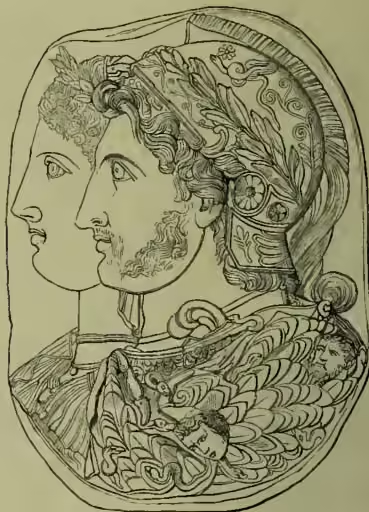
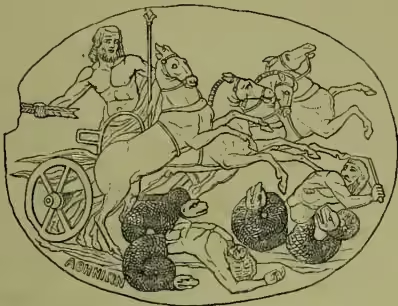
The art of cameo-cutting was not practised till after the era of Praxiteles, and it was in the courts of the successors of Alexander the Great that classical cameos were chiefly sought after. The stones used by the ancient engravers were obtained from the east, and many of them were of surprising size and perfection of form and colour. These banded agates are known generically as onyx stones; when the alternate layers are simply white and dark neutral tint or black they are called simply onyxes; a sardonix consists of strata of white and ruddy brown sard; in the same way we have chalcedony onyx or chalcedonyx (white and translucent gray), jasper onyx, bloodstone onyx, &c. Frequently three differently coloured layers are available to the engraver in the same stone, and these are taken advantage of to obtain the ground in one colour, the figure in a second, and wreaths or other accessories in the third. When cameo-engraving first flourished, the most artistic products were highly prized, not only for personal ornaments, but for the adornment of cups, caskets, vases, candelabra, and other objects of domestic luxury. Patere and other vessels were frequently worked out of a single stone, around which were engraved a whole series of figures in the most exquisite and accurate taste. A vast number of genuine antique cameos have been preserved in fine condition, and are now deposited in various famous public and private collections. Among these ancient art works several have the highest value for artistic excellence, while others are famous for size and for long and romantic histories attaching to them. One of the most celebrated in all respects is the Gonzaga or Odescalchi cameo (fig. 1), a sardonix of three strata, measuring 6 by 5 inches, formerly in the possession of the Empress Josephine, and now preserved in the imperial cabinet at St Petersburg. It was formerly supposed to represent Ptolemy I. and his wife Eurydice; but the portraits have now been identified as those of Nero and Agrippina. Of not less artistic worth is the smaller cameo of Jupiter fighting the Titans, the work of Athenion (50 A.D.), signed in relief by the artist, preserved in the Vatican (fig. 2). For size and historical interest the two most important classical cameos are the Ste Chapelle cameo—the apotheosis of Augustus, now in the Bibliothèque Nationale, Paris, and the Gemma Augustea in Vienna.
The art of cameo-cutting was revived with the general renaissance of the arts in Italy in the 15th century, and it continued to be practised with great success till comparatively recent times, the last of the long line of famous engravers in precious stones having been Pistrucci, who executed works of very great beauty for the English mint. The imperfect supply of fine onyxes, and the difficulty of treating hard stones, led the modern cameo-cutters in Italy and elsewhere to seek other media for their work, and shell-cameos were by them introduced. The shells, like the stones chosen for this purpose, are such as possess layers of different colours. The most useful are the Bull's Mouth, the under layer of which is red, resembling the sardonyx; the Black Helmet, which has a dark onyx ground; and the Queen's Conch, whose ground is of a pinkish hue. These shells have three strata, the undermost of which forms the ground, the figure being sculptured in the second, and the third serving to mark the hair, wreaths, armour, and other more prominent objects. The portion of shell having been prepared of the requisite size, form, and thickness by various mechanical means, it is fixed by some adhesive substance—usually rosin—to a small block of wood of such form and thickness as to be conveniently grasped by the artist in his left hand. The outline of the object or objects to be represented is then sketched with a pencil, and, in the case of portraits, is usually copied from a previous pencil-sketch on paper. The pencil-marking on the shell is then followed with a scratch-point, and the surrounding white substance is removed by means of files and gravers. This latter process, which is more mechanical than the rest, is usually performed by an assistant. The artist then proceeds slowly and carefully to work out his subject by the use of smaller tools; those used at last for deepening the finer lines being scarcely larger than ordinary darning-needles. The manufacture of shell-cameos hardly ever attained to the dignity of art; and it, combined with the forgeries and frauds in spurious antiques of the latter part of the 18th century, had much influence in causing the decline and present extinction of gem-cutting.
Imitation cameos termed pastes are made in glass of different colours, the figures or subjects being formed in moulds, in soft fusible glass, by the aid of heat, and cemented to the background. Sometimes both background and subject are fused together. James Tassie, a Scottish artist working principally in London, formed a collection of about 20,000 moulds from antique and modern gems for such pastes, and a very full collection of his productions is now in the possession of the Board of Manufactures in Edinburgh. The engraving of relief figures on glass of two or more strata is an art allied to cameo-cutting, which will be treated of under GLASS, and the technical details of gem-cutting will be given under INTAGLIO.