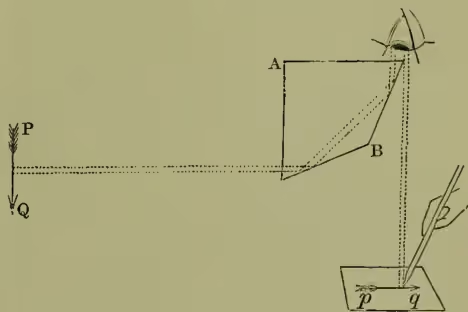
Camera Lucida (so named in contrast to Camera Obscura, q.v.), an optical instrument constructed of various forms and for various purposes. Dr Robert Hooke invented one about 1674; whilst Dr Wollaston's (1807), intended to facilitate the perspective delineation of objects, consists of a small quadrilateral prism of glass, of which AB in the annexed figure is the perpendicular section, held in a brass frame, which is attached to an upright rod, having at its lower end a screw-clamp, to fix it to the edge of a table. The prism being at the height of about a foot from the table, has its upper face horizontal. Two of its faces, as in the figure, are at a right angle at A; the contiguous faces make respectively with them angles of ; so that the remaining obtuse angle at B contains . Rays coming from an object PQ, and falling nearly perpendicularly on the first surface, enter the prism, and undergo total reflection at the contiguous surface (see OPTICS); they then fall at the same angle on the next surface, and are totally reflected again; finally, they emerge nearly perpendicularly to the remaining surface. An eye, as in the figure, then receives the emergent pencil through one part of the pupil, so that an image, pq, of the object is seen projected upon a sheet of paper upon the table. The rays from the drawing-pencil passing the edge of the prism, enter the other part of the pupil; and the pencil and image being seen together upon the paper, a sketch of the latter can be taken. There is, however, a practical difficulty—the image and the drawing-pencil are at distances sensibly different from the eye, and so cannot be seen together distinctly at the same time. To obviate this, a plate of metal, with a small aperture as an eye-hole, is placed at the edge under the eye, so that the rays through the prism, and those from the drawing-pencil, which both pass through the eye-hole, form only very small pencils. By this the difficulty is greatly diminished. It is still, however, difficult to use the instrument satisfactorily; and though many acquire great readiness in its use, others have never been able to attain the same facility. A simpler form is merely a piece of smooth glass fixed at an angle of to the horizon. In this case, however, the image seen on the paper below will be inverted. In Amici's form of the instrument a right-angled triangular prism is used, involving two refractions and one reflection.