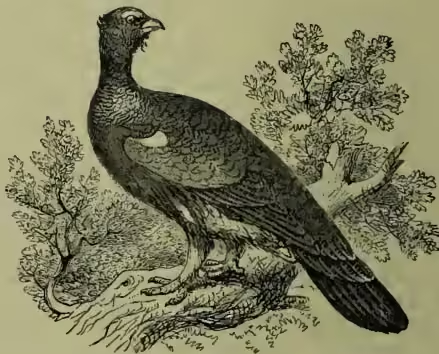
Capercaillzie, or CAPERCAILLIE, also called Wood-grouse, or Cock of the Woods (Tetrao urogallus), the largest of the gallinaceous birds of Europe. It is a species of Grouse (q.v.), almost equal in size to the turkey; the male, which is about a third larger than the female, sometimes weighing fifteen pounds or more. In figure and appearance it much resembles the blackcock, but the male has a rounded, not forked tail, and elongated head-feathers. The general colour of the adult male is brownish black, minutely freckled with grayish white and with lighter brown; the quill-feathers dark brown; the tail-feathers nearly black, some of the longer tail-coverts on the sides of the tail tipped with white; the chest is of a shining dark green; there is a small scarlet patch of naked skin above the eye, and the bill is whitish. The general colour of the female and of young males is dark brown, freckled with yellowish brown; the front of the neck and the chest are yellowish chestnut; and the feathers of the under parts are generally edged with white. The feet are feathered to the toes, but these are naked. It is an inhabitant of pine-woods; feeds on berries, seeds, worms, insects, &c., and on the young shoots of the pine, greatly preferring the Scotch fir to the spruce; occasionally also eating, at least in winter, the buds of the birch and other trees. The females and young feed largely on insects and worms. The female makes her nest on the ground, and lays from six to twelve eggs, of a pale reddish or yellowish brown, spotted with other shades of brown, and more than two inches long. The young birds keep by the mother till winter. Like the blackcock, the capercaillzie is polygamous. In spring the males indulge in untiring love-song, and in grotesque play to attract the females. Fights between rival males are of common occurrence. The geographical distribution is very extensive: it is found on the pine-covered mountains of all parts of Europe, from Spain and Italy almost to the North Cape, and is abundant in the northern parts of Asia. It was at one time found both in Scotland and Ireland, but was completely extirpated about the end of the 18th or beginning of the 19th century. Through the exertions, however, of the Earl of Fife and other proprietors of great Highland estates, but particularly of the Marquis of Breadalbane, it has again been restored to the forests of the Highlands of Scotland. It is very capable of domestication, and breeds readily, if allowed the range of a space containing pine-trees. It is much esteemed for the table, and is imported from Sweden into London. See Brown's The Capercaillie in Scotland (1879).