Capillaries. The tubes which convey the blood from the heart to the various parts of the body are termed arteries, while those which return it to the heart, after it has discharged its various functions in the body, are known as veins. The name of capillary (from capillus, 'a hair') is given to the minute vessels which form the connection between the terminal branches of the arteries and the commencements of the trunks of the veins. These little vessels are of various sizes, some admitting only one blood-corpuscle at once, while others are large enough to allow of the simultaneous passage of two, three, or more corpuscles. In the muscular tissue their average diameter is 0.003 of a line; they are smallest in the brain, and largest in bone. Their arrangement varies in different parts. In the accompanying figure, which represents their distribution in muscular tissue, they run for the most part parallel to one another; in other cases (as around fat-cells) they have a spherical arrangement, and in the skin and in parts of the intestines they form loops; and many other forms of distribution might be mentioned. These various arrangements have been discovered by the microscopic examination of tissues that have been successfully injected with coloured fluids.
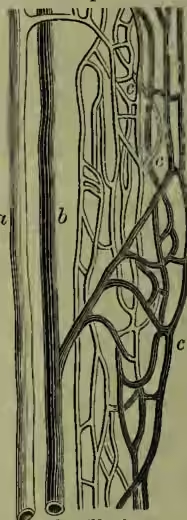
The circulation of the blood through the capillaries may be readily seen in the web between the toes of the hind-foot of the frog, in the tongue of that animal, in the tail or gills of the tadpole, in the wing of the bat, &c. The wall of a capillary is formed of a single layer of flattened cells, attached to each other by their margins (which may be rendered apparent by nitrate of silver), and continuous with the corresponding layer lining Arteries and Veins (q.v.).
The principal uses of the capillary system of vessels will be noticed in the articles on DIGESTION, NUTRITION, RESPIRATION, and SECRETION.