Capillarity. When a number of clean glass tubes of very fine bore, each open at both ends, are immersed in water, or in any other liquid capable of wetting them, the water rises in each to a higher level than that at which it stands outside, and the finer the bore the greater is the height of the water. Moreover, the surface of the water is always concave outwards. The accompanying diagram (a) shows the phenomenon in question.
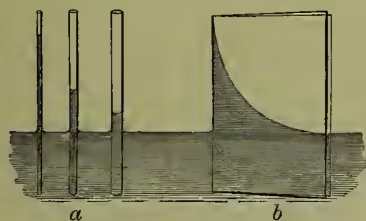
When similar tubes are immersed in mercury the results are just the opposite of the above. The mercury now stands at a lower level inside than outside each tube, and the mercury-surface is always concave downwards. The diagram, if turned upside down, will correspond to this effect. In both cases it is to be observed that the curvature of the surface of the fluid is greater the finer the bore of the tube.
These are the fundamental facts which constitute the phenomena of capillary action, the tubes, with their fine hair-like bores, being called capillary tubes, from capillus, 'a hair.' The phenomena of capillarity may, however, be produced without the use of capillary tubes. Thus, if two plates of clean glass be set vertically and parallel to one another in a dish of water, the liquid will rise up between them, but the rise is only half of that which would occur in a capillary tube whose diameter is equal to the distance between the plates. As in the case of capillary tubes, the height of the water increases as the distance between the plates diminishes, and the water-surface is concave outwards. If mercury be used in place of water, the mercury will be depressed, and its surface will be convex.
If the plates have two vertical edges in contact, while the opposite edges are kept separate by a thin wedge, the water will rise between the plates to different heights, the height at any point being inversely as the distance between the plates at that point. The intersection of the water-surface with the plate thus forms a curve which is known as the equilateral hyperbola. The diagram (b) shows the phenomenon in question.
In order to understand the cause of capillary action it is necessary to refer to what is known as the surface-tension of fluids. The particles of a body of moderate dimensions are kept together by powerful molecular forces which have one main characteristic, that they are only sensible at insensible distances. From this it is at once evident that there must be an essential difference in state between parts of a liquid close to its surface and others in the interior of its mass. The result of this difference is that every liquid may be regarded as bounded by a surface-film which behaves like a stretched membrane. The tension of this film is what is termed the surface-tension of the fluid. Now, when a soap-bubble is blown at the mouth of a funnel, and the neck is left open, the bubble shrinks and expels the contained air. The air within the bubble is thus proved to be at a pressure greater than that of the atmosphere, otherwise it would not rush out; and it can be proved by mathematical methods that the effect of the surface-tension of the soap film is to make the pressure per unit of surface on the concave side exceed that on the convex side by the expression , where is the intensity of the surface-tension, and , , are the radii of curvature of any two sections normal to the surface and to each other.
We are now in a position to explain the fundamental capillary phenomena. The water-surface is concave outwards, and therefore the water im- mediately under the surface-film has a less pressure than that of the atmosphere to which its concave side is exposed; and thus by the ordinary hydrostatic law it belongs to a higher level than the undisturbed water, the pressure on which is equal to that of the atmosphere. In the case of mercury, on the other hand, we see that, since the fluid surface is convex outwards, the mercury immediately under the surface-film must have a greater pressure than that of the atmosphere, and must therefore stand at a lower level than the undisturbed mercury.
It can be shown mathematically that the height of elevation of water, or depression of mercury, varies inversely as the radius of the tube. This agrees with the experimental fact that the finer the bore the greater is the capillary action, and is also a direct consequence of what has been stated above. The finer the bore, the greater is the curvature of the surface, and therefore the greater is the difference between the pressure on the concave and that on the convex side of the film. Thus we account for the increased height of elevation of water and depression of mercury.
We have now to explain why the water-surface is concave and the mercury-surface convex.
When two fluids, such as water and air, are in contact, we have seen that the surface of separation is in a state of tension. Now, when a solid is in contact with two fluids, as in the case of water in a capillary tube, there is a different tension in each of the three surfaces separating a pair of media. Further, since the solid cannot alter its form, the angle at which the surface of contact of the two fluids meets the surface of the solid, called the angle of capillarity, must depend on the value of the three surface-tensions. When the two fluids are air and water, or air and mercury, the tension of the surface separating the two fluids exceeds the difference between the tensions of the surfaces separating the solid from each of the fluids; and thus the angle of capillarity will be acute or obtuse, according as the one or the other of the latter tensions exceeds the other.
The effect of heat on capillary action may be noted in passing. When heat is applied, it is found that the tension and curvature of a water-surface are diminished, and thus, on both accounts, the height to which water rises, or the depth to which mercury is depressed, in a capillary tube, becomes less as the temperature rises.
The depression of mercury in a fine glass tube makes it necessary to use a correction in reading off the height of the mercurial column in the barometer, which, owing to it, stands always a little lower than the height due to the atmospheric pressure.
There are many phenomena which can easily be explained by the help of capillary action. Thus, when two light bodies, such as two pieces of cork, are left to float on still water, near each other, they soon come together, moving at last with a rush. The water wets the floating bodies and rises round them, and thus, when they are near each other, the space between them becomes like part of the interior of a capillary tube; and, the pressure between the bodies being less than that outside, the bodies are driven together, and therefore seem to attract one another. This is always the case with any two bodies each of which is wetted by the water, and it is also true when neither is wetted. If one of the bodies is smeared with oil to prevent the water from wetting it, the two will behave as if they repelled one another. Again, when a drop of water is placed between two very true plates of glass, the pressure produced by the capillary action forces the plates together, thus increasing itself not only by the enlargement of the wetted surfaces, but by increasing the curvature round the edges. The pressure produced in this way may be sufficiently great to crack the plates. The action of a boy's 'sucker' is explainable in a similar manner.