Carabidæ, a tribe of beetles, or coleopterous insects, of the section Pentamera (see COLEOPTERA).
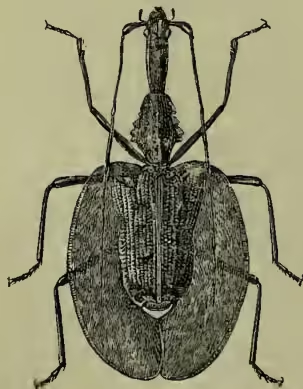
The species are extremely numerous, those already known numbering about ten thousand. They mostly feed at night on other insects, worms, snails, &c., and are extremely voracious and active, habits which are fully shared by their larvæ. One form at any rate, Zabrus gibbus, is exceptional in its vegetarian diet, and sometimes does con- siderable damage in wheat-fields. Some of them burrow in the earth; most of them live under stones, under the bark of trees, among moss, &c.; and their bodies are adapted to this mode of life, being very firm and hard. Their legs are in general pretty long, having on the anterior pair often brush-like soles, and much more efficient than their wings. Some of them indeed are wingless, or have only rudimentary wings. Many exhibit much beauty of colour and metallic lustre. When irritated they eject an irritant, strong-smelling fluid from glands situated posteriorly (see BOMBARDIER BEETLE). The Carabidæ occur everywhere, even in the arctic regions, and blind forms occur in caves. With extremes of temperature they become readily dormant. The largest British species is only about an inch long, but some foreign ones are much larger. Some of the species of Carabus are among the most common British insects. Their wings are not fitted for flight.—A very large and singular insect of this tribe is Mormolyce phyllodes, a native of Java, which, in consequence of the extremely depressed form of its body and the expansion of its wing-cases, resembles some of the Mantidæ (q.v.) and the insects known as Leaf-insects (q.v.).