Carbonic Acid, CARBON DIOXIDE, or CARBON ANHYDRIDE, also called Fixed Air or Choke-damp, exists as a normal constituent of the atmosphere, of which it forms about th part. While enormous quantities of it are poured into the atmosphere by the respiration of animals and by the combustion of fuel in our furnaces, this proportion scarcely seems to vary; for, as plants absorb carbonic acid by the leaves, and therefrom obtain the carbon necessary for the formation of wood, they remove it as fast as it is produced, and thereby keep the atmosphere in a state suitable for animal life. Carbonic acid also exists in combination as carbonates, the most largely distributed of which are the carbonate of lime, , either alone, or in combination with mag- nesinm as dolomite, the blackband ironstone (carbonate of iron, ), malachite (basic carbonate of copper, ), &c. The term carbonic acid is hardly a correct one, and it is better to call the gas, , carbon dioxide or carbonic anhydride, reserving the term carbonic acid for the solution in water. The gaseous carbonic acid is represented by the formula , and contains 12 parts of carbon and 32 parts of oxygen by weight. It is a very dense gas, having a specific gravity of 1.529, that of air being 1.000. In consequence of this it can be poured from one vessel to another like a liquid; while in vats in which it is being disengaged by fermentation, it remains at the bottom, for some time even when freely exposed to the air, giving rise to fatal accidents when workmen carelessly enter them. Carbonic acid is a colourless gas, possessing a pleasant acidulous taste. Under a pressure of about forty atmospheres (600 lb. per square inch) it becomes condensed to a liquid. When the liquid carbonic acid is allowed to escape through a small jet, it rapidly evaporates and produces intense cold, with the result that a certain portion becomes frozen into a solid resembling snow. The solid carbonic acid volatilises without becoming liquid, and by the low resulting temperature produces strange phenomena. Thus when pressed on the skin it produces the sensation of burning, and when thrown into a hot crucible along with mercury, the latter (under suitable conditions) becomes frozen into a solid mass.
At ordinary pressures carbonic acid is soluble in about its own bulk of water, its solubility increasing with increased pressure. This property is taken advantage of in the manufacture of Aerated Waters (q.v.), the sparkling appearance of which is due to the liberation of carbonic acid. Carbonic acid is non-combustible, and it does not support combustion or animal life. A lighted taper is immediately extinguished when plunged into a vessel containing carbonic acid, and this simple experiment is used to test if workmen may safely enter a vat which has contained the gas. Although irrespirable by itself, acting as it does, like water, by causing spasm of the glottis, it can be breathed when diluted with air, and in such circumstances it acts as a narcotic poison, even so small a proportion as 4 per cent. acting rapidly. In much less quantity it causes depression and headache, but in aerated water works, where carbonic acid gas is liberated in quantity, it has never produced this effect, probably owing to the efficient ventilation. The French suicides who make use of a charcoal fire to terminate their existence, are partly poisoned by the carbonic acid, and partly by the Carbonic Oxide (q.v.) produced by the burning carbon.
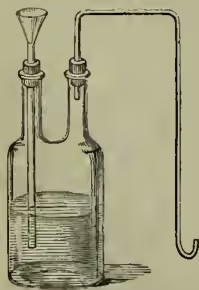
Carbonic acid may be very readily prepared from chips of marble, water, and hydrochloric acid, which are placed in a glass bottle furnished with suitable tubes (see fig.). The hydrochloric acid, , acts on the marble, , forming chloride of calcium, , and water, , while the carbonic acid gas, , escapes with effervescence, and may be collected in suitable vessels. Carbonic acid, as indicated before, is the principal product of combustion; the carbon of the burning substance (wood, coal, paper, coal-gas, &c.) uniting with the oxygen of the air to form carbonic acid. It is also a product of Respiration (q.v.), and is evolved more or less largely by all animals not only by the lungs, but also by the skin. During the Fermentation (q.v.) of beer or wine it is liberated, while decaying vegetable or animal matters give off the gas in quantity. There is a popular prejudice against having plants in a bedroom during the night-time. This is based on the fact that plants give off carbonic acid in the dark, while they absorb it during the day. Plants also liberate carbonic acid during the flowering season, but the total amount from these two sources is so very small, that a single gas-burner will vitiate the air of a room more rapidly than a large collection of plants. The prejudice based on the carbonic acid theory seems therefore to be practically groundless. Carbonic acid forms two classes of salts, called carbonates and bicarbonates. The bicarbonates differ from the carbonates in containing twice as much carbonic acid gas relatively to the base. Thus carbonate of soda, , may be regarded as consisting of soda, , and carbonic acid, ; while the bicarbonate, represented in the same way, would be , or shortly, (see SODA, SODIUM). The bicarbonates very readily lose the extra molecule of carbonic acid, yielding then the ordinary carbonate. For the carbonates of potash and of iron, see POTASH, IRON.
The bicarbonate of lime is interesting as being the form in which most of the lime present in drinking water is held in solution. When the rain, impregnated with carbonic acid from the atmosphere, or charged with the gas from subterranean sources, percolates down through a chalky soil, it dissolves the chalk, or carbonate of lime, , forming a bicarbonate, and thus becomes what is known as a hard water. Such a water may be readily softened by boiling, when the carbonic acid escapes, and the chalk, no longer soluble, falls to the bottom. This gives rise to the domestic phenomenon known as the furring of the kettle. A solution of slaked lime in water (the lime-water of the shops) forms a ready test for carbonic acid. Thus, if a little be placed in a wine-glass, and a steady stream of expired air from the lungs be blown into it, a turbidity will soon be noticed, due to the formation of carbonate of lime. On continuing to blow, the carbonic acid dissolves this up, and a clear solution of bicarbonate is obtained.
Other carbonates, such as those of silver, iron, copper, baryta, &c., are not of sufficient importance to warrant further notice here.
Carbonic acid in solution forms a refreshing drink in feverish states of the system, while in nausea and gastric irritation its value is very considerable. It acts also as a diuretic, and probably, when taken in moderation, as a stomach tonic. Owing to its sparkling properties it is used to conceal the taste of many drugs; and the granular effervescing preparations, such as citrate of magnesia, now so widely known, have come into use mainly on account of the ease with which nauseous drugs may be administered under the guise of an effervescing drink. In the form of gas, carbonic acid is said to be beneficial in the irritable states of the larynx, owing to its exercising a slight local anaesthetic action.
The carbonates possess mainly the medicinal properties of the bases, than which they are less irritating, the soda, potash, lime, and magnesia salts being recognised antacids. The magnesia salt, in the form of the bicarbonate, is well known as 'fluid magnesia,' which possesses both antacid and aperient properties.