Carnivora, a well-defined order of Mammals more or less efficiently adapted for predaceous life, and including most of the forms popularly known as Beasts of Prey. It partly corresponds with the order Ferae defined by Linnæus, but the latter included also Marsupials and Insectivora. Not all animals carnivorous in diet are Carnivora in structure, for the Dasyure or Tasmanian Devil is a Marsupial, and the blood-sucking Desmodus is a bat. Nor are all the members of the order Carnivora in diet purely carnivorous, for the polar bears eat grass greedily, the ratels are very partial to honey, and many forms eat fruits, berries, insects, molluscs, or crustaceans in a highly omnivorous manner.
General Characters.—The dentition of most Carnivora is very characteristic; there are in each jaw six pointed cutting teeth, two strong sharp recurved canines, and molar teeth often adapted for cutting. The skull is short and dense. The lower jaw works up and down in a deep transverse semi-cylindrical groove, and there are deep hollows on the sides and prominent crests on the roof of the skull for the reception and insertion of the powerful muscles which work the jaw. The toes are clawed, with more or less pointed nails almost always well developed.
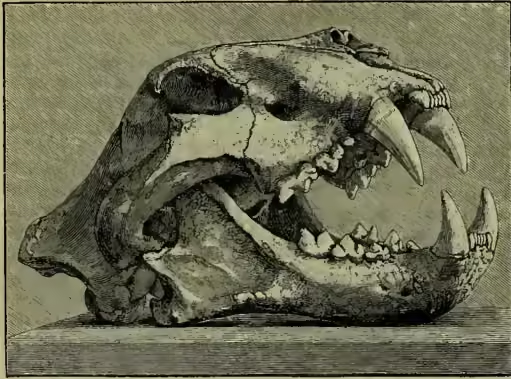
As one would expect in animals with a vigorous life-experience, the convolutions of the brain and olfactory lobes are well developed. In contrast to herbivorous animals, the stomach is simple, and the cæcum or blind process of the intestine is either absent or small. The placentation is deciduate and generally zonary. Carnivorous diet, vagrant predatory habit, fierce disposition, and high intelligence are familiarly characteristic.
Classification.—It becomes at once necessary to distinguish two sub-orders (a) the typical, terrestrial Carnivora (Fissipedia), and (b) the aberrant, aquatic forms (Pinnipedia), which may be thus contrasted:
| FISSIPEDIA. | PINNIPEDIA. |
|---|---|
| Terrestrial, at most partially aquatic. | Aquatic, except at birth. |
| Special cutting back-tooth in each jaw. | Very uniform back-teeth. |
| Incisors almost always 3. | Always fewer. |
| Strong curved sharp claws. | Webbed feet. |
| First and fifth digits of hind-foot never longer than the others. | Outmost and inmost toes of hind-foot predominate in length and strength. |
The second sub-order, with its numerous adaptive characters, has doubtless been derived from the first, and is divided into three families, with about fifty species: (1) Otariidæ (Sea-bears), nearest the typical Carnivores, (2) Tricheidæ (Walrus), and (3) Phocidæ (Seals). Some Tertiary fossil forms are known, but they are not nearer the typical Carnivores than those now existing.
Cuvier proposed to divide the typical carnivores into Plantigrades, walking on the entire sole—e.g. bears, and Digitigrades, walking on finger-tips—e.g. cats; but these physiological differences are rendered useless by the multitude of transitional links connecting them, and besides, as an accurate fact, the majority of Carnivores ‘belong to neither one form nor the other, but may be called sub-plantigrade.’ It is at once more accurate and useful to divide the typical Carnivores into three sections, represented familiarly by bear, dog, and cat, and technically known as Arctoidea, Cynoidea, Æluroidea. The distinctions are based on certain features in the base of the skull, but are corroborated by other more general characteristics. There are about 300 living species.
(1) The Arctoidea, which are least specialised, and nearest the aquatic sub-order, include the following families: (a) Mustelidæ—e.g. Otter (Lutra), Sea-otter (Enhydra), Skunk (Mephitis), Sand-bear (Arctonyx), Badger (Meles, Taxidea), Ratel (Melivor), Grison (Galicis), Marten and Sable (Mustela), Stoat or Ermine (Putorius), Glutton (Gulo), &c.; (b) Procyonidæ—e.g. Raccoon (Procyon), Coati (Nasua), Kinkajou (Cercoleptes); (c) Ailuridæ—e.g. Panda (Ailurus); (d) Ursidæ—e.g. Bear (Ursus).
(2) The Cynoidea (q.v.), occupying a median position, include numerous forms in two series represented by dog and fox.
(3) The Æluroidea, comprising the most specialised carnivores, include four families: (a) Felidæ—e.g. Cat, Lion, Tiger, Jaguar, Cheetah (Felis); (b) Viverridæ—e.g. Civet (Viverra), Binturong (Arctictis), Ichneumon (Herpestes); (c) Hyænidæ—e.g. Aardwolf (Proteles), and Hyæna.
Pedigree and History.—The fossil history of Carnivora is of great interest, for not only have some remarkable forms like the sabre-toothed tiger (Machairodus, q.v.) been unearthed, but the various families are linked together, as the cats and civets by Proviverra, and the ancestors of at least the cats and the dogs are found in primitive generalised carnivores, such as Miacis, Oxyæna, and Arctocyon. The group affords beautiful illustration of increasing and of divergent specialisation as illustrated in the passage from primitive forms to the lion on the one hand and the seal on the other. As to the relation of the Carnivora to other orders of mammals, speculation is rife, but firmly based conclusions hard to find. Looking backward, some naturalists have discovered affinities with the marsupials, while others looking forward have with more abundant evidence regarded the primitive carnivores as ancestral to Insectivora, and through them to Chiroptera. Some, again, find affinities between Cetacea and carnivores, though this is vigorously denied by other authorities. See Huxley, Anatomy of Vertebrate Animals; and Flower, Osteology of Mammalia.