Carpets. When and where the earliest carpets were made can only be matter of conjecture. Skins of animals covered with fur, and plaited plant stems, such as those of rushes, would in all probability be used as mats in prehistoric times. Sir G. Wilkinson states that imperfectly preserved fragments of woollen stuff, presenting the appearance of a carpet, were found at Thebes in Egypt. He also calls attention to a small ancient rug brought from Egypt to England. It is made of woollen threads on linen string, and has upon it the figures of a boy and a goose—the hieroglyphic of a child. But in Dr Birch's opinion this rug is of the Greek or Roman, not of the Pharaonic period. Carpets were in use in ancient Greece and Italy.
Persian Carpets.—The manufacture of these goes back to a very remote period. Indeed it appears to be certain that pile carpets were first made in Persia, and from that country introduced into India by the Mohammedan conquerors. The Persian habit of sitting and sleeping on the ground probably brought into use soft floor-coverings suited to such a custom. Even among the higher classes in Persia carpets constitute the whole furniture of a room, except a few ornaments placed in niches in the wall. A Persian not only sits and sleeps upon, but also makes a table of a carpet. Fine Persian fabrics of this kind are very highly prized for their beautiful and appropriate designs, and for the quiet harmony of their colours. They are of great durability. Sir Murdoch Smith states that the floor of the chief pavilion of the Chehel Sittān palace at Ispahan is covered with a fine carpet which has been in use since the time of Shah Abbas, who reigned in the end of the 16th century. Persian pile carpets are made by firmly knotting tufts of woollen yarn on the warp threads, and these tufts are held in their place by the woof yarn. The finest are those of Kurdistan; but carpets are made in many parts of Persia, so also are felts or nūmūds, the best of which are fully an inch thick. These felts are formed of camel's hair, more or less mixed with wool, and are ornamented on one side with inlaid devices. They are used to cover the sides and end of a room, and owing to their thickness are softer to sit upon than ordinary carpets. An attempt was made to introduce the making of Persian carpets after the Persian manner into Finland in 1888. At the sale of the Goupil collection in Paris in the spring of 1888, two small old Persian carpets, each 7 feet by 6 feet, brought respectively £800 and £1300. For three others, also of small size, the sum of £1500 was obtained. About £200 is believed to be the highest price hitherto paid in Persia itself for a small carpet. There are photo-engravings of two of Goupil's carpets in the Gazette des Beaux-Arts for 1885, and larger coloured illustrations of fine Persian carpets in the Portfolio of Persian Art, issued by the South Kensington Museum.
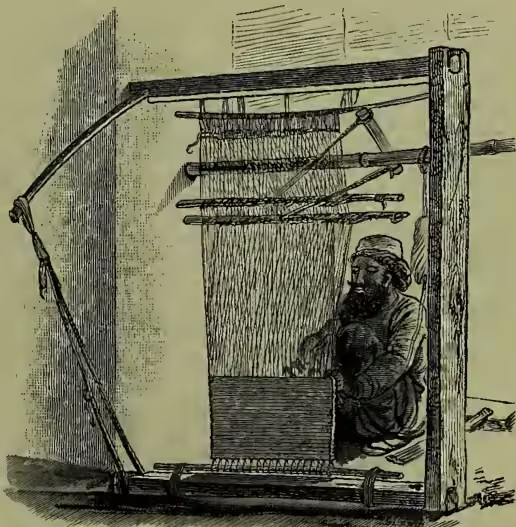
Indian Carpets.—Both cotton and woollen carpets are made in India. Those composed of cotton are chiefly made in Bengal and Northern India, and are usually in two coloured stripes, such as red and blue. They are often further ornamented with squares and diamond shapes, and occasionally with gold and silver. Sir George Birdwood, a high authority on the history of Indian manufactures, considers that the patterns upon these cotton carpets, as well as those upon portions of some native dresses, illustrate the most ancient ornamental designs of India. The patterns on the woollen pile carpets of India can be traced back to Persian originals, and both fabrics are made in the same way. Many of the older ones, as well as some quite recently made, are scarcely less remarkable than those made in Persia for their beauty and other meritorious qualities. In numerous parts of India, however, the designs have suffered from European influence. Fig. 1 shows an Indian carpet loom; those used in Persia are equally primi- tive. Carpets are made in Cashmere, the Punjab, Sind, and on the Malabar coast; also at Agra, Mirzapur, Jubbulpore, Hyderabad, Masulipatam, and elsewhere. Some silk and velvet carpets are likewise made in India.
Turkey Carpets.—Like the carpets of Persia, India, and North Africa, these are made on rude simple looms by knotting tufts of woollen yarn on the warp threads across the width of the carpet, and firmly binding the rows of these tufts by the weft. The most characteristic patterns of Turkey carpets are diamond shapes and zigzags—that is, they are more purely geometrical than the Persian designs. The arrangement of the colours usually adopted produces a rich and pleasing effect, and the fabric from its mode of construction and depth of pile is extremely durable. Turkey carpets are chiefly made at Ushak, near Smyrna, in Asia Minor.
The carpets of the kind manufactured from 1755 till 1835 in England at Axminster, and still made to a small extent at Wilton, as well as some of the highly ornamental French carpets, such as those of Aubusson and Beauvais, are made on the same principle as oriental pile carpets.
Kidderminster or Scotch Carpet.—This is the oldest kind of machine-made carpet. It has no pile, the yarn of which it is composed lying flat upon the surface like an ordinary worsted cloth. In some respects, although coarser and stronger, it resembles a woollen damask of two colours, and like it is reversible. The pattern is most perfect on the face side, but if in this position it shows a purple flower on a green ground, then on the other side the flower is green on a purple ground. This would be a two-ply carpet, the purple portion forming a separate layer from the green portion, except at the edges of the flower, where the yarn in passing from the front to the back binds the two layers together. A three-ply is in three layers, and is usually in three or more colours or shades of colour. The different layers are interlocked by the manner in which the threads are used to form the pattern. Union Kidder Carpets resemble the two-ply kind, except that instead of being all wool, they have cotton warps and worsted wefts. In these the colour of the cotton usually fades before that of the wool. Kidderminster carpeting is woven on power-looms with Jacquard apparatus.
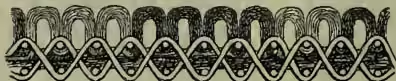
Brussels Carpet.—In this make of carpet the worsted threads are arranged in the warp, and are interwoven into a network of linen. Still the bulk of the carpet consists of wool. What is called a six-frame 'Brussels' consists of six layers or thicknesses of coloured worsted yarn, but there are also five, four, and three frame carpets of this kind, each formed of a corresponding number of worsted threads. Of these the best and thickest is the six-frame variety. The number of colours in the carpet indicates often, but not always, the number of frames used in its construction. These frames are placed behind the loom, and each of them contains about 260 reels or bobbins of worsted, which as a rule is of one colour, that being the number of threads in a carpet of the usual width of 27 inches. But by a little ingenuity five or six colours can be arranged in a four-frame carpet, in which case only an expert can determine its quality. Brussels carpet is woven on a loom with a Jacquard apparatus (see LOOM), which raises such of the coloured yarns to the surface as the pattern requires at each throw of the shuttle.
These are at the same time formed into loops by the insertion of wires, which are immediately withdrawn. Fig. 2 shows a section of a Brussels carpet in which these wires are shown.
Velvet Pile or Wilton Carpet.—This only differs from a Brussels carpet in having the raised loops cut so as to give it a velvet-like surface.
Tapestry Carpet (fig. 3), the name given to a carpet made of parti-coloured yarns by a very ingenious method patented by Mr Richard Whytock of Edinburgh in 1832. It resembles the 'Brussels' make inasmuch as the surface is formed of loops of worsted yarn, but instead of each thread being of a single colour, it is of several colours in the tapestry carpet. It is really a printed carpet, but it is only the woollen warp yarn, not the woven fabric, which is printed. These yarns are placed on a large drum which is traversed by small rollers charged with dyes, and thus the threads are printed in bands of various widths. When the parti-coloured warp threads are arranged for weaving, the pattern appears long drawn out. In that stage what are to be squares in the woven pattern appear as oblongs, and what are to be circles as ellipses.

The weaving draws them up into proper shape, and the looms are simple. Although the back of a tapestry carpet may be of any vegetable fibre, it is very frequently of jute, but the wool is practically all on the surface. In a Brussels carpet on the contrary the worsted yarns are not only on the surface but in layers below it.
Carpets of undyed worsted yarn are made of a similar structure to the tapestry kind, and afterwards printed with a pattern on the surface.
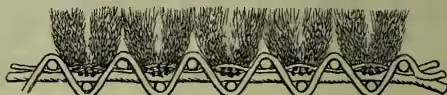
Patent Axminster Carpet (fig. 4).—Mr J. Templeton of Glasgow patented in 1839 a method of making carpets by the use of chenille which are known by this name. The wool chenille is first woven on a separate loom, and cut into strips for the weft. In this kind of carpet the elements of the design or pattern exist in the chenille weft, which somewhat resembles the parti-coloured warp yarn in the tapestry carpet; but this chenille, having a pile to begin with, does not require to be formed into loops. The surface of the carpet is in fact formed of weft lines of chenille, which, so to speak, has a backbone of thread. By means of 'catcher warps' crossing its backbone, the chenille is bound to a strong under-fabric of cotton, linen, or hemp.
Royal Axminster Carpet.—This is a kind of carpet which has been recently introduced. It differs from Templeton's patent Axminster in not requiring the preliminary weaving of the chenille, and from 'Brussels' in not requiring the use of Jacquard apparatus to weave it. In the Royal Axminster the pattern is arranged line by line on a succession of small spools of yarn, from which tufts are cut by machinery and fastened into the carpet by the interlacing of linen or jute warp and weft.
Jute Carpets.—Owing to the fact that jute is neither a very durable fibre nor easily dyed with permanent colours, carpets made of it are not highly esteemed, but they are much cheaper than other kinds. They are made (at Dundee on a very large scale) either with a looped or plain surface, and their patterns may be as beautiful as any on Brussels or Kidderminster carpet.
Seats of the Industry.—Kidderminster is the chief seat of the Brussels and velvet pile carpet manufacture, but this branch of the trade is also carried on at Stourbridge, Durham, and Halifax. 'Scotch' carpets are made at Dewsbury and other towns in Yorkshire, to a small extent at Kidderminster, and more largely at Kilmarnock and Bannockburn. Tapestry carpets have been made to a very large extent in Yorkshire; as also on the banks of the Esk near Edinburgh, where they were originally made. The expensive patent Axminster carpet is made at Glasgow and in England. In the United States, carpets are manufactured extensively at Philadelphia, Lowell, and elsewhere. German-made carpets compete formidably with English and Belgian carpets, and the export is increasing year by year; a French consular report of 1888 says fine German handworked carpets are sent to Smyrna, and re-imported to Europe as Eastern carpets. But Britain is the great head-quarters of carpet manufacture; and carpets of all kinds (including, for example, prayer carpets, or rugs for carrying to church) are largely exported—the value of the exports amounting to £1,250,000 per annum.
Merits and Defects of Carpets.—Brussels carpet is growing most into favour. Both it and the tapestry kind let less dust through them than a Kidderminster does. The latter, though an excellent fabric when well made, wears much sooner than either of the other two kinds to the extent of disfiguring the pattern on one side—that is, unless the tapestry carpet is of poor quality. The advantage of getting wear out of two sides does not bring a Kidderminster up to a Brussels in point of durability, but a Kidderminster is better in this respect than a fair quality of tapestry carpet. When the woollen surface of the latter is worn it is very unsightly, which is not the case with a Brussels, at least not nearly to the same extent. The patent Axminster carpet is very durable when it has a deepish pile; but if not carefully handled, a strip of its chenille gets loose, and this is a little difficult to repair. Rag-carpets are made of rags variously joined together. Formerly carpets were always cut to fit an apartment in Britain. Of late it has become not unusual to have square carpets occupying only the centre of the room (as is common abroad), the rest of the floor being varnished.
The so-called Holy Carpet, sent annually from Cairo to Mecca with solemnities, is really a silk covering for the Ka'aba. See MECCA.