Cartridge, a cylindrical case containing the powder charge only in the case of Cannon (q.v.), but powder, cap, and shot in that of small-arms; or the bullet may be omitted, when it is called 'blank cartridge.' Those for large guns are bags usually of serge or flannel, filled with the proper weight of powder, tied round the neck, and strengthened by worsted hoops. In the largest cartridges a strong stick is placed to give greater strength, and those used for drill and salutes have cases of raw silk, because that material does not smoulder.
The cartridge formerly used with muzzle-loading rifles was a paper cylinder inclosing the powder and bullet and greased outside the latter. To load, the end was torn or bitten off, the powder poured into the barrel, and the bullet, together with the paper cartridge-case, rammed down above it. A cartridge for breech-loading small-arms (see BREECH-
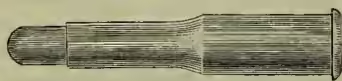
LOADING), as now constructed, is a cylinder of solid brass, with a strong base, in the centre of which is the percussion arrangement. Those made of coiled brass have been discarded as being liable to jam in the barrel. The Enfield-Martini (see RIFLES) rifle has a cartridge of the form shown in fig. 1, containing, beyond the cap, 85 grains of powder, and a Bullet (q.v.) weighing 384 grains. Between them is a compound wad inch thick, half of that thickness being cardboard, next the powder, and the other half beeswax, so that the bore is cleaned out by each discharge. All modern military rifles have similar cartridges, the actual shape depending upon that of the Chamber (q.v.), the calibre, and the powder charge. The solid-drawn case being almost indestructible, can be re-charged and capped twenty times, and the rifle cartridge can be used with Machine Guns (q.v.) of the same bore, and with carbines.
Pistol or revolver cartridges are similar to those for rifles, but shorter, and some of the smaller patterns are ignited differently, the hammer striking a rim at the base of the cartridge, which contains the fulminate.
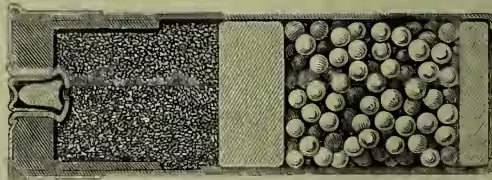
For sporting rifles of large bore the same cartridge-case is generally used as for shot-guns, the bullet being spherical, solid conical, hollow conical, or explosive. For small-bore, or what are known as Express rifles, one similar to the Enfield-Martini cartridge, but containing 4 drachms of powder, is used. This rifle fires a light (270 grains) hollow conical bullet with great velocity, low trajectory, and immense killing power. Fig. 2 shows a section of a .450-inch Henry express cartridge (full size).

The cartridge for breech loading shot guns is usually a stout cylinder of paper with a metal base (fig. 3). The size varies with the calibre, and they have either pin or central-fire ignition. In America the case is often solid brass.
For the cartridge used in blasting with dynamite and the like, see BLASTING.