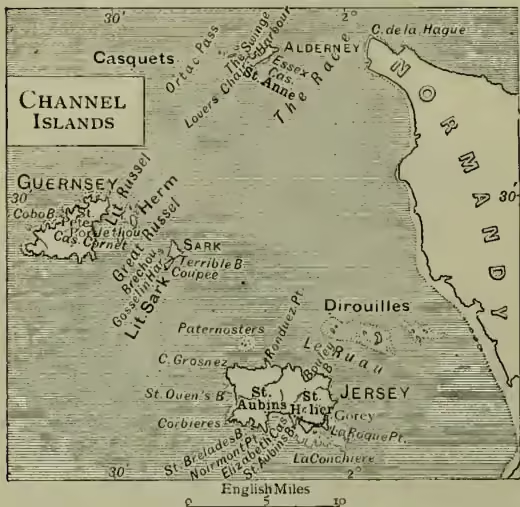
Channel Islands, THE, a group of small islands off the N.W. coast of France, which formed part of the old duchy of Normandy, and has remained subject to the British crown. The nearest points are about twelve miles from the French coast. The principal islands are four in number—Jersey, Alderney, Sark, and Guernsey (q.v.); amongst the others being the Casquets, Burhou, Brecqhou, Jethou, Herm, the Minquiers, and the Chausseys. The total area is 75 sq. m.; and the total population has increased slightly, from 90,739 in 1851 to 92,272 in 1891. Originally a portion of the Continent, they were thinly peopled by the race—probably neolithic—who raised the cromlechs and other monuments of unhewn stone which are com- mon to Brittany and the islands. This population, which came to be represented by what may be termed the Celtiberian nationality, was gradually isolated by the action of the tides and maritime currents. The Christian religion was introduced into the islands by missionaries from Ireland and from Brittany; and the Gallo-Roman hierarchy was centred at Dol. There is some evidence of a partial occupation of the islands by Saxon and Danish sea-rovers. Guernsey is named in the Edda, and arms of Viking character have been dug up there. The islands were probably used as depôts in the conquest of Nentria by the Northmen. Some time elapsed after that event, during which they continued subject to Brittany, but in the early part of the 10th century A.D. the Cotentin was added to the duchy of Normandy, and the islands followed in the annexation. The institutions then introduced were those already established on the mainland of Normandy—derived from the Frankish legal system as it existed when the duchy was first separated from the Frank empire by the treaty of St-Clair-sur-Epte (Stubbs's Const. Hist. i. § 92). The feudal system, however, was only partially introduced. The parishes did not become manors—as happened in England after the Conquest—nor did the Norman seigneurs make a general practice of residing in the islands. They drew rents as absentee landlords from the allodial proprietors who, willingly or otherwise, accepted their protection. But these did not yield military service; and the island militia, when formed, adopted and preserved, till comparatively recent times, a parochial organisation. The 12th century is the beginning of the authentic history of these singular little communities, and of the ecclesiastical organisation already transferred from the see of Dol to that of Coutances. When Philip Augustus declared the duchy of Normandy forfeit on the ground of the alleged contumacy, as a vassal, of John Lackland, he also pronounced the confiscation of the fiefs of those seigneurs who might adhere to John; some of these then settled in Jersey, where they formed the chief notables and members of such local government as might be in existence. John confirmed and strengthened the privileges of this body, and appointed coroners sworn to watch over the judicial interests of the crown. By degrees the seigneurs ceased to attend the sittings of the states, where the rural population was represented by the constables or mayors of the parishes or communes: these, together with the rectors, became associated with the coroners, or 'jurats,' as they came to be called; and the whole assembly was presided over by a bailiff, or lieutenant-governor appointed by the crown. There was also a lord-lieutenant, comes, or governor, but he was often an absentee. In the process of time this latter post became chiefly titular; the office of lieutenant-governor was separated from that of bailiff, though the two were occasionally held by the same person, and a regular system of judicial and executive administration came into action. From the time of John to that of Henry VI., many attempts were made by France to conquer the islands. Guernsey was held by the French for some years during the 14th century, though finally reconquered by the English with help from Jersey. In 1461 Jersey itself was conquered, and was held by a French governor for about six years, being finally liberated early in the reign of Edward IV. by Sir R. Harleston. Henry VII. carried his repression of the aristocracy into the islands, where he curtailed the feudal jurisdictions and did something for the popularisation of the militia. The Reformation took early and deep root in the Channel Islands, aided by a considerable immigration of exiled Huguenots from the mainland; but the Anglican ritual was not introduced without difficulty. For most of the time the islands continued subject to the spiritual sway of the Bishop of Coutances; but in 1568 Elizabeth attached them to the diocese of Winchester. Other effects of Elizabeth's reign are the foundation of the college (grammar-school) of St Peter Port, in Guernsey, the grant of Sark to the Carreters of Jersey, and the improvement of the Castle of St Helier, in Jersey, which, like the Guernsey 'College,' still bears the name of the virgin queen.
During the reign of Charles I. Guernsey sided for the most part with the English parliament, Jersey with the crown. In the former island, however, Castle Cornet, which commands the harbour, held out for Charles, and was not reduced until after Jersey had been conquered. This took place in 1651. Under the Commonwealth the Channel Islands continued to enjoy their old privileges, being specially excluded from the 'Instrument of Government,' and from the operation of the excise, because not governed by our laws, but by municipal institutions of their own (Burton's Diary).
In the reign of Charles II. the Channel Islands were once more threatened by France, and the militia was improved and formed into regiments. The total population of the Channel Islands was then about 25,000; and the chief towns began to increase in importance. The reign of William III. witnessed the famous victory of the British navy at Cape La Hogue, largely due to information conveyed to the admiral by a gentleman of Guernsey. The privilege of neutrality was taken from the inhabitants—to whom it had ceased to be useful—and they entered upon a course of privateering, which made them, in the words of Burke, 'one of the naval powers of the world.'
In 1781, after the French had espoused the cause of the revolted British colonies in America, a semi-official landing took place in Jersey, headed by an adventurer named Macquart, styling himself Baron de Rullecourt. His defeat by Major Pierson, who fell in the engagement, has been rendered famous by Copley's picture in the National Gallery. Since then the chief event has been in Jersey the introduction of elected deputies into the legislature (1856). In the reign of William IV. the militia of the Channel Islands was declared 'Royal.' Queen Victoria visited them in 1849.
The present constitution of the islands is a development of the ancient institutions, slowly modified to meet changes in surrounding circum- stances. The people, especially in Guernsey and Jersey, adhere to their old speech, a dialect of the ancient Langue d'oïl, which was once a literary language. Its best-known monument is the Roman de Rou of Wace, a native of Jersey, who wrote in the 12th century. In our own days it has been revived by the late Georges Métivier, who has been called the 'Guernsey Burns.' The late Sir Robert Maret was also the author of many poems written in the Jersey form of the language. The basis of the local law is the Coûtumer de Normandie, which is primit facie evidence of the common law. Besides this, the local states enact statutes of two kinds—their bylaws (called 'ordonnances'), having force for three years without royal assent, and organic statutes, which must be sanctioned by the crown. The French language, in its modern shape, is the official language of the states and of the law-courts; and a French service is held in the parish churches.
The administration, generally speaking, is of the usual two sorts, the executive and the judicial. The principal officer is the general commanding the troops in each bailiwick, of which Jersey is one, and Guernsey, with its dependencies Sark and Alderney, the other. He is called lieutenant-governor, and is appointed in that capacity for five years. The chief civil officer is the bailiff, who presides in the executive and legislative assemblies, represented when absent by a lieutenant-bailiff. In judicial matters the bailiff is also the chief, the superior courts being formed by a quorum of the jurats. In matters of legislation the states are constituted in Jersey of the twelve jurats, twelve rectors, twelve constables, and fourteen deputies; but in Guernsey almost all power has been retained by the royal court. The other crown officers are the attorney-general, the solicitor-general, and the viscount or prévôt, who have a right of sitting in the states, but not of voting.
The Channel Islands, as already mentioned, are attached to the diocese of Winchester, but each bailiwick has its own dean. The livings are in the gift of the crown, but are of small value. The administration is, to a great extent, gratuitous; such offices as are not so being paid chiefly out of the local revenues of the crown. These islands have compulsory military service within their own limits—about one-tenth of the population being in the ranks or the reserve of the militia. Their immunities have been fully and frequently recognised, and much loyalty to England is consequently felt. The industry, thrift, and prosperity of the inhabitants have been testified to by recent observers. Their holdings are small, but the agricultural population consists chiefly of yeomen-propriators who labour with their own hands. The towns are busy and populous, and the houses, both there and on the farms, are large, substantial, and well kept. The taxation is trifling, the customs duties being very light. Living is very cheap. Communication with the ports of the south of England is regular and frequent.
Geology.—Most of the islands are composed of primary or granitic rocks. Alderney is a mass of syenite, with hornblende, porphyry, and occasional sandstone. The structure of Guernsey is hard syenite to the north, and gneiss to the south. The geology of Jersey is more varied, presenting a mixture of metamorphic rocks, conglomerates, and sandstones, with syenites and quartzites. Shale and blown sand are also prevalent. Sark is composed of very hard syenite, with veins of greenstone and felspar. Granite is quarried from all the islands, especially from Guernsey, Herm, and Mont Mado in Jersey, both for home use and for exportation.
The scenery is exquisitely varied and beautiful; probably in no other area of similar size could be found such a combination of savage rocks and pleasing landscapes.
The climate is agreeable and suitable to invalids. The prevailing winds are from north to northwest. The mean annual rainfall is 35 inches in Guernsey; but the climate is not over moist, the soil being porous, and evaporation rapid. The mean annual temperature of Jersey is 50.8°; of Guernsey, 50.5°, or about 2° warmer than Greenwich. The range of temperature is very moderate; but the climate of Guernsey is rather more equable than that of Jersey. August is the hottest month; February the coldest. Frost and snow are rare. The autumns are very beautiful; and a second summer, called the Petit Été de Saint Martin, generally sets in about the 10th of October, and lasts till the middle of December. Flowering plants and shrubs are about a fortnight earlier in the spring than in England. The sunshine averages nearly six hours a day throughout the year.
The produce of the islands is principally agricultural; but horticulture and floriculture are successfully followed—the latter especially in Guernsey. The soil is generally light, deep, and fertile. The system of cultivation is very primitive. The principal manure is seaweed, which is gathered in vast quantities from the shores at certain seasons under strict regulations. Its annual value to Guernsey alone is estimated at £30,000. A great quantity is burned for the manufacture of kelp and iodine.
The land is held in small parcels ranging from five to twenty English acres. The principal crops are potatoes, hay, wheat, turnips, mangel-wurzel, parsnips, and carrots. The Channel Islands are famous for excellent breeds of horned cattle, usually known as 'Alderneys,' though each island has its own speciality (see CATTLE). The other main articles of exportation are granite, fruit, and early potatoes.
There are no good recent books on the Channel Islands. Physical phenomena will be found treated of by Professor Ansted in The Channel Islands (4th ed. 1896). Useful historical information will be found in Le Quesne's Constitutional History of Jersey (1856), and Tupper's History of Guernsey (1876). See the separate articles on ALDERNEY, JERSEY, GUERNSEY, and SARK.