Channel Tunnel. The proposed tunnel under the narrow channel dividing England and France, which countries in very early geological times were united, would be 23 miles long, including land-approaches. It would be made entirely through and within the area of the 'old gray chalk,' or craie de Rouen, as designated by French geologists. This bed of chalk extends from shore to shore. It consists of a mixture of 65 per cent. of chalk and 35 per cent. of clay, and is therefore impervious to water; though the experimental works have shown cracks here and there which exude for a time a fresh or brackish water, apparently imprisoned for ages in these small fissures. While the experimental works have been suspended most of these fissures have run themselves dry. The French Tunnel Company, who possess a concession for making a tunnel to the middle of the Channel, and the English Tunnel Company, associated under 'limited liability,' have made many thousand soundings and experiments, and consider it proved that the 'gray chalk' is not only in the same position and of the same thickness and consistency on each side of the Channel, but that no erosion or fault interfering with continuity exists as between the two coasts.
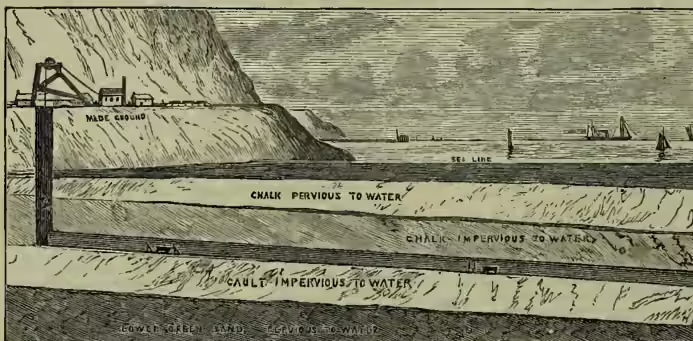
The experimental works, already executed by a headway of 7 feet diameter on the English side, have been extended by the using of a 'boring machine,' from the foot of Shakespeare's Cliff, near Dover, for a distance of 2200 yards under the sea. The similar work on the French side seaward, from Sangatte, near Calais, is of about the same length. Thus, about a tenth of the whole distance has been successfully experimented; and the opinion of the engineers engaged is that the work presents exceptionally favourable features for cheap and rapid accomplishment. The original estimate, before experiment showed the way through this favourable stratum of 'gray chalk,' was about £10,000,000; now that estimate is only £4,000,000. The proposal is to have two single-line tunnels—which can be multiplied to any extent side by side as traffic might demand—one tunnel ventilating the other, and to work the lines by engines which have been successfully designed and worked experimentally, charged with highly compressed air. In the construction hardly any pumping and no 'timbering' would be required. The machine which bores takes up a modicum of water with the debris it excavates; and every turn of it gives out a portion of the air, which, at a pressure of about 25 lb. to the inch, is its motive force (see the article BORING).
The instruction to the engineers by Sir Edward Watkin, the chairman of the English Tunnel Company, to 'find the "gray chalk" at its outcrop, and never leave it,' would seem to have reduced a work which at one time appeared all but impracticable to the utmost simplicity and ease of completion. The scheme for a railway tunnel was discussed in 1867 and succeeding years. In 1876 a convention for carrying it out was concluded between the British and French governments, and in the same year boring was begun on the French side; but the excavations on the English side were stopped by order of the British government, mainly for military reasons.
Amongst the supporters of such a submarine means of intercourse between England and France have been the late Prince Consort, Mr Cobden, the late and present Lords Derby, the late Lords Beaconsfield and Clarendon, and Mr Gladstone.
The engineers whose names have been associated with various schemes for a Channel Tunnel have been those of Thome de Gamond and Raoul-duval in France; and William Low, Frederick Bramwell, Francis Brady, John Hawkshaw, and Brunlees in England.
The experiments near Dover have led to the belief that there is a coal-bed under the Channel. The English Channel Tunnel Company had in 1891 found as many as seven workable seams, of which the deepest (1810 feet) was 2½ feet thick.