Chimney, a flue constructed in the thickness of a wall or in a separate 'stalk' for the purpose of carrying off the smoke from a fireplace or furnace. The heated air being lighter than the atmosphere which maintains the fire, presses the smoke upwards, and rises with a rapidity proportioned to the difference in weight, assuming that the chimney is of proper construction and size. It has been found in practice that a diameter of from 9 inches to 12 inches is suitable for the fireplaces of ordinary rooms, but in the case of kitchens and other large fires a greater width is required. In olden times it was usual to build fireplaces of great size, with very large chimneys, but as these admit a great quantity of air at the ordinary temperature, the draught is thereby checked, and the chimneys are apt to smoke. Experience has taught that the 'throat' or entrance to the chimney from the fireplace should be made as small as possible compatible with its task of carrying off the products of combustion from the fire. A proper draught depends also on the height of the chimney, which ought to be sufficient to be above the interference of swirls of air caused by surrounding buildings or other objects. The higher the chimney, the greater the draught.
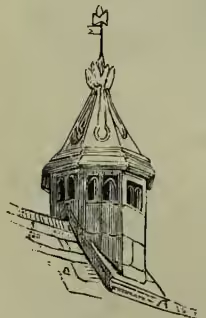
(From Parker's Glossary.)
Chimneys are of comparatively modern origin. Only traces of them are found in classic antiquity; but there must have been some such means of discharging the smoke from the fires which heated the hypocausts of the Roman baths. In medieval times, the earliest examples of fireplaces with chimneys, such as those in the Norman castles of Rochester and Castle Hedingham, erected in the 12th century, have only a short flue ascending a few feet, and discharging by an oblong aperture in the outer face place and capacious chimney, while those of the of the wall. These were no doubt found very smoky and inconvenient, and ultimately the chimneys were carried to the roof. In Gothic buildings they are often detached, and the outlet is ornamented with trefoil and other openings. In the English halls the centre hearth was long retained, without any chimney, the smoke being allowed to find its way out through an opening in the roof called the Louvre (q.v.). In Scottish mansions and castles the fireplace was an invariable feature in every apartment from the 13th century. The hall has always a large fire- bedrooms are smaller. In the late Gothic and Elizabethan styles the chimneys are amongst the most striking features of the design, being carried up in lofty and highly ornamented stalks, frequently built in brick.
In modern times the external appearance of chimneys has been greatly neglected, to the sad disfigurement of our houses, but a better taste is now beginning to prevail. In one direction, however, modern chimneys have received a great development in connection with furnaces and steam-engines. In order to create a draught, and so cause the fire to burn with intense heat, these chimney-stalks are carried to a great height. The difference of pressure of the atmosphere between the top and bottom, added to the lightness of the air caused by the heat, acts as the motive power to the 'draught,' which thus increases with the height of the stalk. Amongst the highest existing chimneys may be mentioned the following: (1) the Townsend shaft, Port Dundas, Glasgow, which is 468 feet in total height, and has a diameter of 32 feet at base, and 13 feet 4 inches at top; weight, about 8000 tons. (2) St Rollox shaft, Glasgow—total height, 455 feet 6 inches; diameter at base, 50 feet; at top, 13 feet 6 inches.
(3) Mechernich shaft, Cologne—total height, 441 feet; diameter (square) at base, 39 feet; at top (round), 11 feet 6 inches; weight, about 5459 tons.
An act to regulate chimney-sweeping was passed as early as 1789; and in 1842, to prevent the fearful cruelties practised on young chimney-sweepers, it was rendered penal to compel or knowingly allow any person under the age of twenty-one, to ascend or descend a chimney or enter a flue for the purpose of cleaning or curing it; and no child under sixteen could be thereafter apprenticed to the trade. The act was extended and made more stringent in 1864 and 1875.
To extinguish a chimney on fire, it is only necessary to hang over the fireplace a piece of wet carpet or blanket: some handfuls of salt thrown into the fire at the same time will greatly aid the extinction. It is also recommended to scatter a handful of flowers of sulphur over the dulllest part of the burning coals, the vapour arising from which will not support combustion, and will consequently extinguish the flames. Throwing water down from the top is a clumsy expedient, by which much damage is frequently done to furniture; so also is stopping at the top, by which the smoke and suffocating smell of the burning soot are driven into the apartment. If every fireplace were provided with a damper, or shutter of sheet-iron, sufficiently large to choke it thoroughly, fire in chimneys would become of little consequence, as it would only be necessary to apply this damper to extinguish them. All good modern grates are furnished with such dampers. To set chimneys on fire with a view to clean them is highly objectionable, even where there is no danger of fire to be apprehended, as the intense heat produced rends and weakens the walls. For other connected subjects, see SMOKE-NUISANCE, VENTILATION, WARMING.