Chimpanzee (Troglodytes niger), one of the highest of the anthropoid or more manlike apes,
(From Parker.) belonging to the same genus as the gorilla (T. gorilla).
History.—The first historical notice of the chimpanzee seems to be that given in an account of a Carthaginian exploration of the north-west of Africa, conducted by Hanno in 470 B.C. Along with other anthropoid apes, it was known to the Romans in their varied communications with Africa. The first thorough investigation of the anatomy was made by Tyson in 1699. Various travellers gradually gathered information in regard to its habits, and captured specimens were known in France and England by the 18th century. The structure of the animal has been studied by several famous anatomists, such as Owen, Duvernoy, Bischoff, and Huxley; and much information, both historical and anatomical, will be conveniently found in Professor R. Hartmann's Anthropoid Apes (Inter. Sc. Series, 1885). To this naturalist much of our knowledge as to the exact anatomy of the chimpanzee and related forms is due. For more general considerations, Huxley's work entitled Man's Place in Nature may be profitably consulted. See also his Anatomy of Vertebrate Animals.
Characteristics.—As the general features of Anthropoid Apes (q.v.) have been already sketched, it will be enough to sum up the more striking characteristics of the chimpanzee. The animal stands about four feet high, has very dark, all but black hair, a broad, leathery, reddish-brown face, small nose, large mouth, protruding lips, large browridges, and small ears. The face has an angle of 70 degrees. The head hangs down upon the chest.
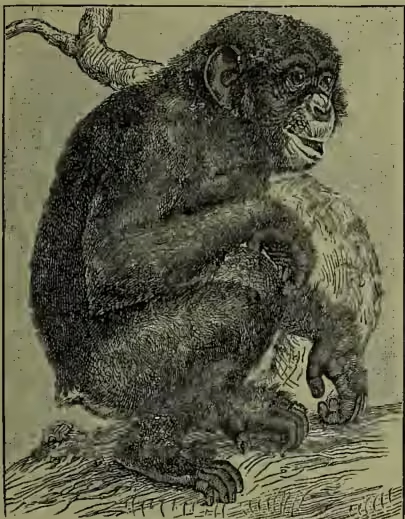
There are no cheek-pouches. The arms are very long, and reach the knee; their span is about half as much again as the height. The hand is narrow, but as long as the foot. The sole of the foot can rest flatly on the ground, and the animal readily stands or walks erect. But his favourite attitude is leaning forward, and supporting himself on the knuckles of the hand. The backbone begins to exhibit the curves characteristic of man, and the chimpanzee is alone among anthropoids in having the spine of the second neck vertebra bifurcated as in man. It has one pair of ribs in addition to the twelve possessed by man. There is of course no tail, nor are there any sitting-pads or ischial callosities. 'The volume of the brain is about half the minimum size of a normal human brain. All the gyri (ridges) of the human brain are represented in the cerebral hemispheres of the chimpanzee; but they are simpler and more symmetrical, and larger in proportion to the brain.'
Habits.—The chimpanzee is found on the coast of Guinea and farther inland. It occupies a wider area than the gorilla, and is even said to have been found in East Africa, to the south of Abyssinia. It lives in forests, is an adept climber, but keeps a good deal to the ground. The diet consists mainly of wild fruits; but animal food seems to be occasionally eaten. The chimpanzees live in families or in small societies. They construct pent-houses in the thick forest darkness, and the males are said to pass the night below the family nest. They make a great deal of noise, of a dreary and horrible character, especially when provoked by other monkeys. Though they generally flee at the sight of man, they can with hands and teeth make themselves in extremity most formidable antagonists. The natives shoot them with arrows or javelins, or in recent days with firearms. The flesh is eaten by the natives of some parts of Africa; the skulls may serve as fetiches.
There is considerable dispute as to the species or varieties of chimpanzee. Hartmann discusses the question at length in the work already referred to, describing one distinct variety in addition to the typical Troglodytes niger, and admitting the possibility of hybrids. Chimpanzees are occasionally brought to European zoological gardens, but rarely stand the climate for more than two or three years. They are known to exhibit great cleverness, and admit of some education.
China. The Chinese Empire, consisting of China Proper and Manchuria (q.v.), with its dependencies of Mongolia, I-li, and Tibet (q.v.), embraces a vast territory in Eastern Asia only inferior in extent to the dominions of Great Britain and Russia. The dependencies are not colonies, but subject territories; and China Proper itself, indeed, has been a subject territory of Manchuria since 1644. It will be convenient, however, to confine ourselves in this article to the former.
China is not known among the people themselves as the designation of the country, and the use of the term is spreading among them only through its all but universal employment by other nations. In the oldest classical writings the country is called Hwâ Hsiâ, 'The Flowery Hsiâ.' Chung Kwo, 'The Middle State,' or kingdom, grew up in the feudal period as a name for the royal domain in the midst of the other states, or for those states as a whole in the midst of the uncivilised states around them. The idea of its being 'in the middle of the earth' did not enter into the designation, though the assumption of universal sovereignty, de jure if not de facto, that has been so injurious to the nation, appears in the very ancient names T'ien hsiâ, 'all beneath the sky,' and Sze Hái, 'all within the four seas.' In the treaties with western nations concluded in the present century the empire is called by the title of the reigning dynasty, 'the Kingdom of the Great Pure (dynasty);' and this is in accordance with the practice of Chinese writers, who are fond of calling their country 'the Land of Han,' and 'the Hills of T'ang,' from the two great dynasties so named.
Serica, Sera, and Seres, in Ptolemy and other ancient geographers, indicate China and the Chinese as the country and people producing silk, being taken from sze (silk), originally the pictorial symbol of a packet of cocoons.
Cathay, a poetical name with us, and still apparent in the Russian name for China (Kitai), came into use as a designation for the northern part of the empire through Marco Polo and other medieval writers. It was the Persian designation of the Tartar K'itan tribes which contended with the Sung dynasty for the supremacy of the empire, then merged in the dynasty of Chin (Kin), and were extinguished by the Mongol conquest. The country south of the Yang-tse River was then styled Manzi or Manzy, from the old name of Man for all the southern aboriginal tribes.
The name China has come to us from India through Buddhism. In a conversation (apocryphal probably), related by Nien Ch'ang in his History of Buddhism, between the Han emperor who welcomed them to his capital and the first two of the Buddhist missionaries, there appear the names of Chi-na and Chin-tan ('the Land of Chin'). We do not know how long before our first century the name had obtained in India, nor how it originated. If it had begun with ts instead of ch, the view of many that it was derived from the great state of Ts'in, whose fortunes culminated in the first but short-lived imperial dynasty (221-209 B.C.), might have been considered as certain. This question must be left as hardly capable of determination; as also how it is that we find the empire called by other Asiatic peoples Sin, Tsin, Tsinistan, and the inhabitants Tsinistæ. 'The land of Sinim,' in Isa. xlix. 12, should be added to these denominations.
CHINA PROPER was divided in the K'ang-hsi reign (1662-1722) into eighteen provinces; from 1887 to 1895, when it was ceded to Japan, Formosa, detached from Fû-chien, was a separate province under the name of T'ai-wan; and the constitution of Sin-chiang or Sin-tsiang as a new province on the extreme west of the empire raised the number of provinces again to nineteen. One of the easternmost portions of the Asiatic continent, bordering on the Pacific Ocean, China Proper lies, if we include the island of Hái-nan, between 18° and 49° N. lat., and 98° and 124° E. long. Its area is given at 1,298,000 sq. m., being more than twenty-five times that of England; but if we include outlying parts of Chih-lí and Kan-sú, the total area is not much, if at all, short of 2,000,000 sq. m. (The whole empire, without Corea, has an area more than twice as large.)
On the north there are four provinces—Chih-lí, Shan-hsi, Shen-hsi, and Kan-sú; on the west, two—Sze-ch'wan (the largest of all) and Yun-nan; on the south, two—Kwang-hsi and Kwang-tung; on the east, four—Fû-chien (Kien—the initial ch used to be pronounced k), Cheh-chiang, Chiaug-sú, and Shan-tung. The central area enclosed by these twelve provinces is occupied by Ho-nan, An-hui (Gan- and Ngan-hwei), Hú-pei, Hú-nan, Chiang-hsi, and Kwei-cháu (parts of which are largely occupied by tribes of aboriginal Miáo-tsze). The province of Sin-chiang, Sin-kiang, or Sin-tsiang, recently constituted, includes Eastern Turkistan (q.v.), Western Kan-sú, Ili, and Zzungaria (q.v.). Formosa, till then Chinese, was ceded to Japan in 1895; and Manchuria, one of the most valuable of the outer provinces, is, since it came under Russian supremacy in 1898, Chinese only in a very limited sense. (See below at page 194.)
The population of these provinces has been so variously estimated as to justify Dr S. W. Williams in holding that, 'until there has been a methodical inspection of the empire' guaranteed by the government, questions concerning the population must be held in abeyance. The Almanach de Gotha for 1900 gives for the provinces of China Proper a population of 346½ millions, and for the whole empire, including Manchuria, Mongolia, and Tibet, but without Corea, 357¼ millions. It is probably safe to say that 400 millions is hardly an overestimate of the population of the Chinese empire. Of the twenty-two ports open to foreign commerce, only five have a population under 50,000. That of Canton was in 1890 estimated at 2,500,000; of T'ien-tsin at 950,000; of Han-k'án at 750,000; of Fû-cháu at 650,000; of Shang-hái at 450,000; of Ning-po at 250,000. The total number of foreigners resident in the open ports was in 1897 stated by the Customs authorities at 11,667, of whom 4929 were British subjects, 1564 American, 1106 Japanese, 975 Portuguese, 950 German, 698 French, 439 Swedish and Norwegian, and 362 Spanish.
As to the physical features of China Proper, the whole territory may be described as sloping from the mountainous regions of Tibet and Nepal towards the shores of the Pacific on the east and south. The most extensive mountain-range in it is the Nan Lín or Southern Range, a far-extending spur of the Himalayas. Commencing in Yun-nan, it bounds Kwang-hsi, Kwang-tung, and Fû-chien on the north, and, passing through Cheh-chiang, enters into the sea at Ning-po. It thus forms a continuous barrier, penetrated only by a few steep passes (of which the Mei Kwan is the best known) that separates the coast-regions of South-eastern China from the rest of the country. This great chain throws off numerous spurs to the south and east, which, dipping into the sea, appear above it as a belt of rugged islands along the seaboard. Of this belt the Chusan Archipelago is the most northerly portion.
North of this long range, and west of the 113th meridian, on to the borders of Tibet, the country is mountainous, while to the east and from the great wall on the north, to the Po-yang lake in the south, there is the Great Plain, comprising the greater part of the provinces of Chih-lí and Shan-tung, Ho-nan, An-hui, and Chiang-sú—an area of about 210,000 sq. m., estimated to support a population of 177,000,000.
In the provinces west from Chih-lí—Shan-hsi, Shen-hsi, and Kan-sú—the soil is formed of what are called the loess beds, which extend even to the Koko-nor and the head-waters of the Yellow River. The name loess is adopted from that of a Tertiary deposit which appears in the Rhine Valley—a brownish coloured earth, extremely porous, crumbling easily between the fingers, and carried far and wide in clouds of dust. It covers the subsoil to an enormous depth, and is apt to split perpendicularly in clefts which render travelling difficult. And yet by this cleavage it affords homes to multitudes of the people, who live in caves excavated near the bottoms of the cliffs. Sometimes whole villages are so formed in terraces of the earth that rise above one another. But the most valuable quality of the loess is its fertility, the fields composed of it hardly requiring any other manure than a sprinkling of its own fresh loam. The husbandman in this way obtains an assured harvest two and even three times a year. This fertility, provided there be a sufficient rainfall, seems inexhaustible. The province of Shan-hsi has borne the name for thousands of years of 'the Granary of the Nation;' and it is no doubt to the distribution of this earth over its surface that the Great Plain owes its fruitfulness.
The rivers of China—called for the most part ho in the north, and chiang (kiang) in the south, are one of its most distinguishing features. Two of them stand out conspicuous among the great rivers of the world; the Ho, Hoang-ho, or Yellow River, and the Chiang, generally misnamed the Yang-tse. They rise not far from each other; the Ho, in the plain of Odontala, called in Chinese the 'Sea of Stars'—i.e. of springs or lakelets, in 35½° N. lat., and 96° E. long.; and the Chiang (Kiang), from among the mountains of Tibet. The Ho pursues a tortuous eastward course to Kan-sú, and the Chiang with a southern inclination enters China at Batang, in Sze-ch'wan. From the prefecture of Lan-cháu the Ho flows north-east more or less along the Great Wall, till it arrives