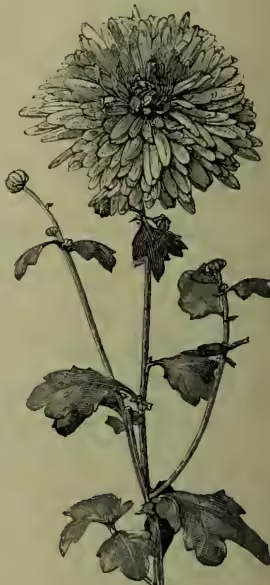
Chrysanthemum (Gr., 'gold-flower'), a genus of plants of the natural order Compositæ, sub-order Corymbifere; having a hemispherical or nearly flat involucre, with imbricated scales, which are membranous at the margin, a naked receptacle, the florets of the disc tubular and hermaphrodite, those of the ray strap-shaped and female, the fruit destitute of pappus. The species of this genus are annuals, perennials, or shrubby; and all have leafy stems. They are natives chiefly of the temperate parts of the Old World. C. leucanthemum, the Ox-eye, or Ox-eye Daisy, is abundant in fields, meadows, and grassy places of woods in Europe and North America. It has large flowers, with white ray and yellow disc. It is often a troublesome weed among hay and in pastures; being perennial, and having a creeping brittle root-stock, it is not easily extirpated. It is common in Britain, which has several other native species, C. segetum (Corn Marigold), a frequent weed in cornfields, which is an annual, with large deep yellow flowers; C. inodorum (Scentless Chrysanthemum), an annual with erect branching habit, leaves like the camomile, and white flowers; and C. parthenium—Pyrethrum parthenium of some botanists—Common Feverfew, a perennial, probably originally spread from cultivation, but now at least apparently indigenous to a great part of Britain. Of the latter, the Golden Feather, so commonly used in designs in the flower-garden, and a compact free-flowering form with double flowers, are two useful and well-marked varieties. From C. inodorum has also recently evolved a variety with pure white double flowers, of great value to those who cater for cut flowers, the colour and form being desirable and the crop enormous. The Paris Daisy or Marguerites, which have recently become so popular as greenhouse and bedding plants, are forms of C. frutescens and C. pinnatifidum, the latter a native of Madeira, the former of the Canaries. The old-fashioned yellow and white chrysanthemum of our cottage-gardens is C. corduarium, a native of Sicily and North Africa. C. carinatum, a pretty annual species from Barbary, is sometimes seen in gardens in this country treated as a tender annual. The most favoured species, however, with gardeners of this and other countries is C. sinense, sometimes also named C. indicum. It was introduced in 1764, and has increased in varieties immensely since then. In 1832 there were only about forty known; now they are to be reckoned by hundreds, and the numbers are yearly being added to. Long before it was known in Europe the gardeners of China and Japan were enthusiastic cultivators of the flower; and it gives its name in the latter country to the highest order of honour—'The Order of the Golden Flower.' The colours are exceedingly various and beautiful, and the form of the flower-heads in some varieties is marked by the most perfect symmetry, while in others it assumes a medusa-like character, with numerous twisted thread-like florets of several inches in length. The circumstance that it may be had in flower during the late autumn months and far into winter, coupled with its profuse flowering quality and its simple cultural requirements, renders it a universal favourite. Cuttings are struck in November, December, and January. They require no heat, but merely protection from frost, and till they strike root they must be kept in a close case away from draught. The soil they delight in most is a rich loam, with decomposed manure, a third of the latter to two-thirds of the former. They should be placed out of doors from May till the beginning of October, when they must be housed to protect them from frost. See Burbidge, The Chrysanthemum: its History and Culture (1884).