Cicada, a large genus of hemipterous insects, typical of the sub-order Homoptera, with uniform wings. They are well known for the noise made by the males, and for the 'Manna' (q.v.) or sap which their incisions cause to exude from trees. Specially abundant in warm countries, some eighteen species of cicada occur in the vine-bearing regions of Europe. When they do occur, their presence is not kept secret, for in the warm sunshine the males keep up a continuous and very loud, doubtless amatory, chirping. Their shrill 'song' has been echoed by poets from Anacreon to Byron, but seems to have sounded more sweetly in the ears of the ancients.
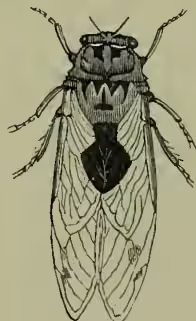
Yet some people are so fond of the chirping that they keep the cicadas in little cages. Some large South American species are said to chirp 'loud enough to be heard at the distance of a mile.' The noise is caused by the vibrations of membranes at the openings of two respiratory tubes (tracheæ) on the last joint of the thorax, and the volume of sound is increased by two complex resonating cavities a little farther back. The apparatus is rudimentary in the females; which in this case at least cannot be blamed for noise. The commonest South European species is Cicada orni, feeding especially on ash-trees. C. plebeja is a somewhat larger form. C. mannifera causes abundant 'manna' in Brazil. C. septendecim is the North American 'seventeen years' locust,' or harvest-fly, said to occur in special abundance every seventeen years; though they probably appear in some part of the country every year. The males of the species perform the act of reproduction and soon die, probably taking no nourishment in the perfect state. The females deposit about 500 eggs in the twigs of trees, and die immediately after. The larvæ drop and bore their way into the ground, where they are supposed to remain for seventeen years, sucking the juices of the roots of trees and plants. There is also a thirteen years' variety or brood. When the pupæ emerge, the ground sometimes seems honeycombed by their numbers. The larvæ are devoured in great quantities by birds, frogs, and swine. The damage done by the larvæ in their long underground career is nothing as compared with that inflicted on the foliage by the perfect insect (female) during its short life. See Bulletin
No. 8 (1885) of the United States Department of Agriculture. C. hamatodes, a small species, is recorded from the New Forest in Hampshire. The family to which the cicadas belong is often known as that of the stridulant insects, and includes about five hundred species. An even larger closely allied family is that of the Cicadellidæ, including the common Froth-fly (q.v.). The name Cicada has sometimes been applied to another hemipterous insect, a common bug named Halticus pallicornis or C. aptera of Linnæus. It need hardly be said that the cicadas are not crickets, or loeusts, or grasshoppers. See LOCUST.