Cissoid

Chambers's Encyclopaedia, Volume 3: Catarrh to Dion, p. 266
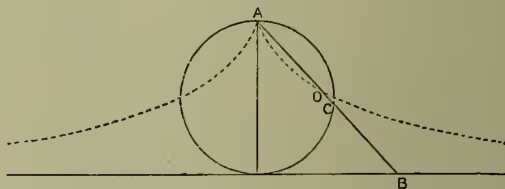
A geometric diagram illustrating a cissoid curve. A circle is shown with its center on a horizontal line. A vertical line segment from the center to the top of the circle is labeled 'A'. A horizontal line segment from the center to the right is labeled 'B'. A point 'C' is marked on the circle where the vertical line meets it. A dashed line extends from point 'C' to the right, passing through point 'B' and continuing as an asymptote. A solid line segment connects point 'A' to point 'B'. A dashed curve, representing the cissoid, starts at point 'C', goes down and to the left, and then curves back up and to the right, asymptotically approaching the horizontal line AB.

Cissoid (Gr., 'ivy-like,' from the shape), a plane curve consisting of two infinite branches symmetrically placed with reference to the diameter of a circle, so that at one of its extremities they form a Cusp (q.v.), while the tangent to the circle at the other extremity is their common asymptote. It was invented by Diocles of Alexandria to solve the problem of finding two mean proportionals; but Newton first showed how to describe the curve by continuous motion. The area included between the two branches and the asymptote is exactly equal to thrice the generating circle. In later times the term has been generalised to comprise higher curves described by the same law, but where the generating curve is not a circle. When the asymptote is vertical, the circular cissoid seems to grow towards it as ivy does to a wall, &c. Draw any straight line AB to the tangent. Measure AO = BC, and thus O traces the curve.

Source scan(s): p. 0277