Citric Acid, , is the acid to which lemon and lime juice owe their sourness. It also occurs, in some cases along with tartaric acid, in oranges, cherries, currants, gooseberries, and other fruits having a subacid taste. For practical purposes it is always obtained from lemon, lime, or bergamot juice, which contain it in large quantity. The first named of these contains from 20 to 40 grains of citric acid in each fluid ounce.
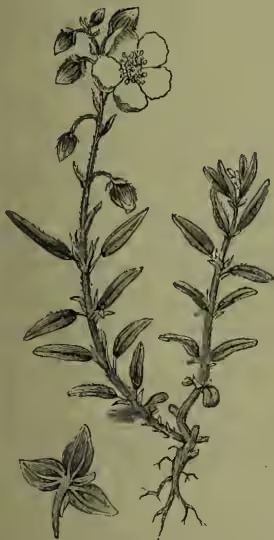
(Helianthemum vulgare).
Citric acid is prepared from these juices by a very simple process. The juice having been heated to the boiling-point to clarify it from albumen, mucilage, &c., is mixed with chalk, , which, combining with the citric acid, falls to the bottom as citrate of calcium. The supernatant liquid being drawn off, sulphuric acid is added to the precipitate, decomposing it, with the formation of citric acid and sulphate of lime, . By crystallisation it may be obtained pure in the form of colourless, odourless prisms, which effloresce in dry air, and possess an agreeable acid taste and an acid reaction. It is readily soluble in water and alcohol, but almost insoluble in ether and chloroform. A solution of it in water cannot be kept owing to its tendency to ferment. Dissolved in syrup it keeps much longer, and is used largely in the manufacture of lemonade and other aerated beverages, communicating an acid, fruity taste. When heated, the crystals melt, then decompose, and are finally reduced to a combustible form of charcoal. In addition to its employment as a flavouring agent it is largely used in the manufactures. Calico-printers employ it for discharging the mordant from the cloth in patterns, and it is used in dyeing silk with safflower, &c.
Citric acid may also be prepared artificially, but the process is too complex ever to come into practical use. Chemically it is of great interest as exemplifying that as soon as the chemical constitution is known there is a possibility of producing the substance artificially. There is a popular idea that some day quinine, morphia, and other natural products will be formed by the random mixing together of chemicals in the chemist's beaker, but the first step towards this result must be the knowledge of their constitution, to be followed by a series of careful experiments.
Citric acid is a powerful tribasic acid (see ACIDS), and the solution in water readily dissolves zinc and iron. It forms a class of salts called Citrates, many of which are employed in medicine.
The so-called Citrate of Magnesia, a granular substance, which effervesces on the addition of water, and is very popular as a gentle aperient, is not really a citrate at all, but consists of a mixture of tartaric and citric acids, bicarbonate of soda, and sugar, with perhaps a trace of some magnesium salt to justify the name. The granulating is effected by mixing the powders and placing them in a pan heated by steam, when, in proportion to the citric acid present, the powders run together into a pasty mass. This is forced through a coarse riddle, and the granules are dried by a gentle heat.
Citrate of Potash, , is prepared by neutralising citric acid with bicarbonate of potash. It forms a white, granular, deliquescent powder, which acts as a cooling diaphoretic in cases of fever. Dissolved in lemon-juice it is of much value in rheumatism. It is given in doses of 20 to 30 gr.
Citrate of Ammonia can only be obtained in solution, as when this is evaporated decomposition takes place and ammonia escapes. It is employed, like the potash salt, in febrile diseases.
Citrate of Iron and Citrate of Iron and Quinine are but examples of a large number of compounds obtained in the form of brown or greenish-brown scales which are largely used in medicine. In these the medicinal value lies not in the citric acid, but in the iron or quinine with which it is associated, although the acid has doubtless a subsidiary action. A peculiarity about these 'scale preparations,' as they are called, is that the inky taste, so characteristic of iron in the form of steel drops, is in great measure removed. Citric acid also forms a series of organic salts called citric ethers, of which citrate of ethyl is an example. Lemon-juice, in which citric acid is the most active ingredient, is a most valuable medicine in scurvy, and when it cannot be obtained the acid may be used as a substitute. Citric acid in solution does not, however, appear to be nearly so effective as the juice itself.