Cocoa, Cacao, or COCO. The different kinds of cocoa are prepared from the seeds of trees of the genus Theobroma.
The genus Theobroma (Gr., 'food of the gods') belongs to the natural order Byttneriaceæ (q.v.), and contains a number of species, trees of moderate size, with large undivided leaves and clustered flowers, all natives of the tropical parts of America.
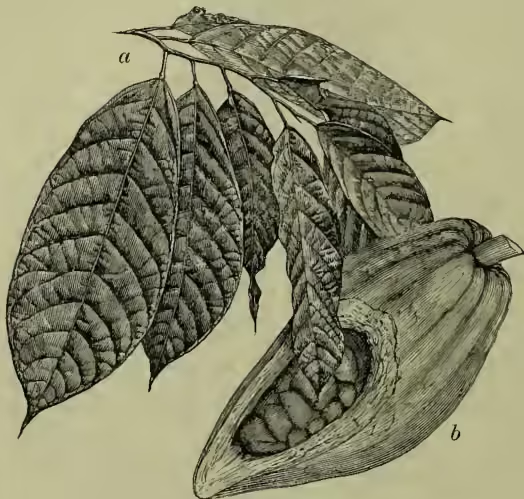
By far the most important species of this genus is T. cacao, to which the name cocoa-tree is often exclusively appropriated. It is extensively cultivated in tropical America and the West Indies, and its cultivation has been introduced into some parts of Asia and Africa. The fruit is somewhat like a cucumber in shape, is 6 or 8 inches long, yellow, and red on the side next the sun; the rind is thick and warty, the pulp sweetish, and not unpleasant; the seeds numerous, compressed, and not unlike almonds, with a thin, pale, reddish-brown, fragile skin or shell, covering a dark-brown, oily, aromatic, bitter kernel. These seeds are the cocoa beans of commerce; when bruised so as to be reduced to small pieces, after being shelled or decorticated, they become cocoa nibs. The cocoa-tree produces larger seeds in cultivation than in a wild state. The tree attains its full vigour and productiveness in seven or eight years, and generally yields two principal crops in the year. When gathered, the fruit is subjected to five days' fermentation in earthen vessels or in heaps on the ground, and then opened by the hand; or it is buried for a while in the earth till the pulp becomes rotten. The latter method is said to produce the best cocoa (carthed cocoa or cacao terré). The seeds are then roasted.
The average composition of the shelled and roasted bean is, in round numbers, about as follows. There is considerable variation in different samples.
| (Hydrocarbon) Cocoa-butter..... | 51 |
| (Nitrogenous food) Gluten, albumen, &c..... | 22 |
| (Carbo-hydrates) Starch, gum, &c..... | 13 |
| Water..... | 5 |
| Mineral matter..... | 3½ |
| Indigestible woody matter (cellulose)..... | 3 |
| Theobromine..... | 2½ |
| 100 |
This expresses a very high nutritive value, as will be understood by comparing it with the following, which shows the proportion of corresponding constituents in lean beef—a beefsteak, for example:
| (Hydrocarbon) Fat..... | 4 |
| (Nitrogenous food) Gelatin, albumen, &c..... | 19 |
| (Carbo-hydrates)..... | .. |
| Mineral matter..... | 5 |
| Water..... | 72 |
| 100 |
In order to render its large amount of nutritious matter digestible, the nut must be prepared. The best mode of preparation is by crushing and continuous grinding under rollers until the whole is reduced to an impalpable paste. This, when dried, adheres, and forms a hard cake. In this form it is now supplied to the navy and many merchant ships, and forms a most valuable beverage-food for sailors when scraped or pounded and boiled for a short time in water. The large amount of fatty matter and nitrogenous food renders it especially suitable for men exposed to cold and fatigue. It is a most valuable reserve food for travellers, so much of both heat-giving and flesh-forming nutriment being concentrated in a given bulk and weight. It is thus used by Swiss and Tyrolean mountaineers in the form of edible chocolate. For the preparation of chocolate, see CHOCOLATE.
An infusion of the broken and roasted shells, which are set aside in preparing the best qualities of chocolate, is used in Italy, Spain, and other countries as a cheap substitute for coffee, and bears the name of miserabile ('poverty stricken'). The pulp of the fruit is eaten in the countries in which the tree grows, and a kind of spirit is obtained from it by fermentation and distillation.
Cocoatina, cocoa essence, concentrated cocoa, are names given to preparations from which some of the cocoa-butter has been extracted to render the beverage more digestible. These, when honestly prepared, are excellent. Another mode of preparation consists in adding large quantities of cooked farinaceous material to the ground cocoa, mixing these when in a pasty condition, then drying and selling the mixture under various names—soluble cocoa, &c. Some of them contain but a homeopathic proportion of actual cocoa, producing, when prepared by the addition of boiling water, merely a gruel flavoured with cocoa. Those who prefer such mixtures will find it economical to prepare their gruel or porridge themselves, and add genuine cocoa to it. The writer has done this by sprinkling a little powdered cocoa into ordinary Scotch porridge. By using whole or ground cocoa nibs, a genuine cocoa beverage may be obtained, but for this it is necessary to subject the nibs to very long boiling; a whole day is desirable. The full and peculiar flavour of the nut comes out, and much of the butter floats on top, while the cellulose and other insoluble constituents remain as sediment.
The Theobromine or special crystallisable alkaloid of cocoa resembles that of tea and coffee, but contains a larger proportion of nitrogen, and appears to be less stimulating in its action on the nervous system. Some regard it as highly nutritious.
In South Carolina the earth-nut is roasted and used as a spurious cocoa; and in Spain the root of the earth chestnut (Cyperus esculenta) is similarly used. See ADULTERATION.